Key takeaway
There is no single formula for what a business is worth. There are four in common use, and each answers a slightly different question. On the worked example in this guide, the same online store comes out at $72,000, $193,628, $194,400 and $216,000 depending on the formula. Knowing why they differ is more useful than memorising any one of them.
This guide gives each formula with the arithmetic shown. For the wider picture of how small businesses are valued, see the business valuation guide.
The four formulas at a glance
| Formula | Calculation | Best for | Data needed | Main weakness |
|---|---|---|---|---|
| Earnings multiple | Yearly profit × multiple | Profitable small businesses | A year of profit records | Depends on a clean profit figure |
| Revenue multiple | Yearly revenue × multiple | Subscription software, fast growth | Revenue, ideally recurring | Ignores costs |
| Asset value | Assets − liabilities | Loss-making or asset-heavy businesses | A list of assets and debts | Ignores earning power |
| Discounted cash flow | Sum of future cash flows in today's money | Large, predictable businesses | A multi-year forecast and a required return | Relies on a forecast |
The U.S. Small Business Administration groups these into three approaches. The market approach "compares your business to other similar businesses that have recently sold," which is what both multiples do. The income approach "looks at projected revenue and accounts for potential risks," which is discounted cash flow. The assets approach "subtracts total business liabilities from the total value of all assets."
The example business
One business is used throughout: an online store, four years old.
- Yearly revenue: $360,000
- Yearly profit before the owner's pay (SDE): $72,000
- Stock at cost: $40,000
- Equipment, domain and other assets: $45,000
- Amounts owed to suppliers: $13,000
Formula 1: earnings multiple
Value = yearly profit × multiple
This is the standard formula for a small, profitable, owner-run business. Profit is usually SDE, which is net profit with the owner's pay and any genuine add-backs put back in.
For the store, using the midpoint of VALUERAQ's default range for ecommerce businesses, 2.7:
- $72,000 × 2.7 = $194,400
The default range runs from 2.0 to 3.5, so the low and high figures are $144,000 and $252,000. Stock is normally paid for separately at cost, which would add $40,000.
Use it when the business has at least a year of steady profit. Watch for a profit figure inflated by doubtful add-backs. The multiple is only as good as the number it multiplies.
Formula 2: revenue multiple
Value = yearly revenue × multiple
The Corporate Finance Institute explains that revenue multiples are used when a company has no positive earnings to multiply. Their weakness, in its words, is that the measure "ignores profitability and cash flow generation."
For the store, suppose someone quotes 0.6 times revenue:
- $360,000 × 0.6 = $216,000
That looks close to formula 1, but only because this store keeps 20% of its revenue as profit. Give the same store a 5% margin and the revenue formula still says $216,000, while the earnings formula falls to $48,600 ($18,000 × 2.7). Revenue multiples carry a hidden assumption about margin.
Use it when revenue recurs by contract, as with subscription software, where VALUERAQ applies a default of 2.0 to 5.0 times annual recurring revenue. Avoid it for stores, content sites and other businesses where costs vary widely. The guide to revenue and profit multiples covers the choice in detail.
Formula 3: asset value
Value = total assets − total liabilities
For the store:
- Assets: $40,000 stock + $45,000 other = $85,000
- Liabilities: $13,000
- $85,000 − $13,000 = $72,000
This is far below the other answers because it counts what the business owns and nothing for what it earns. It sets a floor. A business should not sell for less than its assets would fetch.
Use it when the business makes little or no profit, or when most of its worth is in stock or equipment. The SBA points out that assets can include intangible items such as "brand presence, intellectual property, customer information," which are real but hard to price.
Formula 4: discounted cash flow
Value = CF₁ ÷ (1 + r)¹ + CF₂ ÷ (1 + r)² + … + CFₙ ÷ (1 + r)ⁿ
CF is the cash expected in each future year, r is the yearly return the buyer requires, and n is the number of years away. The Corporate Finance Institute describes discounted cash flow as valuing an investment "by discounting the estimated future cash flows."
For the store, assume $72,000 a year for five years and a required return of 25%:
| Year | Cash flow | Divide by | Value today |
|---|---|---|---|
| 1 | $72,000 | 1.25 | $57,600 |
| 2 | $72,000 | 1.5625 | $46,080 |
| 3 | $72,000 | 1.9531 | $36,864 |
| 4 | $72,000 | 2.4414 | $29,491 |
| 5 | $72,000 | 3.0518 | $23,593 |
| Total | $193,628 |
A full model would add a value for the years after the fifth. Here the five-year total lands close to the earnings multiple, but only because of the 25% return chosen. A different required return gives a different answer.
Use it when future cash can be forecast with some confidence. Watch for false precision. Change the required return to 20% and the total rises to about $215,300. Change it to 30% and it falls to about $175,400.
The four answers side by side
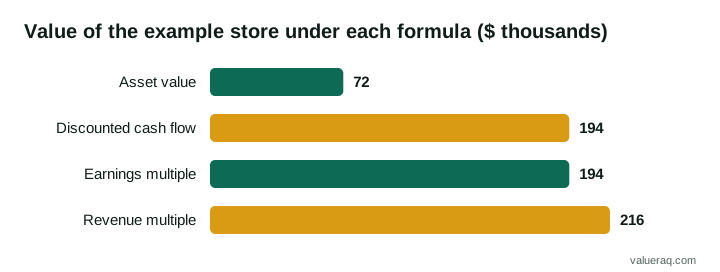
| Formula | Result for the store |
|---|---|
| Asset value | $72,000 |
| Discounted cash flow, five years at 25% | $193,628 |
| Earnings multiple at 2.7 | $194,400 |
| Revenue multiple at 0.6 | $216,000 |
Three of the four agree within about 12%. The asset figure is the outlier because the store's worth lies in its earnings. If the store made no profit, the order would reverse and asset value would be the only figure left standing.
Working backwards from a price
Each formula can be turned around to test an asking price. Suppose the store is listed at $230,000 plus stock.
- Implied earnings multiple: $230,000 ÷ $72,000 = 3.2 times yearly profit. That is inside the default range of 2.0 to 3.5, toward the top.
- Implied revenue multiple: $230,000 ÷ $360,000 = 0.64 times revenue.
- Payback period: 3.2 years of profit to earn the price back, if profit stays level and before paying yourself for running it.
- Premium over assets: $230,000 − $72,000 = $158,000 paid for the store's earning power on top of what it owns.
Working backwards is often more useful than working forwards. It turns "is this price fair?" into "do I believe this business deserves a multiple near the top of the range?", which is a question you can investigate. The business multiple calculator does the division for you.
Which formula to use
Quick lookup for online businesses:
| Your business | Start with | Check against |
|---|---|---|
| Content site, affiliate or ad-funded site | Earnings multiple | Asset value, as a floor |
| Ecommerce store | Earnings multiple, plus stock at cost | Revenue multiple, with care |
| Newsletter or app | Earnings multiple | Asset value |
| SaaS or AI product | Revenue multiple on recurring revenue | Earnings multiple, if profitable |
| Loss-making or brand-new business | Asset value | Judgement about what a buyer could do with it |
The longer version follows.
- A profitable store, content site, app or newsletter: the earnings multiple, checked against asset value as a floor.
- Subscription software: the revenue multiple on recurring revenue, checked against the earnings multiple. See SaaS valuation multiples.
- A business with losses: asset value, plus a judgement about what a particular buyer could do with the audience or technology.
- A larger business with contracts and forecasts: discounted cash flow, usually prepared by a professional.
Whichever you choose, run a second formula as a check. When two methods disagree sharply, the gap usually points at the real question: a margin that is unusually thin, a profit figure that needs explaining, or growth that the past figures don't yet show.
What no formula captures
- How good the records are. A formula takes the profit figure on trust. A buyer will not.
- Dependence on the owner. A business that needs its founder's skills or contacts is worth less to anyone else.
- Concentration. One customer, one supplier or one sales channel can end the business.
- Terms. A price paid in full at closing is worth more than the same price spread over three years.
The SBA advises having an attorney review the sale agreement, and a formal appraisal is worth paying for when the figure will be used for tax, a loan or a dispute.
Frequently asked questions
What is the simplest formula to value a small business?
Yearly profit before the owner's pay, multiplied by a multiple that fits the type of business. For a small online business VALUERAQ's default multiples run from 2.0 to 4.0 times yearly profit before adjustments.
How do I value a business based on revenue only?
Multiply yearly revenue by a revenue multiple, but treat the answer as rough unless the revenue recurs by contract. Two businesses with equal revenue and different margins are not worth the same.
Is there a formula for a business with no profit?
Use asset value: what the business owns minus what it owes. An earnings multiple can't be applied to a loss.
Which formula do banks and courts use?
That depends on the purpose and the country, and it is set by the appraiser or the rules that apply. If a valuation is needed for a loan, tax or a legal matter, use a qualified appraiser.
Why do two calculators give different answers?
They use different formulas, different default multiples or different definitions of profit. Check which profit figure each one asks for and whether stock is included.
Which formula is best for a small online business?
The earnings multiple, because most small online businesses are bought for the profit they produce. Use asset value as a floor and a second formula as a check.
Sources
- U.S. Small Business Administration, Close or sell your business: the income, market and assets approaches.
- Corporate Finance Institute, DCF Formula and Enterprise Value to Revenue Multiple.
- VALUERAQ, Valuation methodology: the default multiples quoted in the examples.
Next step
Turn any asking price into a multiple of profit or revenue and see where it sits.
Written by VALUERAQ Editorial Team. The VALUERAQ editorial team writes and maintains the platform's guides, methodology and glossary. Every guide is reviewed against the published methodology before publication and when the methodology changes.