Key takeaway
A buyer of a small SaaS business is buying a stream of subscriptions and the software that delivers it. To sell well, you need to prove the stream is real, show how long customers stay, and make sure the product keeps running on the day it changes hands. This guide covers the steps in order, the documents buyers ask for, and a planning schedule you can adapt. For the general process that applies to any online business, see how to sell a digital business.
Figures in this guide are examples built from VALUERAQ's published default assumptions. They are estimates, not records of real sales, and your own timeline and price will differ.
Step 1: Decide why and when you are selling
Buyers will ask why you are selling, so settle the answer first. Burnout, a new project and a change of focus are all fine reasons. What matters is that your answer is true and consistent.
Timing matters too. Revenue that is growing or steady sells more easily than revenue that is falling. If churn has just spiked or a large customer has just left, a buyer will want to see a few months of recovery before trusting the numbers. Selling a quarter or two later can be worth more than selling in a hurry.
Step 2: Prepare your metrics
SaaS buyers think in a small set of standard measures. Stripe defines the main ones: monthly recurring revenue is "the total amount of money a company can expect to receive from its existing customers each month," and churn is "the percentage of total customers who discontinue using a product or service during a given period." Have each of these ready for the last 12 months, month by month:
| Metric | What to prepare |
|---|---|
| MRR and ARR | Current figure, and the monthly history behind it |
| Churn | Customers lost each month, and revenue lost each month |
| Net revenue retention | Revenue kept from existing customers, including upgrades |
| Customer count and plan mix | Customers by plan, monthly or annual billing |
| Gross margin | Hosting, third-party services and payment fees against revenue |
| Largest customers | Each one's share of revenue, and how long they have stayed |
| Costs | Everything you pay, including contractors and software |
| Your time | Hours you work each week, and what you do |
Match the revenue in your records to the payouts in your bank account. A buyer who can trace each number to a source will trust the rest.
Step 3: Clean up the business
Fix what a buyer will find anyway:
- Code ownership. Make sure you own the code. Keep the licences for open-source packages you use, and any agreements with contractors who wrote parts of the product.
- Accounts and access. Move the product off personal logins. Hosting, the code repository, the payment processor, email, analytics and support tools should sit in accounts that can be handed over without exposing your other projects.
- Documentation. Write down how to deploy the product, where the secrets are kept, which scheduled jobs run, and how support is handled. A short document now saves days of questions later.
- Terms and privacy. Check that your terms of service and privacy policy are in place and match what the product does. Ask a lawyer if you hold customer data from other countries.
- Customer agreements. Collect any contracts, annual-plan terms or special deals, and note which customers have them.
Avoid large changes just before listing. A new pricing model or a rebuilt product makes recent months hard to compare with the past year.
Step 4: Set the price
Most small SaaS businesses are priced on ARR, which is MRR multiplied by 12.
Price = ARR × multiple
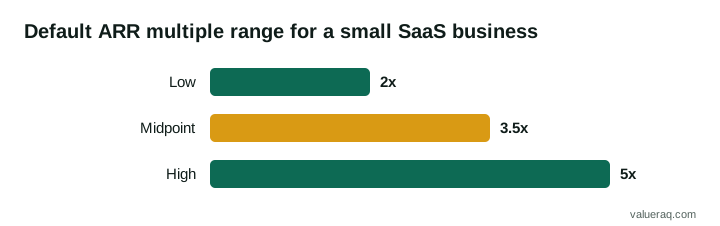
VALUERAQ's default range for a small SaaS business is 2.0 to 5.0 times ARR, with 3.5 as the midpoint. Churn, revenue trend, gross margin, customer concentration, age and owner hours then move it up or down. The range is a published platform assumption and not a market average. The reasoning is in the methodology, and SaaS valuation explains how each factor works.
A worked example
A SaaS product has MRR of $10,000.
- ARR: $10,000 × 12 = $120,000.
- At 2.0 times: $120,000 × 2.0 = $240,000.
- At 3.5 times: $120,000 × 3.5 = $420,000.
- At 5.0 times: $120,000 × 5.0 = $600,000.
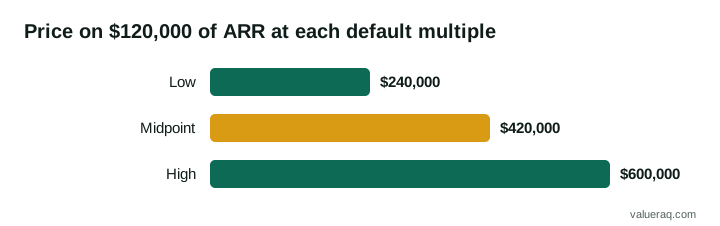
Which end applies depends on the business. Low churn and steady growth point to the upper half; high churn, one customer paying most of the revenue, or a falling trend point to the lower half. Enter your own figures in the SaaS Valuation Tool to see where you land and why.
A revenue multiple has a known weakness: Corporate Finance Institute notes it "ignores profitability and cash flow generation." If your business earns a healthy profit, say so in the listing, because buyers will check the price against profit as well.
Step 5: Write the listing
A good SaaS listing lets a buyer decide in two minutes whether to ask for more. State:
- What the product does and who uses it.
- MRR, ARR and how they have changed over 12 months.
- Monthly churn and revenue retention.
- Customer count, plan mix and the largest customer's share of revenue.
- Monthly costs and net profit.
- Your weekly hours and what you do.
- What is included: code, domain, customer list, support tools, documentation.
- The technology it is built on and any outside services it depends on.
- Why you are selling.
Listing on VALUERAQ is free and there is no commission or success fee; see fees. Every listing is reviewed before it goes live, and you can request revenue verification, described on the verification page. Start at sell a business. You can also use broker services or direct outreach to buyers; the ways to sell a digital business compares the options.
Step 6: Answer buyer questions
Buyers message sellers privately through the listing. Expect questions on:
- Why churn rose or fell in a particular month.
- How customers are found and what it costs to win one.
- What happens if a key supplier, API provider or payment processor changes terms.
- Who else has access to the code and the accounts.
- How much support work there is, and whether it can be handled by someone else.
- Security incidents, if any, and how they were handled.
Answer plainly, including the awkward questions. Before sharing the product's address or account access, ask about the buyer's budget and experience, and consider a non-disclosure agreement. When you share data, give read-only access to the billing dashboard so the buyer sees the figures first-hand; screenshots can be edited. The due diligence checklist shows what a careful buyer will ask for. For the buyer's side, see how to buy a SaaS business.
Step 7: Agree terms
When a buyer is serious, the main terms go into a letter of intent: the price, how it is paid, what is included, how long the buyer has to check your figures, and how long you will help after the sale. The final terms go into a purchase agreement. Most small SaaS sales are an asset sale, where the buyer acquires the code, domain, customer relationships and accounts rather than your company.
Part of the price is sometimes paid later, through seller financing or an earnout tied to results. For example, a $420,000 deal could pay $336,000 at closing and $84,000 over the following six months once the buyer confirms the customers have moved across. That is $336,000 + $84,000 = $420,000, with 20% held back. The U.S. Small Business Administration recommends that an attorney review the sales agreement, and an accountant can explain the tax effect before you sign.
Step 8: Close through escrow and hand over
Use an independent escrow service. The buyer pays the escrow provider, you transfer the assets, the buyer confirms they have them, and the provider releases the money to you. VALUERAQ is not a broker or an escrow service and does not handle the purchase price.
Agree the order of the handover before closing. A sensible sequence is:
- Add the buyer to the code repository and hosting accounts.
- Move the billing account, so subscriptions keep renewing without a gap.
- Transfer the domain and email.
- Hand over support tools, analytics and documentation.
- Introduce the buyer to key customers and any contractors.
- Remain available for the agreed support period.
Moving the billing account needs the most care, because customers' payment details sit with the processor. Ask the processor how it handles a change of owner, and plan the steps with the buyer before the closing date.
A planning schedule
Every sale moves at its own pace, and no timeline here is an average. This outline shows how the steps fit together:
| Stage | What happens |
|---|---|
| Preparation | Metrics, cleanup, documents, price (steps 1 to 4) |
| Listing | Write the listing, wait for review, answer first messages (steps 5 and 6) |
| Due diligence | Buyer checks your figures and the product (step 6) |
| Terms | Letter of intent and purchase agreement (step 7) |
| Closing and handover | Escrow, transfer, support period (step 8) |
Preparation is the stage you control, and it is the one that most often shortens the rest.
Frequently asked questions
How much is my SaaS business worth?
On VALUERAQ's default assumptions, a small SaaS business is priced at 2.0 to 5.0 times ARR before adjustments. With $120,000 of ARR, that is $240,000 to $600,000. Run the SaaS Valuation Tool for a range based on your own figures.
What documents do buyers ask for?
Monthly revenue and churn records for the last 12 months, billing reports, a cost sheet, customer and plan lists, code ownership and contractor agreements, hosting and account lists, and your terms and privacy policy.
Do I have to tell customers before I sell?
That depends on your terms and on the laws where you and your customers are. Check your customer agreements and ask a lawyer. Plan how and when customers will hear about the change with the buyer.
Can I stay on after the sale?
Often yes. A support period of some weeks or months, written into the agreement, helps the buyer and can support the price you ask.
Should I sell the company or the assets?
Most small SaaS sales transfer the assets. The structure affects tax and liability, so take professional advice before you sign.
Sources
- Stripe, Essential SaaS metrics: definitions of MRR, churn and net revenue retention.
- Corporate Finance Institute, Enterprise Value to Revenue Multiple: when revenue multiples are used and their limits.
- U.S. Small Business Administration, Close or sell your business: valuation approaches and attorney review of the sales agreement.
- VALUERAQ, Valuation methodology: the default ranges and adjustment rules used in the examples.
Next step
Price your SaaS before you list it. The free SaaS Valuation Tool shows the multiple and every adjustment.
Written by VALUERAQ Editorial Team. The VALUERAQ editorial team writes and maintains the platform's guides, methodology and glossary. Every guide is reviewed against the published methodology before publication and when the methodology changes.