Key takeaway
EBITDA valuation is a three-step job: work out a clean earnings figure, pick a multiple, and then convert the result into what a seller would actually receive. The first step is where most of the value is won or lost, because a few thousand dollars of adjusted earnings is multiplied by the whole multiple.
This guide walks through all three steps with one worked example. It also covers the case many small sellers need to hear: for an owner-run business, EBITDA is often not the right starting point at all. The multiples used below are VALUERAQ's own default assumptions from the methodology or plainly labelled illustrations. They are not market data. Nothing here is financial, tax or legal advice.
What EBITDA measures
EBITDA stands for earnings before interest, taxes, depreciation and amortization. It is a measure of operating profit that leaves out financing costs, taxes and non-cash charges for the wear or write-down of assets. The EBITDA glossary page gives the formula in short form.
The reason buyers like it is comparability. Two businesses with the same operations can show very different net profit because one has a loan, one sits in a different tax position, or they use different depreciation schedules. Stripping those out puts the operations side by side.
Corporate Finance Institute describes multiples analysis as using "different financial metrics from comparable companies to value a target company" and as a way to "make quick computations to assess a company's value" (CFI). EBITDA is one of the most common metrics used that way.
One feature matters for small businesses. EBITDA assumes everyone who works in the business, including management, is paid a market salary. That is the main difference from SDE, which adds the owner's pay back. The full comparison is in SDE vs EBITDA, so this guide does not repeat it.
Step 1: Calculate reported EBITDA
Start from net profit in the income statement and add back four items:
EBITDA = net profit + income taxes + interest + depreciation + amortization
Here is the business we will use throughout. It is an invented company that sells a paid newsletter and online courses, with two part-time staff and an owner who runs it day to day.
| Item | Amount |
|---|---|
| Net profit | $82,000 |
| Add: income taxes | $18,000 |
| Add: interest on a loan | $4,000 |
| Add: depreciation and amortization | $6,000 |
| Reported EBITDA | $110,000 |
The arithmetic: $82,000 + $18,000 + $4,000 + $6,000 = $110,000.
Reported EBITDA is only the starting point. It reflects the accounts as they were kept, including every quirk of how the owner ran the business.
Step 2: Adjust it to what a new owner would earn
Adjusted EBITDA answers a different question: what would this business earn under a new owner, running it in an ordinary way? Three kinds of adjustment apply.
Put the owner's pay at a market salary
Because EBITDA assumes a market salary for the manager, the owner's actual pay has to be replaced with that figure. In our example the owner pays themselves $90,000, but a capable manager for the same job would cost $60,000. The $30,000 difference is added back:
$90,000 actual pay − $60,000 market pay = +$30,000
If the owner paid themselves nothing, the adjustment would go the other way and reduce EBITDA. A business that looks profitable only because its owner works unpaid is overstated.
Add back one-off and personal costs
These are the add-backs that sellers list. BizBuySell defines them as "expenses added back to a company's bottom-line profits when determining Seller's Discretionary Earnings (SDE) or EBITDA", and also warns that "some add-backs can unrealistically overvalue the company" (BizBuySell). In our example:
- A $9,000 legal fee for a trademark dispute that has now ended: +$9,000.
- $6,000 of personal travel paid through the business: +$6,000.
Deduct costs the business is not paying
The adjustment that sellers forget is the one that lowers the figure. If the owner's spouse does the bookkeeping unpaid, a new owner will have to hire someone. At a market cost of $12,000 a year, that is −$12,000.
The result
| Step | Amount |
|---|---|
| Reported EBITDA | $110,000 |
| Owner pay set to market salary | +$30,000 |
| One-off legal fee | +$9,000 |
| Personal travel | +$6,000 |
| Unpaid bookkeeping at market cost | −$12,000 |
| Adjusted EBITDA | $143,000 |
The arithmetic: $110,000 + $30,000 + $9,000 + $6,000 − $12,000 = $143,000.
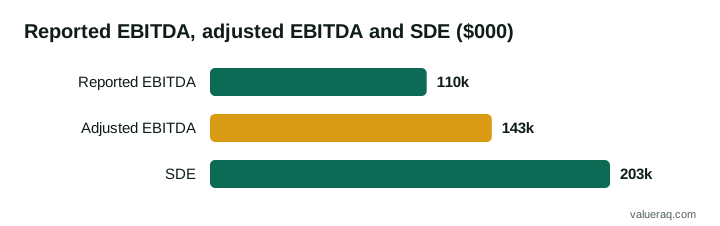
The chart includes SDE, which we calculate in the next section. Notice how far apart three descriptions of the same business can be.
Which add-backs will a buyer accept?
A buyer will test every line. A rough guide to how each type is usually received:
| Add-back | Usually accepted when | Usually questioned when |
|---|---|---|
| One-off legal or settlement cost | There is a paper trail and it will not recur | Similar costs appear most years |
| Personal expenses run through the business | Receipts show they are personal | They are mixed with real business use |
| Owner pay above market | A market salary for the role can be shown | The role is defined to suit the number |
| Software or tools the owner "doesn't need" | Almost never | The business actually uses the tool |
If a cost recurs, it is part of running the business, not an add-back. The due diligence checklist shows what buyers ask for to confirm these figures.
Step 3: Choose a multiple
A multiple turns earnings into a price. For adjusted EBITDA, the multiple depends on the size of the business, its growth, how much it relies on the owner, and how concentrated its traffic and customers are. VALUERAQ's methodology publishes the adjustments it applies to its default ranges, such as owner hours, revenue trend and channel concentration.
VALUERAQ does not publish a separate EBITDA multiple. Its website, app, newsletter and ecommerce tools value a business on annual SDE. For a website, the default range is 2.5x to 4.0x, with a midpoint of 3.2x. These are editorial assumptions, not measured transaction data.
You can still use them to sense-check an EBITDA-based price by converting the earnings figure first. SDE is adjusted EBITDA plus the market cost of the owner's job:
$143,000 + $60,000 = $203,000 SDE
Then apply the default range to SDE and express the answer as an EBITDA multiple:
| SDE multiple | Price | Equivalent EBITDA multiple | |
|---|---|---|---|
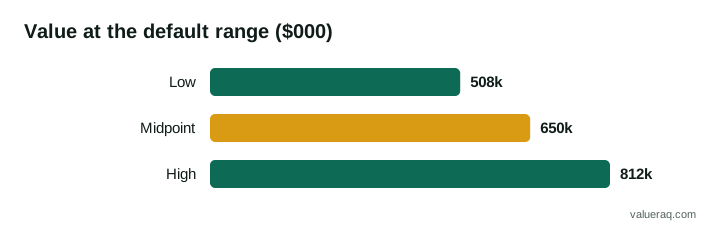
| Low | 2.5x | $507,500 | 3.5x |
| Midpoint | 3.2x | $649,600 | 4.5x |
| High | 4.0x | $812,000 | 5.7x |
The arithmetic for the midpoint: $203,000 x 3.2 = $649,600, and $649,600 ÷ $143,000 = 4.5x.
The same price looks like a 3.2x multiple on one figure and 4.5x on the other. This is why a multiple with no label is almost useless. Before comparing two businesses, ask which earnings figure each multiple was applied to.
Test the sensitivity
Because the multiple is the least certain input, check how much it matters. Applying a range of EBITDA multiples directly to $143,000 gives:
| EBITDA multiple | Value |
|---|---|
| 3.5x | $500,500 |
| 4.0x | $572,000 |
| 4.5x | $643,500 |
| 5.0x | $715,000 |
| 5.5x | $786,500 |
These multiples are illustrations, not market data. Each half-turn of the multiple moves the answer by $71,500. Take the whole range into a negotiation, not a single number.
Step 4: Convert the value into what the seller receives
An EBITDA multiple gives the value of the business's operations. This is close to what finance texts call enterprise value. Corporate Finance Institute gives the formula as market capitalization plus the market value of debt, minus cash and equivalents (CFI). Our enterprise value page explains the term.
Going the other way, from operations value to what the owners receive, means adjusting for debt and cash. Suppose the example business has a $40,000 loan and $25,000 in cash, and the midpoint price is $649,600:
$649,600 − $40,000 + $25,000 = $634,600
Whether debt and cash stay with the business or are settled by the seller is a point of negotiation in the contract. Most small online business sales are priced as an asset sale, which can leave debts behind. See asset sale and ways to sell a digital business. Ask a lawyer and an accountant how your deal is structured.
When EBITDA is the wrong figure
EBITDA is useful, but it can mislead. Four situations call for something else.
The business is owner-run and small. If a buyer will step into the owner's role, SDE is the figure they will use. Putting a market salary in front of a buyer who plans to do the job themselves understates what they will take home. See how to calculate SDE.
There is no profit yet. An earnings multiple cannot price a business with zero or negative earnings. Corporate Finance Institute says the revenue multiple is used when a company has no positive EBITDA or net income, and also that it "ignores profitability and cash flow generation" (CFI). Read revenue vs profit multiples and how to value a business with no profit.
The business needs steady reinvestment. EBITDA leaves out capital spending. A business that must keep replacing equipment or paying for large development work produces less cash than its EBITDA suggests.
It is a subscription software business. SaaS and AI products are usually valued on annual recurring revenue with profit as a cross-check. See SaaS valuation methods.
CFI also lists the limits of multiples in general: they oversimplify, and they depend on how comparable the other businesses are. It notes that the method "only considers the company's position for a certain time period" (CFI). A single year of EBITDA misses a trend, so look at the last 12 months and the months before them.
A short checklist
- Collect 12 or more months of profit and loss statements.
- Calculate reported EBITDA from net profit.
- List each adjustment with a document that supports it.
- Replace the owner's pay with a market salary for the job.
- Deduct costs the business is not currently paying.
- State the earnings figure by name: "adjusted EBITDA" or "SDE".
- Apply a range of multiples, not one.
- Convert to what the seller receives, after debt and cash.
Frequently asked questions
What is the formula for valuing a business with EBITDA?
Value = adjusted EBITDA x the multiple. Adjusted EBITDA starts from net profit, adds back taxes, interest, depreciation and amortization, and then adjusts owner pay to a market salary and removes one-off or personal costs.
Is EBITDA or SDE better for a small business?
For a small business where the owner does the main job, SDE is usually the better base because the buyer will take over that job. EBITDA suits businesses that run with a manager in place. The same business has a lower EBITDA than SDE.
Can I use an EBITDA multiple I found online?
Only if you know which earnings figure it was applied to, what size of business it covers, and where it came from. A multiple from a much larger company or one applied to SDE will give a misleading result for your business.
Do I need an accountant to calculate adjusted EBITDA?
For a sale, yes. Buyers will test the adjustments, and an accountant can help document them. The U.S. Small Business Administration suggests considering an accountant and an attorney when buying an existing business (SBA).
Sources
- Corporate Finance Institute: Multiples analysis
- Corporate Finance Institute: Enterprise Value (EV)
- Corporate Finance Institute: Enterprise Value to Revenue Multiple
- BizBuySell: Add-Backs for Seller's Discretionary Earnings
- U.S. Small Business Administration: Buy an existing business or franchise
- VALUERAQ methodology
Next step
Enter an asking price and a profit figure to see the multiple it implies.
Written by VALUERAQ Editorial Team. The VALUERAQ editorial team writes and maintains the platform's guides, methodology and glossary. Every guide is reviewed against the published methodology before publication and when the methodology changes.