
Key takeaway
A website's price is mostly its yearly profit multiplied by a multiple. You can improve both. Profit is slow to change, but the multiple moves when buyers see less risk: traffic that does not depend on one source, an owner who is not needed every day, revenue that is growing, and income from more than one place. Those changes take months, not days, so start well before you list.
This guide uses the factors in VALUERAQ's methodology to show what each change is worth in a worked example. The multiples are VALUERAQ's default assumptions, not market data. A real buyer may weigh things differently.
What a buyer is really pricing
The U.S. Small Business Administration says to "use business valuation to set a monetary value" when selling, and describes an income approach that "looks at projected revenue and accounts for potential risks" (SBA). The word that matters is risk. Two sites with the same profit can sell at different multiples because one looks safer.
For a website, VALUERAQ's default range is 2.5 to 4.0 times yearly profit, with a midpoint of 3.2. The tool then adjusts that range for several factors. The ones a seller can change in a year are in this table.
| Factor | What the default tool looks at | Adjustment range |
|---|---|---|
| Channel concentration | Share of traffic or sales from the largest channel | −12% to 0% |
| Owner involvement | Hours the owner works each week | −10% to +5% |
| Revenue trend | Revenue change over the last 12 months | −25% to +20% |
| Monetization | Main income source | −3% to +3% |
| Business age | Years of history | −20% to +5% |
Business age is the one factor you cannot speed up. The rest can improve.
Change 1: Spread your traffic
If more than 80% of visits come from one source, the default tool takes 12% off the multiple. Between 60% and 80% it takes 6% off. At 60% or less there is no reduction. See the methodology for the full bands.
What helps:
- Build an email list. Visitors you can reach without a search engine reduce dependence on it.
- Add a second reliable source. This could be a newsletter feature, a partner site or a social audience, as long as it brings visits you can show in analytics.
- Do not hide the dependence. Buyers will see it in traffic checks. A plan to widen the mix is more credible than silence.
A shift from 85% to 55% in one source takes six months or more in most cases, so this is the change to begin first.
Change 2: Reduce your own hours
Owner time works in bands. Over 40 hours a week takes 10% off the default multiple, over 20 to 40 hours takes 5% off, 10 to 20 hours is the baseline, and under 10 hours adds 5%.
A buyer is taking on your job as well as your site. The fewer hours it takes, the easier the handover:
- Write down each recurring task: publishing, updating, answering email, paying invoices, checking links.
- Note how long each takes and what tool or login it needs.
- Hand repeatable tasks to a freelancer or automate them, and keep the receipts so a buyer can see the cost.
- Record short videos or checklists for the rest.
Be careful with the accounts. If you pay a freelancer to take over your tasks, that cost reduces profit. Show it honestly. A lower-hours business with slightly lower profit can still sell for more than a high-hours business, but only if the numbers are clean. See add-backs for what buyers accept and what they reject.
Change 3: Show steady growth
Revenue that is flat is the baseline. Growth above 5% up to 25% adds 8% to the default multiple, and above 25% up to 75% adds 15%. A fall of more than 5% takes 12% off, and a fall of more than 20% takes 25% off.
Growth cannot be rushed, and it should not be faked. A one-month spike before listing does not help, because buyers look at a full year (trailing twelve months) and will ask why. What does help is steady work you can explain: refreshing the pages that already earn, fixing slow or broken ones, and improving how visitors become customers or clicks.
If revenue has been falling, find out why before you list. See how to value a website with falling traffic.
Change 4: Mix your income
The default tool treats display advertising and lead generation as the baseline. Affiliate-led income takes 3% off, because commission rates and programs can change. Own products and mixed income, where no source is over 60%, add 3%.
The effect is small compared with traffic and owner hours, so do not rebuild a site for it. But a second income stream is also a safety net, which buyers like.
Change 5: Clean up the records
Records do not appear in the multiple, but they decide whether a buyer trusts your figures. Before you list:
- Keep twelve full months of statements from every payment, ad and affiliate account.
- Keep expenses in one place with invoices.
- Separate personal costs from business costs.
- List every asset: domain, hosting, content, accounts, tools and logins.
BizBuySell warns that "some add-backs can unrealistically overvalue the company" (BizBuySell). Every add-back you claim needs a document behind it. Clean records shorten due diligence and reduce the chance of a price cut late in the deal.
A worked example
A content website earns $6,000 a month in revenue and $3,500 a month in profit, so $42,000 a year ($3,500 × 12). It is four years old, its revenue is flat, it earns mainly from affiliate links, 85% of visits come from one search engine, and the owner works 30 hours a week.
The table applies one change at a time in VALUERAQ's Website Valuation Tool. Profit is held at $42,000 in every row, which is an assumption, since in practice some changes cost money.
| Step | Change | Midpoint multiple | Midpoint value |
|---|---|---|---|
| Start | As described | 2.72× | $114,000 |
| 1 | Largest source falls from 85% to 55% | 3.10× | $130,000 |
| 2 | Owner hours fall from 30 to 8 | 3.42× | $144,000 |
| 3 | Revenue grows 10% over 12 months | 3.70× | $155,000 |
| 4 | Income becomes mixed | 3.92× | $165,000 |
Check the first and last rows: $42,000 × 2.72 = $114,240, shown as $114,000, and $42,000 × 3.92 = $164,640, shown as $165,000. The full range moves from about $89,000 to $143,000 at the start, to about $129,000 to $206,000 at the end.
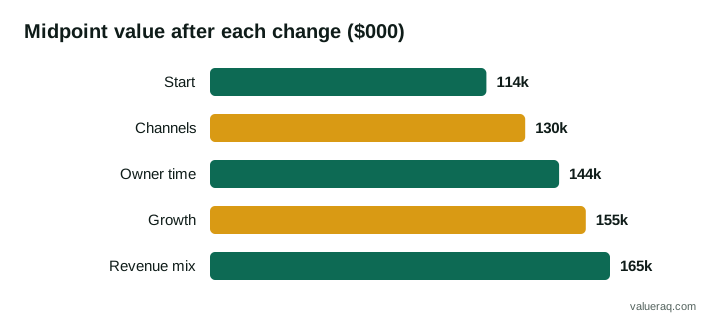
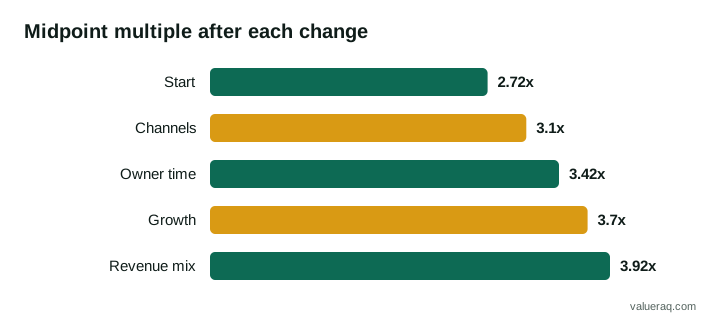
This is an illustration under VALUERAQ's default assumptions. It shows why risk matters, not what any buyer will pay. Combined adjustments are also capped, so the gains cannot grow without limit.
Mistakes that cost sellers value
- Changing too much at once. If traffic, pricing and content all change in the same quarter, a buyer cannot tell what drives the profit. Make one major change at a time and leave a few months of data after each.
- Cutting costs that feed growth. Dropping content updates or tools to lift profit for a few months can make revenue fall later, and buyers see the trend.
- Hiding a dependence. A buyer who finds an undisclosed reliance on one source, one account or one person during due diligence will often lower the price or leave. Say it up front and show your plan.
- Counting hopes as figures. Only revenue and costs you can show in statements count. Plans and projections help the story, but they are not part of the profit figure.
- Waiting for the perfect time. Every site has weak points. Aim for a clear, documented business with the risks explained, not a flawless one.
What to do first
| Priority | Action | Typical time to show in the numbers |
|---|---|---|
| 1 | Start widening traffic sources | 6 to 12 months |
| 2 | Document tasks and cut owner hours | 1 to 3 months |
| 3 | Clean twelve months of records | 1 month |
| 4 | Build steady, explainable growth | 6 to 12 months |
| 5 | Add a second income stream | 3 to 12 months |
These time ranges are rough planning guides, not measured figures. Run the Website Valuation Tool today and again after each change to see its effect. When you are ready, follow how to sell a website, and plan the handover using how to transfer a website to a new owner.
Frequently asked questions
How long before selling should I start improving my website?
Changes to traffic mix and revenue trend show up over a year of data, so six to twelve months before listing is a sensible start. Records and documentation can be done in a month or two.
Is it better to wait for higher profit or sell now?
It depends on your plans and on how stable the profit is. Use the tool to compare the range today with the range after the changes, and weigh that against the months it takes and the risk that traffic falls in the meantime.
Do these changes guarantee a higher price?
No. They address factors VALUERAQ's default method weighs, but buyers decide for themselves, and market conditions change. Treat the output as an estimate, not an offer.
Should I cut my own hours to zero?
Not necessarily. Under 10 hours a week earns the best default adjustment, but a buyer still wants a handover period and clear instructions. Do not remove time you cannot replace cheaply.
Sources
- U.S. Small Business Administration, Close or sell your business
- BizBuySell Learning Center, Add-Backs for Seller's Discretionary Earnings
- VALUERAQ methodology
Next step
Enter your numbers in the free Website Valuation Tool to see which factors move your range.
Written by VALUERAQ Editorial Team. The VALUERAQ editorial team writes and maintains the platform's guides, methodology and glossary. Every guide is reviewed against the published methodology before publication and when the methodology changes.