Key takeaway
A Shopify store is worth what a buyer will pay for the profit it earns, adjusted for how safely that profit can be handed over, plus the stock that comes with it. The working formula is value = yearly net profit × multiple, plus inventory at cost. Sales matter less than most owners expect, because product cost, shipping, refunds and advertising take a large part of every order.
This guide uses the Shopify store as the example, but the method applies to any online store. For the general version, read how to value an ecommerce business. Figures below are worked examples built from VALUERAQ's published default assumptions. They are estimates, not records of real sales.
Why profit comes before revenue
Two stores can each sell $500,000 a year and keep very different amounts. One sells a branded product with a healthy gross margin and spends little on ads. The other resells a commodity and spends most of its margin on paid traffic. A revenue figure hides that difference, so small stores are priced on profit. See revenue vs profit multiples for the reasoning.
Corporate Finance Institute describes the revenue approach as one that "ignores profitability and cash flow generation," which is why it is a poor starting point for a store with thin margins. It is useful as a cross-check, not as the main number.
Step 1: Work out the store's real profit
The profit buyers use is SDE: seller's discretionary earnings. It is the profit left after all running costs, before the owner is paid. Build it from the last 12 months, not the best quarter.
- Start with net sales, after refunds, discounts and returns.
- Subtract the cost of goods: what you paid for the products, inbound freight and packaging.
- Subtract shipping you paid that was not charged to the customer.
- Subtract payment processing fees and platform fees. These include the Shopify plan, any paid apps and the payment gateway.
- Subtract advertising. Count every channel, including influencers and affiliates.
- Subtract other running costs: software, contractors, customer service, accounting.
- Add back the owner's own pay and costs that are one-off or personal.
Be strict with the last step. BizBuySell warns that "some add-backs can unrealistically overvalue the company," and buyers will ask for evidence of every item. A cost that recurs every year is not a one-off, however it is labeled.
Step 2: Apply a multiple
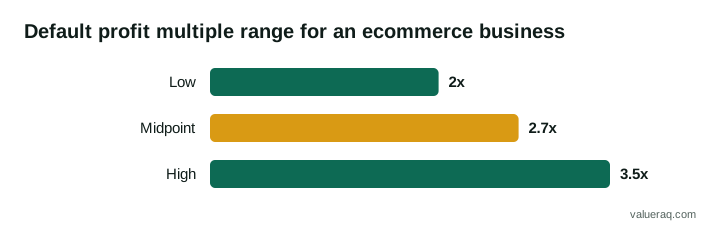
VALUERAQ's default range for an ecommerce business is 2.0 to 3.5 times yearly profit, with 2.7 as the midpoint. It is a published platform assumption, not measured market data, and the reasoning is in the methodology. No complete public record of private store sales exists, so be wary of any claim that a single multiple is "the market rate."
A worked example
A Shopify store selling its own branded products earns $6,000 a month in profit after all costs, before the owner is paid.
- Yearly profit: $6,000 × 12 = $72,000.
- At 2.0 times: $72,000 × 2.0 = $144,000.
- At 2.7 times: $72,000 × 2.7 = $194,400.
- At 3.5 times: $72,000 × 3.5 = $252,000.
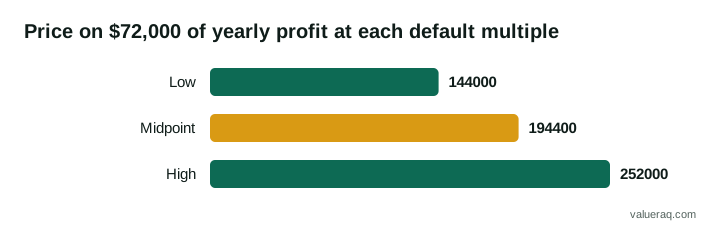
That is the range before any adjustment. The next sections show what moves the store toward either end.
Step 3: Adjust for the things that make a store safer or riskier
VALUERAQ publishes its adjustment rules so you can see exactly what they do. For ecommerce, the ones that matter most are these.
| Factor | Situation | Default adjustment |
|---|---|---|
| Fulfillment | Third-party logistics (3PL) | +3% |
| Fulfillment | Own warehouse or home storage | Baseline (0%) |
| Fulfillment | Dropshipping | −8% |
| Channel reliance | Over 60% to 80% of sales from one channel | −6% |
| Channel reliance | Over 80% of sales from one channel | −12% |
Revenue trend, store age and owner hours are adjusted in the same way as for every other business type. The adjustments are multiplied together, and the combined effect is capped at −50% and +40%.
Fulfillment
A store that ships from a third-party warehouse hands over cleanly: the new owner takes over the account and the stock keeps moving. A store packed from the owner's garage depends on the owner's time, space and equipment. A dropshipping store has no stock to buy, but it depends on suppliers the buyer does not control, and a supplier can change prices or stop shipping. That is why the default rule gives dropshipping a lower multiple.
Reliance on one sales channel
Many Shopify stores get most of their orders from one source: paid social ads, one search term, one marketplace or an email list. If that source changes its rules or its prices, profit can fall quickly. Ask for the share of orders from each channel, and look at how it has moved over the year.
Repeat customers and order value
A customer who orders again costs nothing to win a second time. Buyers look at the repeat purchase rate, average order value and the conversion rate to judge how efficiently the store turns visitors into profit. VALUERAQ's ecommerce tool does not adjust for these directly, but they are strong reasons to argue for the top or the bottom of the range.
Trend, age and owner hours
Steady growth, several years of trading history and a short list of weekly owner tasks all support a higher multiple. A falling line, a store that is a few months old or a business that needs 40 hours of the owner's week all point down. Compare each month with the same month a year earlier, because many stores are seasonal.
Step 4: Add the stock
Inventory is not part of the multiple. A buyer normally pays for sellable stock separately, at cost, after a count at closing. That keeps the price fair if stock levels move between the offer and the handover.
Count only stock that can actually be sold. Slow-moving, damaged or expired goods are worth less than their cost, and a careful buyer will discount or exclude them. If stock is held at a third-party warehouse, ask for the warehouse's own report, not the seller's spreadsheet. The questions that surround stock and unpaid supplier bills are covered under working capital.
The worked example with adjustments and stock
Return to the store earning $72,000 a year. It uses a 3PL, which adds 3%, and it holds $30,000 of sellable stock at cost.
- Adjusted multiples: 2.0 × 1.03 = 2.06, 2.7 × 1.03 = 2.781, 3.5 × 1.03 = 3.605.
- Value range: $72,000 × 2.06 = $148,320, $72,000 × 2.781 = $200,232, and $72,000 × 3.605 = $259,560.
- Plus stock at cost: $200,232 + $30,000 = $230,232 at the midpoint.
Now take a similar store that dropships, so it carries no stock and loses 8%.
- Adjusted multiples: 2.0 × 0.92 = 1.84, 2.7 × 0.92 = 2.484, 3.5 × 0.92 = 3.22.
- Value range: $72,000 × 1.84 = $132,480, $72,000 × 2.484 = $178,848, and $72,000 × 3.22 = $231,840.
Same profit, a gap of more than $20,000 at the midpoint. The difference is not about how much the store earns. It is about how safely the earnings can be passed on.
Step 5: Check the things that are particular to a Shopify store
Before you rely on a valuation, whether you are buying or selling, test the facts behind it.
- Ownership of the store. Confirm who owns the Shopify account, the domain, the theme license and the apps. Some app subscriptions and licenses are tied to the person who bought them.
- Sales records. Match Shopify's reports to payment processor payouts and to the bank. Screenshots can be edited; read-only access is better.
- Advertising accounts. Ask who owns the ad accounts, the pixel data, the audiences and the customer email list, and whether they transfer with the sale.
- Supplier terms. Ask for contracts or email agreements. A supplier relationship that exists only as a friendship with the owner is a risk.
- Returns, chargebacks and refunds. A rising refund rate may show a product problem that profit figures do not yet reflect.
- Taxes and compliance. Sales tax and customs rules depend on where you sell and ship. Ask an accountant; this guide does not give tax advice.
The U.S. Small Business Administration lists financial statements, tax returns, contracts, leases, cash flow and inventory among the things to look at when buying a business, and advises a "thorough, objective investigation." The digital business due diligence checklist turns that into questions you can use.
Mistakes that lead to a wrong valuation
| Mistake | A better approach |
|---|---|
| Valuing the store on revenue | Use net profit, then cross-check against revenue |
| Counting the best quarter | Use a full 12 months and compare with the year before |
| Forgetting ad costs that are paid outside the store | Include every channel and every agency fee |
| Adding unsellable stock at full cost | Count only stock that can be sold, at cost |
| Removing a recurring cost as a one-off | Ask for evidence for each add-back |
| Ignoring how much comes from one channel | Check the share of orders by source |
| Treating a range as a single price | Use the range to open a negotiation |
How to use the number
A valuation is a starting point for a conversation. If you are selling, it helps you set an asking price you can defend, and the high end of the range is only reachable if you can prove the profit and show that it will continue after you leave. If you are buying, it helps you judge whether an asking price makes sense, and which risks are worth asking the seller to explain or to cover with part of the price paid later.
Enter the store's figures into the Ecommerce Valuation Tool to see the range, which adjustments applied and why. VALUERAQ lists stores for sale at ecommerce businesses for sale, and buyers can message sellers directly from each listing. VALUERAQ is not a broker and does not guarantee a sale price.
Frequently asked questions
How much is my Shopify store worth?
Take yearly net profit before the owner's pay, multiply it by a range of 2.0 to 3.5 on VALUERAQ's default assumptions, adjust for fulfillment, channel reliance and the other factors, and add sellable stock at cost. A store earning $72,000 a year falls between $144,000 and $252,000 before adjustments and stock.
Is a Shopify store valued on revenue or profit?
Profit. Revenue says how much customers paid, not how much the owner kept. Revenue can be a cross-check, but a store with thin margins can have large sales and little worth.
Is stock included in the price?
Usually not in the multiple. Sellable stock is normally added on top at cost after a count at closing. Always write the treatment of stock into the offer.
Does it matter that I use dropshipping?
Yes. VALUERAQ's default rule lowers the multiple by 8% for dropshipping, because the business depends on suppliers the buyer does not control. A store with its own stock or a 3PL is easier to hand over.
Do I need an accountant?
For a sale or a purchase, yes. An accountant can check the profit figures and explain how the deal structure affects tax. The SBA also suggests hiring an attorney and an accountant when buying a business.
Sources
- U.S. Small Business Administration, Buy an existing business or franchise: investigating a business and getting professional help.
- Corporate Finance Institute, Enterprise value to revenue multiple: limits of revenue-based multiples.
- BizBuySell, Add-backs and SDE: how add-backs work and their risks.
- VALUERAQ, Valuation methodology: the default ranges and adjustment rules used in the examples.
Next step
Enter your store's profit, fulfillment and stock into the free Ecommerce Valuation Tool to see a range and the reasons behind it.
Written by VALUERAQ Editorial Team. The VALUERAQ editorial team writes and maintains the platform's guides, methodology and glossary. Every guide is reviewed against the published methodology before publication and when the methodology changes.