Key takeaway
Revenue tells you how much money comes in. It does not tell you how much the owner keeps, or whether the money will come again next year. In the examples below, three businesses each bring in $240,000 a year. At VALUERAQ's default midpoints they come out at $840,000, $230,400 and $64,800. Same revenue, a gap of more than $775,000. The multiple you choose has to reflect what the revenue turns into.
What "valuing on revenue" means
The method is simple:
Value = annual revenue × revenue multiple
A revenue multiple is a price divided by yearly revenue. A business that sells for $300,000 with $150,000 of revenue is priced at 2.0 times revenue. See the revenue multiple entry for the formula in short form.
The Corporate Finance Institute describes the wider idea of multiples as using "different financial metrics from comparable companies to value a target company", and says it lets you "make quick computations to assess a company's value" (CFI, multiples analysis). The speed is the appeal. The risk is that a quick answer hides what sits behind the revenue.
Why revenue alone can mislead
CFI's guide to the enterprise value to revenue multiple lists the main weaknesses. The multiple "ignores profitability and cash flow generation" and "does not take into account the company's capital structure" (CFI, EV to revenue). In plain words: a dollar of revenue at a 5% margin and a dollar at a 60% margin look the same, and they are not.
Three problems come up again and again in small online businesses:
- Margin. A store that spends 90 cents of each dollar on stock, ads and shipping leaves little for a buyer.
- Repeat or one-off. Subscription revenue that renews is worth more than a launch that will not repeat.
- Run-rate traps. Taking one strong month and multiplying by 12 assumes nothing changes. CFI notes the revenue run rate "takes a company's current revenue in a certain period (a week, month, quarter, etc.) and converts it to an annual figure" and warns about seasonality and one-off events (CFI, revenue run rate).
When a revenue multiple does work
Revenue multiples fit best when revenue is recurring and predictable. That is why VALUERAQ values SaaS and AI businesses on annual recurring revenue (ARR) rather than profit. CFI also says the revenue multiple is used when a company has no positive EBITDA or net income, which is common in young subscription businesses that put profit back into growth.
Even then, the multiple should move with the quality of the revenue. For SaaS, growth, churn, gross margin, customer concentration, age and owner workload all matter. The adjustments are listed on the methodology page.
For most other small online businesses (websites, newsletters, apps, stores), buyers look at owner profit, called SDE, and apply a profit multiple. The comparison is covered in revenue vs profit multiples.
Worked example: three businesses, same revenue
All three have $240,000 of revenue a year. The multiples below are VALUERAQ's default range for each type. They are editorial assumptions, not market data, and they are shown before any adjustments for age, growth or risk. See the methodology.
| A: SaaS | B: Content website | C: Online store | |
|---|---|---|---|
| Annual revenue | $240,000 (MRR $20,000 × 12) | $240,000 | $240,000 |
| Annual profit (SDE) | not needed | $72,000 (30% margin) | $24,000 (10% margin) |
| Valued on | ARR | Profit | Profit |
| Default multiple (low / mid / high) | 2.0 / 3.5 / 5.0 | 2.5 / 3.2 / 4.0 | 2.0 / 2.7 / 3.5 |
| Value range | $480,000 to $1,200,000 | $180,000 to $288,000 | $48,000 to $84,000 |
| Midpoint value | $840,000 | $230,400 | $64,800 |
| Midpoint as a multiple of revenue | 3.5x | 0.96x | 0.27x |
The arithmetic, step by step:
- A (SaaS): $20,000 × 12 = $240,000 ARR. $240,000 × 3.5 = $840,000.
- B (website): $72,000 × 3.2 = $230,400. Then $230,400 ÷ $240,000 = 0.96.
- C (store): $24,000 × 2.7 = $64,800. Then $64,800 ÷ $240,000 = 0.27.
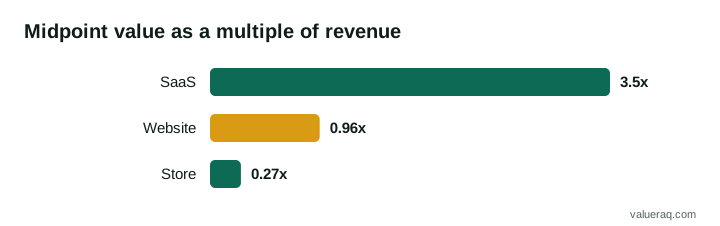
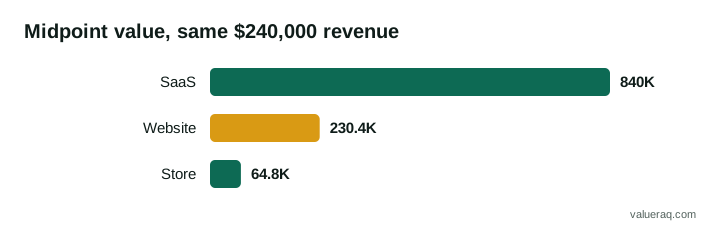
If you valued all three at 3.5 times revenue because "that is the SaaS number", the store would be priced at $840,000 when its profit-based midpoint is $64,800. A buyer who checks the profit will not agree to that price.
What drives the gap in the example
The gap comes from three separate things, and it helps to pull them apart.
First, the base is different. Business A is valued on recurring revenue, so every dollar of its $240,000 counts. Businesses B and C are valued on profit, so only the part the owner keeps counts: $72,000 and $24,000. B and C therefore start from a base that is 70% and 90% smaller than revenue.
Second, the multiples differ. The default midpoint is 3.5 for SaaS, 3.2 for a website and 2.7 for a store. Those gaps are smaller than the gap in the bases, which is why the base matters more than the multiple here.
Third, margin feeds through. If business C improved its margin from 10% to 20% without growing at all, its profit would be $48,000 and its midpoint value would be $48,000 × 2.7 = $129,600, double the original. Margin is often the cheapest thing a seller can improve before a sale, and it has no effect on a revenue-only valuation.
This is also why sellers who quote "we do $240,000 a year" in a listing get pushback. A buyer will ask the next question straight away: what is left after costs? Have the SDE calculation ready, with the add-backs explained, before the first conversation.
Questions to ask before you quote a revenue multiple
- Is the revenue contracted or repeating, or does it need to be won again each month?
- What share comes from one customer, one channel or one marketplace? Concentration lowers the multiple.
- Is revenue growing, flat or falling over the last 12 months?
- What are the costs that sit between revenue and profit, and are any of them the owner's own pay?
- Would a buyer have to do the owner's work, or can the business run without it?
If you cannot answer these, any revenue multiple you quote is a guess. If you can, you will usually find the profit multiple answers the question more directly.
A practical way to use revenue in a valuation
- Start with the right base. For recurring-revenue businesses use ARR. For others, find SDE first.
- Work out the implied revenue multiple. Divide the value you get by revenue. It is a useful sense check, as in the table above.
- Compare to the margin. A low implied revenue multiple is normal for a low-margin business. A high one needs recurring, growing revenue to back it up.
- Look at the trend. The SBA says the income approach "looks at projected revenue and accounts for potential risks" (SBA). Falling revenue weakens every multiple.
- Test against another method. If the answer looks high, check it with an asset or comparable-sales view. The business valuation guide covers all three.
You can put your own figures into the business multiple calculator to see both the revenue and the profit view side by side.
Where revenue multiples show up in practice
You will meet revenue multiples in listings, in advice from other owners and in published articles. Treat each as a claim to test, not a fact. Ask three things. What type of business was it? Which revenue figure was used, last 12 months or a single month? And was profit in the picture at all? A multiple with no answers to those questions cannot be compared to your business.
Mistakes to avoid
- Quoting a multiple without saying what it multiplies. "3x" could mean revenue, profit or ARR.
- Using a best month. Use the last 12 months, or the current MRR for subscriptions.
- Counting one-off revenue as recurring. Setup fees, big launches and one-time projects do not repeat.
- Copying numbers from large companies. Figures for big listed businesses do not carry over to small online ones.
- Ignoring owner work. If the business needs 50 hours a week from you, a buyer will lower the multiple.
Frequently asked questions
Can I value my business on revenue alone?
You can get a rough number, but it is only reliable for recurring-revenue businesses. For others, profit decides the price. Use revenue as a cross-check.
What is a good revenue multiple?
There is no single good number. It depends on margin, growth, how much revenue repeats and how risky it is. VALUERAQ's default range for SaaS is 2.0 to 5.0 times ARR, an editorial assumption rather than market data.
Why is a store worth less than a SaaS business with the same revenue?
Because less of each sale becomes profit, and a store's sales usually have to be won again every month. In the example, the store keeps $24,000 of $240,000 and the SaaS business is valued on recurring revenue that renews.
Should I use revenue or profit when I have no profit?
Revenue can help if it recurs, since CFI says it is used when there is no positive EBITDA or net income. Otherwise see how to value a business with no profit.
Sources
- CFI, Multiples analysis
- CFI, Enterprise value to revenue multiple
- CFI, Revenue run rate
- SBA, Close or sell your business
- VALUERAQ methodology
Next step
Try your own revenue and profit figures in the business multiple calculator.
Written by VALUERAQ Editorial Team. The VALUERAQ editorial team writes and maintains the platform's guides, methodology and glossary. Every guide is reviewed against the published methodology before publication and when the methodology changes.