
Key takeaway
An Amazon FBA business ("Fulfillment by Amazon", where a seller sends stock to the marketplace and the marketplace picks, packs and ships) is valued like any other online store: yearly net profit × a multiple, plus sellable stock at cost. What makes it different is where the risk sits. Almost all of the sales usually come through one marketplace that sets the fees, the rules and the visibility, and the owner has no control over any of them.
This guide shows how to work out the profit, how the multiple is built, and how to weigh the risks that are particular to FBA. Figures are worked examples from VALUERAQ's published default assumptions. They are estimates, not records of real sales. For the general method, see how to value an ecommerce business, and for a store you run on your own site, how to value a Shopify store.
Step 1: Work out the real profit
Marketplace sales reports flatter a business, because the payout is not the profit. Build the figure from the last 12 months.
- Net sales, after refunds and returns.
- Cost of goods: the product, packaging and freight to the warehouse. See cost of goods sold.
- Marketplace fees: the referral fee on each sale, the fulfillment fee, storage fees and any removal or disposal fees.
- Advertising: on-marketplace ad spend and any outside traffic you pay for.
- Other costs: software, prep and inspection, accounting, any virtual assistant or agency.
- Add back the owner's pay and genuinely one-off costs.
Two items are often missed. The first is storage and aged-stock fees, which can rise sharply in the busy season. The second is the cost of inventory that never sold. If last year's profit was helped by selling off old stock at a discount, that is not a repeatable result. Use SDE as the profit measure, and treat every add-back with care: BizBuySell warns that "some add-backs can unrealistically overvalue the company."
Step 2: Apply the multiple
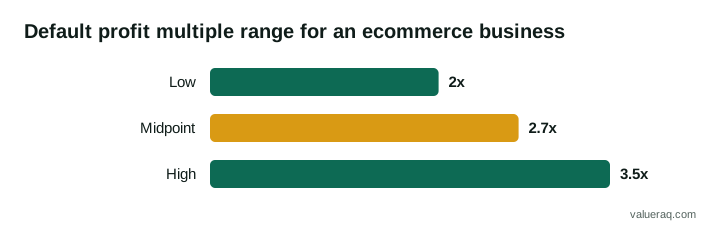
VALUERAQ's default range for an ecommerce business is 2.0 to 3.5 times yearly profit, midpoint 2.7. This is a published platform assumption, not market data; the reasoning is in the methodology. There is no complete public record of private marketplace-business sales, so treat any single "FBA multiple" quoted online with caution.
A worked example
An FBA business earns $10,000 a month in profit after all costs, before the owner is paid.
- Yearly profit: $10,000 × 12 = $120,000.
- At 2.0 times: $120,000 × 2.0 = $240,000.
- At 2.7 times: $120,000 × 2.7 = $324,000.
- At 3.5 times: $120,000 × 3.5 = $420,000.
That is the range before adjustments and stock.
Which stretch of profit to use
Buyers rarely use one number. They look at profit averaged over different windows: the last 12 months, the last 6 and the last 3. The 12-month figure is the usual base, in the same way as trailing twelve months. The shorter windows show the direction. Here is the same business in two situations, valued at the 2.7 midpoint before other adjustments.
| Window | Falling profit: monthly average | Yearly | Value at 2.7x | Rising profit: monthly average | Yearly | Value at 2.7x |
|---|---|---|---|---|---|---|
| Last 12 months | $10,000 | $120,000 | $324,000 | $10,000 | $120,000 | $324,000 |
| Last 6 months | $9,000 | $108,000 | $291,600 | $11,000 | $132,000 | $356,400 |
| Last 3 months | $8,000 | $96,000 | $259,200 | $12,000 | $144,000 | $388,800 |
A seller with falling profit should expect the buyer to lean on the shorter windows, and a seller with rising profit should show them. Neither window decides the price on its own, and a recent jump needs an explanation, such as a stock-up sale, a one-off promotion or cut ad spend.
Step 3: Weigh channel reliance, the main FBA risk
VALUERAQ's default rules reduce the multiple when a large share of sales comes from one channel.
| Share of sales from the largest channel | Default adjustment |
|---|---|
| Under 60% | No adjustment |
| Over 60% to 80% | −6% |
| Over 80% | −12% |
A typical FBA business sells over 80% of its units through the marketplace itself, so the larger reduction often applies. Take the example above with the −12% adjustment.
- Adjusted multiples: 2.0 × 0.88 = 1.76, 2.7 × 0.88 = 2.376, 3.5 × 0.88 = 3.08.
- Value range: $120,000 × 1.76 = $211,200, $120,000 × 2.376 = $285,120, and $120,000 × 3.08 = $369,600.
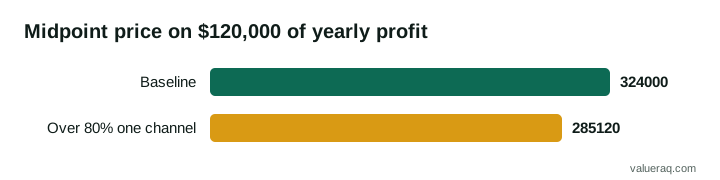
The midpoint falls by $38,880. A seller who also sells on its own website, through email or on other marketplaces reduces that discount, and a buyer will often pay more for that spread. Ask for sales by channel for every month of the year, not just the total.
Step 4: Look at the risks specific to marketplace sellers
- Account health. The seller's account is the business. Ask about warnings, suspended listings, intellectual property complaints and any past suspension. Find out how the account would pass to a new owner under the marketplace's own rules, and do not assume it can be transferred.
- Product concentration. If one product earns most of the profit, a stock-out, a bad review run or a copycat competitor can change the picture quickly. Ask for profit by product.
- Supplier dependence. Who makes the product, on what terms, and does the buyer get an introduction? A supplier who only trusts the current owner is a risk.
- Advertising dependence. If sales fall away when ad spend is cut, the profit is partly bought. Compare organic sales with sales from ads.
- Rank and reviews. Listing history and reviews stay with the product listing, but they are earned over time and can be damaged. Check the review trend.
- Price and fee changes. The marketplace can raise its fees or change its rules. A thin margin has little room to absorb that.
- Product safety and compliance. Some products carry rules for labels, testing or safety. Ask for evidence and take advice.
- Brand ownership. Confirm who owns the trademark, the listing rights and the product designs.
Step 5: Add the stock
As with other stores, inventory is paid for separately at cost, after a count at closing, rather than multiplied. Count what can be sold.
- Stock at the warehouse. Ask for the marketplace's own inventory report, not the seller's list.
- Stock in transit. Agree who owns goods that are on their way and how they are counted.
- Aged or stranded stock. Slow-moving units and units that cannot be sold are worth less than cost. Agree a discount or leave them out.
- Reserved or returned units. Check that these are counted correctly.
In the example, the business holds $45,000 of sellable stock at cost. At the adjusted midpoint, the price is $285,120 + $45,000 = $330,120. Write how stock will be counted and valued into the offer, because it is the most common cause of a price dispute. The working capital page covers how to treat stock, cash and unpaid supplier bills.
Step 6: Check the evidence
Before you accept a valuation as a buyer, or rely on it as a seller, test it against the source documents.
- Match the marketplace's payment reports to bank deposits for the whole year.
- Ask for read-only access to the seller account's reports, not screenshots.
- Compare the profit figure with supplier invoices and freight bills.
- Ask for the tax records that support the sales figures. Sales tax and import rules depend on where you sell and ship, so ask an accountant.
- Confirm that no money is owed for chargebacks, returns or fees that have not yet been taken.
The U.S. Small Business Administration advises a "thorough, objective investigation" before buying a business and suggests hiring an attorney and an accountant. The digital business due diligence checklist lists the questions in more detail.
What a buyer will want to see
A prepared seller answers these questions before they are asked. Expect a buyer to request monthly profit and loss statements for at least 12 months, sales and units by product and by channel, the advertising spend and what it returned, the inventory report with ages, supplier contracts or order history, and a list of anything that went wrong in the last year, such as a stock-out, a listing removal or a quality complaint.
A seller who can show clean figures and explain the bad months is more believable than one who only shows the good ones. Buyers also read the pattern. A business whose profit rises every month before the listing date raises the question of whether ad spend was cut, or stock was run down, to flatter the numbers. Explain any such move in writing.
How to improve the valuation before you sell
| Action | Why it helps |
|---|---|
| Sell through a second channel | Lowers channel reliance and the adjustment that goes with it |
| Spread sales across more products | Reduces dependence on one listing |
| Keep clean monthly accounts | Makes the profit easy to prove |
| Clear aged stock before listing | Removes arguments about stock value |
| Write down the supplier process | Helps the buyer take over without you |
| Cut the owner's weekly hours | A low workload supports a higher multiple |
| Stay steady in the months before the sale | A falling trend pulls the multiple down |
A 90-day plan before you list
| Days | What to do |
|---|---|
| 1 to 30 | Close the books for each month, split profit by product and channel, and reconcile marketplace payouts to bank deposits |
| 31 to 60 | Clear aged stock, resolve open account warnings or listing complaints, and write down the supplier and prep process |
| 61 to 90 | Hold ad spend and pricing steady, gather the inventory report with stock ages, and prepare read-only report access for buyers |
Do not make changes in the last 90 days that flatter profit without lasting, such as cutting ads for a quarter. Buyers check the trend and will ask why.
Frequently asked questions
How much is an Amazon FBA business worth?
Take yearly net profit before the owner's pay, apply 2.0 to 3.5 on VALUERAQ's default assumptions, reduce it for reliance on one channel and other risks, and add sellable stock at cost. A business earning $120,000 a year falls between $240,000 and $420,000 before adjustments and stock.
Is an FBA business valued on revenue or profit?
Profit. Marketplace fees, advertising and product costs take a large share of each sale, so revenue says little about what the owner actually keeps.
Is inventory included in the price?
Usually not within the multiple. Sellable stock is normally added at cost after a count at closing, and the offer should say so.
Can an Amazon seller account be sold?
That depends on the marketplace's own rules and on how the deal is structured. Do not assume it can be transferred. Read the marketplace's current seller terms and ask a lawyer before you agree a price.
Which months of profit do buyers look at?
Most start with the last 12 months, then compare the last 6 and last 3 to see the direction. Profit that is falling in the shorter windows usually leads to a lower offer than the 12-month figure suggests.
What should I fix first before selling?
Start with proof: monthly accounts that match payout reports and bank deposits. Then deal with account warnings and aged stock, because both lead to price disputes.
Does selling on only one marketplace lower the value?
On VALUERAQ's default rules, yes: more than 80% of sales from one channel reduces the multiple by 12%. The reduction is a judgment about risk, not a penalty, and spreading sales across channels reduces it.
Sources
- U.S. Small Business Administration, Buy an existing business or franchise: investigating a business and getting professional help.
- BizBuySell, Add-backs and SDE: how add-backs work and their risks.
- VALUERAQ, Valuation methodology: the default ranges and adjustment rules used in the examples.
Next step
Enter your profit, fulfillment and stock into the free Ecommerce Valuation Tool to see a range and the reasons behind it.
Written by VALUERAQ Editorial Team. The VALUERAQ editorial team writes and maintains the platform's guides, methodology and glossary. Every guide is reviewed against the published methodology before publication and when the methodology changes.