Key takeaway
The price on a listing says little about what a deal is really worth to each side. What matters is how much is paid on closing day, how much comes later, and what has to happen before it does. That plan is the deal structure.
Four building blocks cover almost every small online sale: all cash, seller financing, an earnout and a holdback, all usually run through escrow. You can mix them. This guide explains each one, shows when it fits, and then pays the same $120,000 price four ways so you can see the difference in numbers.
VALUERAQ is not a party to any sale. Buyers and sellers agree terms directly, VALUERAQ takes no commission and does not handle the payment (see how it works). Nothing here is legal or tax advice.
What "deal structure" means
A structure answers four questions:
- What is being bought? For most websites, apps, newsletters and stores this is an asset sale: a list of assets such as the domain, code, content and accounts.
- How much is paid at closing?
- What is paid later, and what decides whether it is paid?
- Who holds the money in the meantime?
The answers are first set out in a letter of intent and then written into the sale agreement. The U.S. Small Business Administration names a letter of intent, a confidentiality agreement, a sales agreement and a purchase price adjustment among the documents professionals can help with (SBA).
The four building blocks
All cash at closing
The buyer pays the full price once the checks are done, and the seller hands over the assets.
- Best for: smaller deals, clean businesses, and buyers who have the money ready.
- Buyer's risk: the whole price is paid before the buyer has run the business.
- Seller's risk: low, once the money is released.
Cash is the simplest structure and often the easiest to negotiate, because there is nothing to monitor afterwards.
Seller financing
The buyer pays part of the price at closing and signs a written promise to pay the rest in instalments. See seller financing for the terms a note usually sets out.
- Best for: buyers who cannot fund the full price up front, and sellers who want a wider pool of buyers.
- Buyer's gain: less cash needed on day one.
- Seller's risk: the buyer may run the business badly or stop paying. A damaged website or store is rarely worth what was still owed.
The debt is owed whatever happens to the business. That is what separates it from an earnout.
Earnout
Part of the price is paid after closing, but only if the business meets a target agreed in the contract, such as revenue over the next 12 months. See earnout.
- Best for: deals where the two sides disagree on the future, for example a fast-growing site with only a short record, or revenue that depends on a few customers.
- Buyer's gain: pays the extra amount only if the growth shows up.
- Seller's risk: after closing the buyer controls pricing, marketing and costs, all of which can move the result.
Revenue targets are harder to dispute than profit targets, because profit depends on which costs the new owner charges to the business.
Holdback
A small share of the price stays with a neutral party for an agreed period after closing, for example 90 days. It gives the buyer a source of recovery if something the seller stated turns out to be untrue. It is not tied to future performance, which is the difference from an earnout.
Escrow around all of them
Escrow is not a payment plan. It is who holds the money. The buyer pays an independent provider, the seller transfers the assets, the buyer checks everything during an inspection period, and only then are the funds released. Any of the four structures above can run through escrow, and for a deal with a stranger it is the sensible default. See how escrow works for website sales.
Comparing the structures
| Structure | Paid at closing | Paid later | What decides the later payment | Who carries the main risk |
|---|---|---|---|---|
| All cash | Whole price | Nothing | Not applicable | Buyer, if the business disappoints |
| Seller financing | Most of the price | Instalments | The buyer's ability and willingness to keep paying | Seller |
| Earnout | Base price | Extra amount | A target such as revenue | Seller (the target) and buyer (the overpayment) |
| Holdback | Most of the price | Held-back share | No claim being made in the agreed period | Buyer, until the period ends |
Risk for each side, at a glance
| Structure | Main risk for the buyer | Main risk for the seller | Clause that matters most |
|---|---|---|---|
| All cash | Pays in full before knowing how the business performs | Few, beyond the price being lower | Warranties about the figures in the listing |
| Seller financing | Instalments stay due if profit falls | Buyer stops paying; the business is already handed over | What happens on a missed payment |
| Earnout | Overpaying if targets are set too low | Buyer's choices after closing change the result | Exactly how the target is measured |
| Holdback | Money tied up until the period ends | Claims delay or reduce the release | What counts as a valid claim, and by when |
Worked example: one $120,000 price, four ways
This is a made-up website used to show the arithmetic. It is an illustration, not a market figure.
A website earns $40,000 a year in profit. The two sides agree a price of $120,000.
- Check the multiple: $120,000 ÷ $40,000 = 3.0x annual profit. VALUERAQ's default range for a website is 2.5x to 4.0x annual profit, with a midpoint of 3.2x. These are VALUERAQ's own default assumptions, set out in the methodology, not market data.
- Monthly profit: $40,000 ÷ 12 = $3,333.
Option A: all cash
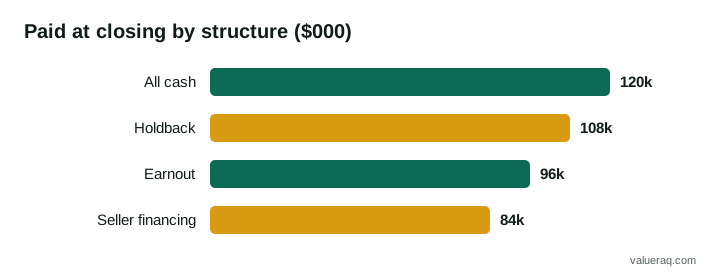
- Paid at closing: $120,000.
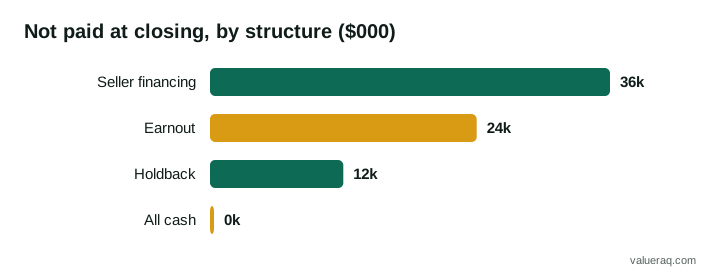
- Uncertain amount: $0.
Option B: seller financing
The buyer pays 70% at closing and the seller finances 30% over 18 months.
- Paid at closing: $120,000 × 70% = $84,000.
- Seller note: $120,000 − $84,000 = $36,000.
- Monthly instalment before interest: $36,000 ÷ 18 = $2,000.
- Share of monthly profit the instalment takes: $2,000 ÷ $3,333 = 60%.
A buyer should plan for this. If profit slips, the instalment takes an even bigger share. Any interest the sides agree is paid on top.
Option C: earnout
The buyer pays 80% at closing and a further 20% if revenue in the 12 months after closing reaches an agreed target.
- Paid at closing: $120,000 × 80% = $96,000.
- Earnout: $120,000 − $96,000 = $24,000.
- Lowest the seller receives: $96,000, which is 3.0x profit × 80%, or an effective 2.4x.
- Highest the seller receives: $120,000.
Option D: holdback
The buyer pays 90% at closing and 10% stays in escrow for 90 days.
- Paid at closing: $120,000 × 90% = $108,000.
- Held back: $120,000 − $108,000 = $12,000.
- If no claim is made in 90 days, the $12,000 is released to the seller.
Cumulative cash the seller has received over time
Using the same four options, and assuming the earnout target is met and paid after month 12 and the holdback is released at day 90 (about month 3):
| Time | A: all cash | B: seller financing | C: earnout | D: holdback |
|---|---|---|---|---|
| At closing | $120,000 | $84,000 | $96,000 | $108,000 |
| Month 3 | $120,000 | $90,000 | $96,000 | $120,000 |
| Month 6 | $120,000 | $96,000 | $96,000 | $120,000 |
| Month 12 | $120,000 | $108,000 | $96,000 | $120,000 |
| Month 18 | $120,000 | $120,000 | $120,000 | $120,000 |
Seller financing builds by $2,000 a month from $84,000 (month 3: $84,000 + 3 × $2,000 = $90,000), before any interest. If the earnout target is missed, row C stays at $96,000.
What the example shows
The headline price is $120,000 in every case, but a seller who needs cash today would rank them A, D, C, B. A buyer who is worried about the profit figure would rank them in nearly the opposite order. Seller financing leaves the most unpaid, but it is a debt that is owed regardless of results. The earnout leaves less unpaid but it is only owed if the target is met, so a seller should value it below its face amount. When comparing offers, compare the amount that is certain, not the headline price.
When each structure tends to fit
| Situation | Structure often considered |
|---|---|
| Small deal, buyer has the cash, clean records | All cash through escrow |
| Buyer needs time to raise the full price | Seller financing, with a large down payment |
| Strong recent growth, short track record | Earnout tied to revenue |
| Seller made many claims that are hard to check in advance | Holdback, or a longer inspection period |
| Seller is essential to daily work | Earnout or seller financing plus a handover period |
| Buyer and seller do not know each other | Escrow, whichever structure is chosen |
None of these is a rule. Each one trades cash today against risk later.
How to choose and negotiate a structure
As a buyer
- Verify before you structure. A structure cannot fix numbers you have not checked. Work through the due diligence checklist and ask for records, and use a data room if the seller offers one.
- Ask what you are most unsure about. If it is the future, an earnout is the answer. If it is the past, a holdback or inspection period fits better.
- Keep the instalments affordable. Check that note payments, plus your own costs, fit within the profit you have verified.
- Put the terms in writing. The target, the period, who measures it and how disputes are settled should be in the agreement, not in a message thread.
For price tactics see how to negotiate buying an online business, and for funding options see how to finance buying an online business.
As a seller
- Compare offers on the certain amount. A higher headline with more deferred can be worth less than a lower all-cash offer.
- Check the buyer. For seller financing, look at the buyer's experience and ability to pay from other income, and the size of the down payment. A larger down payment means the buyer has more to lose by walking away.
- Protect an earnout. Ask for a revenue measure rather than profit, a clear list of what counts, and limits on changes that would hurt the result.
- Keep exclusivity short. If the letter of intent includes exclusivity, give it only as long as the checks reasonably need.
Clauses to check in any deferred payment
Whichever structure you choose, the written terms decide whether it works. Check each of these before signing:
- The measure. Revenue, profit or another number, defined line by line, including how refunds and discounts are treated.
- The records. Which accounts the figure comes from, and who can see them.
- The period. Start and end dates, and what happens if the buyer changes the business.
- Missed payments. The notice period, any interest, and whether the whole balance becomes due at once (sometimes called acceleration).
- Claims. For a holdback, what can be claimed against it and the deadline for making a claim.
- Disputes. Who decides if the two sides disagree.
Common mistakes
- Treating the headline price as the deal. The structure decides what is certain.
- Leaving the earnout measure vague. "Revenue" can mean gross, net of refunds, or only new customers. Say which.
- Letting terms sit in chat messages. Anything not in the agreement is hard to enforce.
- Paying outside escrow. Never pay a seller directly before assets are transferred. The buyer safety page lists the warning signs.
- Skipping advice. The SBA says to "consider hiring an attorney and an accountant" when buying an existing business, and recommends an attorney review the sales agreement (SBA). Tax treatment and contract rules differ by country and by deal.
Frequently asked questions
What is the safest way to pay for an online business?
Through an independent escrow service, with the money released only after the buyer has checked that the assets work as described. Check the provider's web address yourself and do not follow a link the other side sends.
Is seller financing the same as an earnout?
No. Seller financing is a debt that is owed whatever happens to the business. An earnout is owed only if a target is met.
How much should be held back?
There is no set figure. In the example above, 10% for 90 days is used purely to show the arithmetic. The amount and the period are negotiated and written into the agreement.
Can I combine structures?
Yes. A deal might pay 70% in cash, 20% as an earnout and hold back 10%. Each part adds a term to the agreement, so keep the structure as simple as the risk allows.
Which structure is best for the seller?
All cash is the most certain, and a holdback of a small share is close behind. Seller financing and earnouts can lift the headline price but leave part of it dependent on the buyer, so a seller should value the deferred part below its face amount.
What is acceleration in a seller note?
It is a clause that makes the whole unpaid balance due at once if a trigger happens, such as a missed instalment. Without it, the seller may have to wait for each instalment to fall due.
Do I need a lawyer?
For anything sizeable, take advice. Contract terms, security for a note and tax treatment vary by country, and VALUERAQ cannot give legal advice.
Sources
- U.S. Small Business Administration: Buy an existing business or franchise
- U.S. Small Business Administration: Close or sell your business
- VALUERAQ methodology
Written by VALUERAQ Editorial Team. The VALUERAQ editorial team writes and maintains the platform's guides, methodology and glossary. Every guide is reviewed against the published methodology before publication and when the methodology changes.