Key takeaway
Buying a business goes wrong in three places: paying too much, missing a problem that was findable, and having no plan for the first weeks. A checklist works because it puts those three risks in order, with a stop point at the end of each stage. If a stage fails, you stop or renegotiate, and you have spent days, not months or a large sum of money.
This guide gives you a seven-stage checklist from the first look at a listing to day 100 as the owner. It is written for small online businesses such as websites, stores, apps and newsletters, but the order holds for most small deals. Figures in the worked example are made up. Multiples come from VALUERAQ's published default ranges on the methodology page, not from market data. Nothing here is legal, tax or accounting advice, and no price is guaranteed.
The seven stages at a glance
| Stage | Goal | Stop point: walk away if... |
|---|---|---|
| 1. Criteria and budget | Know what you can run and afford | You cannot say in one sentence what you want to buy |
| 2. Screening | Cut a long list to a short one | The listing has no verifiable numbers |
| 3. Valuation | Know a fair price range | The asking price is far above any method you can defend |
| 4. Letter of intent | Agree headline terms and lock a window | The seller refuses a reasonable review period |
| 5. Due diligence | Prove the claims | The records do not match the story |
| 6. Closing | Sign, pay safely, transfer | The seller will not use a safe payment route |
| 7. Day 1 to day 100 | Keep what you bought | You have no plan for the first month |
Stage 1: Set your criteria and budget
Write a one-page brief before you open a single listing. A buyer without a brief is persuaded by the best-looking listing, not the best fit.
- What you can run. How many hours a week can you give? What skills do you have: writing, marketing, code, operations? A business that needs skills you lack is a worse buy even at a low price.
- Your total budget. Include the purchase price and a reserve for the first months: tools, fixes, a contractor if you need one. Our guide on how to finance buying an online business covers the options.
- Business type and size. Website, store, app, newsletter or software. Each is valued and checked differently. See how to buy a website, how to buy an ecommerce business and how to buy a SaaS business.
- Deal-breakers. For example: more than half of revenue from one channel, no records older than a year, a business that depends on the seller personally.
Checkpoint: you can describe your ideal purchase in one sentence and your maximum price in one number.
Stage 2: Screen listings
Most listings are weak. Screening is a fast filter, not a deep check.
- Does the listing give monthly revenue and profit, not just a yearly figure?
- Does it say where traffic or customers come from?
- Does it say why the seller is selling?
- Is the business at least 12 months old, with some history you can see?
- Does it list who does the work, and could you replace that person?
Look for the signs in red flags when buying a website and how to spot a fake website listing. A listing that hides numbers behind "ask for details" is not always bad, but it earns less of your time.
Checkpoint: a shortlist of three to five businesses, not thirty.
Stage 3: Value the business
Before you talk price, know what a defensible range looks like. For small online businesses, the common starting point is a multiple of yearly profit, often called seller's discretionary earnings. Our SDE page explains the measure, and how to calculate SDE shows the steps.
VALUERAQ's default profit multiples for a website range from 2.5x to 4.0x, with 3.2x as the midpoint. For an ecommerce business or an app the default range is 2.0x to 3.5x with a 2.7x midpoint. For SaaS the method uses annual recurring revenue, with a default range of 2.0x to 5.0x. These are the tool's starting assumptions, not market data. See the methodology page and what multiple websites sell for for how to read them.
Two checks that save money:
- Adjust profit before you multiply. Owner pay, one-off costs and personal expenses change the profit figure. See add-backs and normalized earnings.
- Use more than one view. Compare the multiple with what the business would earn you each year, using our ROI guide for website buyers.
Checkpoint: a low, middle and high price you can explain, and a number above which you walk away.
Stage 4: Agree headline terms in a letter of intent
A letter of intent sets the main terms before the expensive work starts: price, what is included, how you will pay, the review period and a promise not to shop the business elsewhere for a set time (see exclusivity period). Most of it is not binding, but the confidentiality and exclusivity parts usually are, so ask a lawyer to read it.
Include in the letter:
- the price and how it is paid: all at closing, or part later through seller financing, a holdback or an earnout;
- what is included: domain, code, content, social accounts, supplier contracts, customer lists;
- the review period for due diligence, and what happens to the price if you find a problem;
- the transition help the seller will give, and for how long. See transition period;
- a non-disclosure agreement if the seller has not already asked for one.
Checkpoint: signed terms, a review window and a named list of what you are buying.
Stage 5: Complete due diligence
This is the stage that earns its keep. The U.S. Small Business Administration advises anyone buying an existing business to carry out a "thorough, objective investigation", and tells buyers to look at financial statements and tax returns and to ask about contracts, leases, existing cash flow and inventory. It also says: "Consider hiring an attorney and an accountant."
Your pre-acquisition due diligence checklist:
| Area | What to check | Proof to ask for |
|---|---|---|
| Revenue | Monthly figures match payouts | Payment processor, ad network or marketplace statements |
| Profit | Costs are complete and normal | Bank records, expense receipts, tax returns where they exist |
| Traffic or customers | Sources are real and stable | Analytics access, ad account exports |
| Ownership | Seller owns what is being sold | Domain registrar, hosting, app store, code repository access |
| Contracts | Nothing transfers a liability | Supplier, partner and customer agreements, leases |
| Risk | No single point of failure | Share of revenue by channel, customer or supplier |
| Legal | No claims, takedowns or unpaid taxes | Written confirmation, searches your lawyer recommends |
| Operations | You can run it | Written processes, logins list, tool and contractor list |
Use our deeper guides for each area: digital business due diligence, financial due diligence checklist, how to verify website revenue and how to verify website traffic. Ask the seller to put documents in a data room; the data room checklist lists what to expect.
Look hardest at customer concentration, platform risk and key person risk. They are the three problems most likely to cut a business's income after the seller leaves.
Checkpoint: every claim in the listing is backed by a document, or you have adjusted the price for what is not.
Worked example: stress-testing the price
The figures below are made up. You are looking at a content website with $4,000 average monthly profit, after adjusting for owner pay and one-off costs.
Annual profit: $4,000 × 12 = $48,000
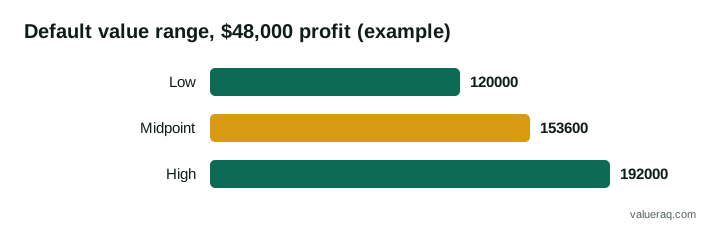
Default value range for a website, 2.5x to 4.0x:
- Low: $48,000 × 2.5 = $120,000
- Midpoint: $48,000 × 3.2 = $153,600
- High: $48,000 × 4.0 = $192,000
Suppose the seller asks $153,600, the midpoint. Before you agree, stress-test it. Due diligence shows most traffic comes from one search engine, so ask what happens if traffic, and with it profit, falls. To keep the arithmetic simple, assume profit falls by the same percentage.
| Scenario | Annual profit | Years to earn back $153,600 |
|---|---|---|
| Base case | $48,000 | 153,600 ÷ 48,000 = 3.2 |
| Profit down 20% | $48,000 × 0.8 = $38,400 | 153,600 ÷ 38,400 = 4.0 |
| Profit down 40% | $48,000 × 0.6 = $28,800 | 153,600 ÷ 28,800 = 5.3 |
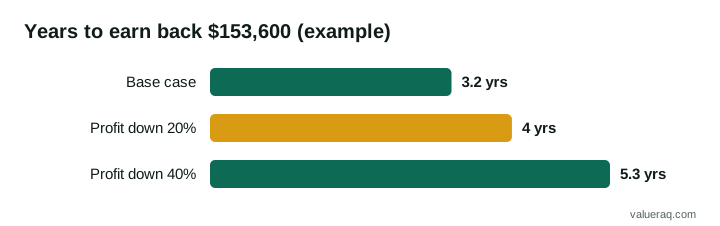
The price is a fair midpoint if profit holds, but it takes more than five years to earn back if profit falls 40%. That does not make the deal bad. It gives you three choices: ask for a lower price that reflects the risk, ask for part of the price to be paid later and tied to results (a holdback or earnout), or pass. A buyer who stress-tests will always know which of the three to use. The example is a teaching tool, not a prediction.
Stage 6: Close safely
Closing is where promises become documents. A lawyer should draft or review the purchase agreement. Read it for:
- the list of assets and whether you are buying assets or the company itself (see asset sale and stock sale);
- the seller's representations and warranties: written statements about the business that you can rely on if they turn out to be false;
- a non-compete agreement, so the seller cannot start a copy next door;
- how the price is allocated between assets, which can affect tax, so ask your accountant;
- the exact order in which accounts and assets move.
Pay through escrow so the money is released only when the transfer is done. Our guide on how escrow works for website sales explains the steps. Avoid paying by routes you cannot reverse or trace to a seller you cannot confirm. For transfers, follow how to transfer a website to a new owner.
Checkpoint: signed agreement, money in escrow, a dated transfer list with every item ticked off.
Stage 7: Day 1 to day 100
Many acquisitions are won or lost after the closing date. Plan the first 100 days before you sign.
| Period | Focus | Tasks |
|---|---|---|
| Day 1 to 7 | Control | Change every password, turn on two-step sign-in, confirm you own domain, hosting, payment and app accounts, set up backups |
| Day 8 to 30 | Learn | Shadow the seller, run everything as it was, write down each process, change nothing big |
| Day 31 to 60 | Stabilize | Fix the small problems found in due diligence, check your numbers against the seller's, talk to customers or readers |
| Day 61 to 100 | Improve | Choose one or two improvements with a clear cause and effect, and measure them against the months before the sale |
Track the same monthly numbers the seller gave you, so you can see whether the business performs as described. If it does not, your written representations and warranties are the place to start, and a lawyer is the person to call. See also what happens after you sell a website for the seller's side of the handover.
Common mistakes to avoid
- Falling for the listing. Decide your price limit before you read the pitch.
- Skipping the lawyer and accountant. The SBA recommends both. The cost is small next to a mistake on a purchase.
- Accepting screenshots. Insist on statements, bank records or direct access.
- Rushing a deadline. A seller who pushes you to skip diligence is telling you something.
- Planning only to closing. Have the first 100 days written down before you sign.
Our guide to valuation mistakes covers the pricing errors in more depth.
Frequently asked questions
What is the first step in acquiring a business?
Write down what you want and what you can afford before you look at a listing. Your criteria, a maximum price and a list of deal-breakers keep you from being steered by a good sales page.
How long does a business acquisition take?
It varies with the size of the deal, how organized the seller is and how quickly each side answers. Small online sales often take weeks to a few months from agreed terms to closing. Our guide on how long it takes to sell an online business shows what drives the timeline from the seller's side.
What is pre-acquisition due diligence?
It is the checking you do after agreeing terms and before closing: confirming revenue, profit, traffic, ownership, contracts and legal standing with documents, not statements. The table in stage 5 is a starting list.
Do I need a lawyer and an accountant?
For anything more than a very small purchase, yes. The U.S. Small Business Administration says to consider hiring an attorney and an accountant when buying an existing business. They can check the purchase agreement, the tax effects and the seller's records.
How do I know what price to offer?
Calculate a range from yearly profit and a defensible multiple, adjust for risk found in due diligence, and set a walk-away number in advance. The free business multiple calculator gives a default range in about a minute.
Sources
- U.S. Small Business Administration, Buy an existing business or franchise
- VALUERAQ, Methodology (default multiples)
Next step
Enter the seller's profit to see a default price range before you make an offer.
Written by VALUERAQ Editorial Team. The VALUERAQ editorial team writes and maintains the platform's guides, methodology and glossary. Every guide is reviewed against the published methodology before publication and when the methodology changes.