Key takeaway
Discounted cash flow (DCF) values a business by adding up the cash it is expected to produce in future years, after reducing each year's amount for waiting and risk. For a small online business, the discount rate and the value after the forecast decide the result, so test several of each and compare the answer with a profit multiple before you trust it.
This guide uses one made-up business all the way through. You will see the cash-flow forecast, every division, a table of discount rates and the same business priced with a multiple. The figures are examples to show the method. They are not market data and not a promise of any price.
What DCF does, in plain words
A dollar next year is worth less than a dollar today. You could use today's dollar now, and next year's dollar may never arrive. DCF turns that idea into arithmetic.
The Corporate Finance Institute describes DCF as a method "used to value investments by discounting the estimated future cash flows" (Corporate Finance Institute). For each future year:
Value today of one year = cash flow ÷ (1 + discount rate) ^ years away
Add every year and you have the value of the forecast period. The discounted cash flow glossary page has a shorter version of the idea.
The U.S. Small Business Administration calls this the income approach, which "looks at projected revenue and accounts for potential risks" (SBA). The word "potential risks" is where the discount rate comes in.
When DCF fits a small online business, and when it does not
DCF is a good teaching tool and a useful second opinion. It works best when:
- The business has at least two years of steady records.
- Income repeats, for example subscriptions or a loyal email audience.
- You can explain why cash flow should rise, hold or fall.
It works poorly when traffic depends on one search ranking, revenue swings month to month, or the business is under a year old. In those cases any forecast is mostly hope, and the multiple method in our guide to website valuation methods is easier to defend. Our methodology page explains why VALUERAQ's tools use multiples of profit.
Step 1: Choose the cash flow to forecast
Use cash the owner could take out, not accounting profit. For a one-person online business, start from seller's discretionary earnings and then subtract what a new owner must spend to keep the business running, such as equipment, software upgrades or a part-time helper. If the buyer will hire someone to replace the owner, subtract that cost as well. The free cash flow to firm page shows the same idea in company terms.
BizBuySell warns that "some add-backs can unrealistically overvalue the company" (BizBuySell). Every add-back in the starting number needs a receipt behind it.
Step 2: Forecast three to five years
Write down a starting year and a growth rate you can defend from the last twelve months of data, then apply it year by year. Five years is the longest most small buyers will accept. Three is often enough.
Our example is a niche content website that earns $60,000 a year in cash flow after all costs and after paying a manager to replace the owner. We assume 5% growth a year.
| Year | Calculation | Cash flow |
|---|---|---|
| 1 | $60,000 | $60,000 |
| 2 | $60,000 × 1.05 | $63,000 |
| 3 | $63,000 × 1.05 | $66,150 |
| 4 | $66,150 × 1.05 | $69,458 |
| 5 | $69,458 × 1.05 | $72,930 |
Amounts are rounded to the nearest dollar.
Step 3: Pick a discount rate
The discount rate is the yearly return the buyer wants for taking the risk. Larger companies often build it from their cost of capital, and CFI notes that the discount rate is typically the weighted average cost of capital (Corporate Finance Institute). See weighted average cost of capital for how that works.
A small online business has no such formula. A buyer simply asks, "What yearly return would make this worth the risk compared with other things I could do with the money?" A riskier business, such as one with falling traffic or one big customer, calls for a higher rate and a lower value.
We use 25% as the base case and test 20% and 30%. These are what-if rates chosen for the arithmetic. They are not market data and not a VALUERAQ default.
Step 4: Discount each year
Divide each year's cash flow by 1.25 raised to the year number.
| Year | Cash flow | Divide by | Value today |
|---|---|---|---|
| 1 | $60,000 | 1.25 (1.25) | $48,000 |
| 2 | $63,000 | 1.25² (1.5625) | $40,320 |
| 3 | $66,150 | 1.25³ (1.9531) | $33,869 |
| 4 | $69,458 | 1.25⁴ (2.4414) | $28,450 |
| 5 | $72,930 | 1.25⁵ (3.0518) | $23,898 |
| Total | $331,538 | $174,537 |
Check: 48,000 + 40,320 + 33,869 + 28,450 + 23,898 = 174,537.
Five years of cash adds up to $331,538, but it is worth $174,537 to this buyer today. That is the first answer: about $174,500 if the buyer counts only the five forecast years.
Step 5: Decide what the business is worth after year 5
A business that is still running in year 6 has value beyond your forecast. DCF captures that with a terminal value. The common growth formula is:
Terminal value = year-5 cash flow × (1 + growth) ÷ (discount rate − growth)
With 2% long-run growth and a 25% rate:
- Year-5 cash flow × 1.02 = $72,930 × 1.02 = $74,388.60.
- Divide by (0.25 − 0.02) = 0.23: $74,388.60 ÷ 0.23 ≈ $323,429.
- Bring it back to today by dividing by 1.25⁵ (3.0518): $323,429 ÷ 3.0518 ≈ $105,981.
Add that to the five forecast years: $174,537 + $105,981 = $280,518.
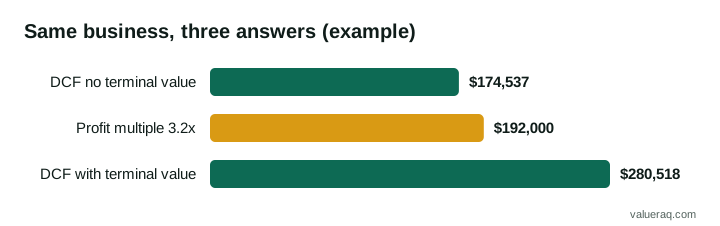
The terminal value is 105,981 ÷ 280,518 = 38% of the total. The rest of this guide is mostly about how much weight that piece deserves.
How the discount rate changes the answer
Small changes in the rate move the result a lot. Here is the same forecast at three rates, with and without a terminal value (2% long-run growth):
| Discount rate | Five years only | With terminal value | Terminal share of total |
|---|---|---|---|
| 20% | about $194,800 | $360,920 | 46% |
| 25% | about $174,500 | $280,518 | 38% |
| 30% | about $157,500 | $229,056 | 31% |
Going from 20% to 30% lowers the full DCF from $360,920 to $229,056, a drop of 37%. Nothing about the business changed. Only the buyer's mood about risk did.
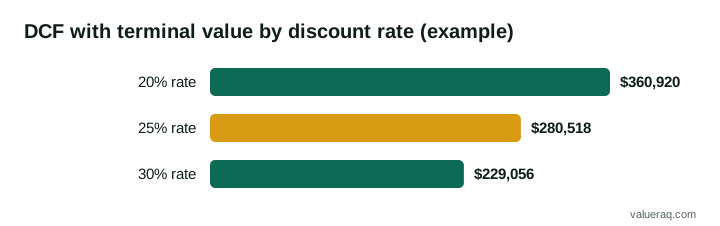
This is why a single DCF number should never be quoted without the rate beside it.
Compare DCF with a profit multiple
Price the same business with VALUERAQ's default website range from the methodology: 2.5× low, 3.2× midpoint and 4.0× high, applied to yearly profit. Using $60,000 as the profit figure:
| Method | Calculation | Value |
|---|---|---|
| Profit multiple, low | $60,000 × 2.5 | $150,000 |
| Profit multiple, midpoint | $60,000 × 3.2 | $192,000 |
| Profit multiple, high | $60,000 × 4.0 | $240,000 |
| DCF, five years only (25%) | from Step 4 | $174,537 |
| DCF with terminal value (25%) | from Step 5 | $280,518 |
The five-year DCF ($174,537) lands inside the multiple range. The DCF with a terminal value ($280,518) lands above the high end. That gap is a warning sign, not a bargain: it comes from assuming the business keeps growing forever at a forecast steady rate.
A multiple is a shortcut for the same idea. Paying 3.2 times yearly profit means the buyer expects to earn the price back in about 3.2 years if profit holds. Valuation multiples explains the link.
A cautious way to use DCF in a real deal
Small buyers who use DCF usually do the following:
- Forecast three years, not five, unless the records support more.
- Use a high discount rate and show a range of rates.
- Leave out the terminal value, or cut it sharply, and say so.
- Compare the result with a multiple range and with comparable sales if any exist.
- Treat the number as the start of a negotiation, not the end of one.
For subscription software, add churn to the forecast. Our guide to SaaS valuation methods shows where DCF sits next to other methods.
Common mistakes
- Starting from revenue. Discount cash flow, not sales. A business that bills $200,000 and keeps $40,000 is a $40,000 business.
- Forgetting the owner's job. If the buyer must hire someone, that wage comes out of cash flow.
- Growth that never ends. Growth of 5% for five years is a forecast. Growth of 5% forever is a fantasy, and in the formula it must stay below the discount rate.
- One rate, no range. Always show at least two more rates.
- Treating decimals as accuracy. The output has dollars and cents, but the inputs are opinions.
Frequently asked questions
Is there a DCF calculator for a small business?
You can build one in a spreadsheet with the formulas in this guide: list the cash flows, divide each by (1 + rate) to the power of the year, and sum. Many online calculators work this way. Whichever you use, check that it lets you change the discount rate and leave out the terminal value.
What discount rate should I use for a small online business?
There is no official figure. Buyers pick a return that matches the risk, and riskier businesses get higher rates. Show a range, as the table above does, rather than one rate.
Is DCF better than a multiple for an online business?
Not by itself. A multiple of profit is quicker and is how most small online businesses are priced. DCF is useful as a second check and for explaining what a price assumes about growth and risk.
Do I need a terminal value?
If you forecast only three to five years of a business that will continue, you leave out some value. Many small buyers accept that on purpose because the later years are uncertain. If you include one, show the result with and without it.
Sources
- Corporate Finance Institute, DCF Formula
- U.S. Small Business Administration, Close or sell your business
- BizBuySell, Add-Backs for Seller's Discretionary Earnings
- VALUERAQ, methodology
This guide is general information, not financial, tax or legal advice. Ask an accountant or lawyer before you buy or sell.
Next step
Compare your DCF result with a profit-multiple estimate from the free Website Valuation Tool.
Written by VALUERAQ Editorial Team. The VALUERAQ editorial team writes and maintains the platform's guides, methodology and glossary. Every guide is reviewed against the published methodology before publication and when the methodology changes.