Key takeaway
A capitalization rate valuation answers one question: if a buyer wants this yearly return on the money spent, what price delivers it? You take the business's normalized yearly earnings, choose a rate, and divide.
Value = yearly earnings ÷ capitalization rate
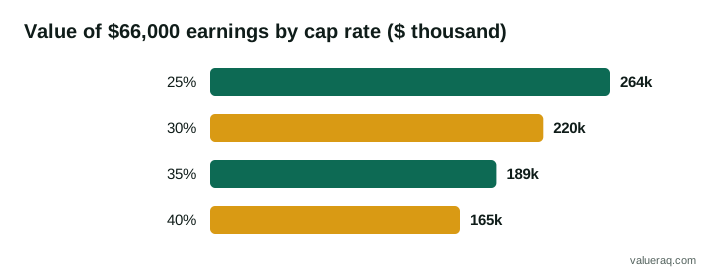
If a business earns $66,000 a year and the buyer wants a 30% return, the value is $66,000 ÷ 0.30 = $220,000. Raise the required rate to 40% and the same earnings are worth $165,000. Nothing about the business changed. Only the buyer's view of its risk did.
That is why the rate is the heart of the method, and why it is worth understanding as the mirror image of the profit multiple you already see in listings. This guide explains the formula, shows the conversion between rates and multiples, builds a rate step by step, and finishes with a checklist and the cases where the method should not be used.
Every dollar figure below is an invented illustration of the arithmetic. None of it is market data or a prediction of a sale price.
What a capitalization rate is
A capitalization rate, often shortened to cap rate, is yearly earnings divided by price, shown as a percentage. It describes the return a buyer gets in the first year if the earnings stay the same.
The valuation method that uses it is often called the capitalized earnings method, and it belongs to the income approach. The U.S. Small Business Administration lists three ways to set a value: the income approach, which "looks at projected revenue and accounts for potential risks", the market approach, which "compares your business to other similar businesses that have recently sold", and the assets approach, which "subtracts total business liabilities from the total value of all assets". Capitalizing earnings is a simple form of the first.
It is simple because it uses one year of earnings and one rate. A discounted cash flow model uses many years of forecasts. The capitalized method packs those years into a single division by assuming earnings continue at a steady level.
The cap rate is a profit multiple upside down
Sellers and listings usually speak in multiples: "priced at 3x profit." Investors often speak in returns: "I want 30%." The two are the same fact:
- Multiple = price ÷ earnings
- Cap rate = earnings ÷ price
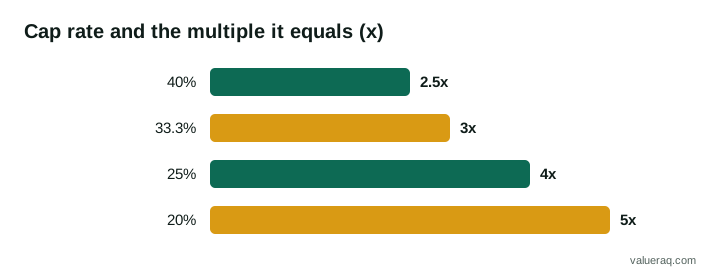
- Cap rate = 1 ÷ multiple, and multiple = 1 ÷ cap rate
| Cap rate | Multiple of yearly earnings | Value of $66,000 earnings |
|---|---|---|
| 50% | 2.0x | $132,000 |
| 40% | 2.5x | $165,000 |
| 33.3% | 3.0x | $198,000 |
| 25% | 4.0x | $264,000 |
| 20% | 5.0x | $330,000 |
Read the table from the bottom up and the pattern is clear: the lower the rate a buyer will accept, the more they will pay. A buyer who sees little risk accepts a low rate. A buyer who sees a lot of risk demands a high one.
VALUERAQ's default range for a profit-based business such as a website is 2.5x to 4.0x annual profit. In rate terms, that is 40% at the low end and 25% at the high end, with the 3.2x midpoint at 31.25%. These are VALUERAQ's own assumptions, explained in the methodology, not market data.
Step 1: Find the earnings to capitalize
The rate only works on the right earnings. For a small online business that is usually seller's discretionary earnings (SDE), which is profit before the owner's own pay. Larger businesses with a paid manager are more often valued on EBITDA. The guide on SDE vs EBITDA explains which fits, and how to calculate SDE shows the build-up.
Whichever you use, normalize it first:
- Start with a full year of net profit, or the trailing twelve months, rather than a good month.
- Add back costs that are really the owner's choice or will not continue. BizBuySell defines add-backs as "expenses added back to a company's bottom-line profits when determining Seller's Discretionary Earnings (SDE) or EBITDA" and warns that "some add-backs can unrealistically overvalue the company." See add-backs.
- Remove one-off gains, such as a single large sponsorship that will not repeat.
- Check the figure against bank or payment records, not just a spreadsheet.
Because the whole value is earnings divided by a rate, an overstated earnings figure inflates the value by the same share. Add-backs a buyer rejects will pull the price down fast.
Step 2: Choose the capitalization rate
This is the judgement call. There are two common ways to reach a rate, and a careful buyer uses both as a cross-check.
Method A: Start from the multiple you expect
If comparable businesses are priced at a range of multiples, invert them. A 2.5x to 4.0x range gives rates of 40% to 25%. This is quick and ties the answer to what you see in the market, as long as the comparison businesses are truly comparable. The Corporate Finance Institute notes that multiples let you "make quick computations to assess a company's value", and also that they oversimplify and depend on comparable businesses using similar accounting.
Method B: Build the rate from a required return and growth
Finance textbooks describe the capitalization rate as the discount rate minus the long-term growth rate of earnings:
Cap rate = discount rate − expected growth rate
The discount rate is the return the buyer needs for taking this risk. The Corporate Finance Institute describes the discount rate in a DCF as typically the weighted average cost of capital, which suits large companies. For a small online business, a buyer usually thinks directly in terms of the return they require on the cash they put in, which is higher because the risk is higher.
Growth lowers the rate because earnings that rise over time are worth more than flat ones. This is a simplification: it treats growth as steady forever, which small businesses rarely deliver.
Worked rate build-up
A buyer decides that a three-year-old website deserves these assumptions. They are invented, to show the arithmetic.
| Item | Figure |
|---|---|
| Buyer's required yearly return (discount rate) | 35% |
| Expected long-term growth in earnings | 3% |
| Capitalization rate | 35% − 3% = 32% |
| Equivalent multiple | 1 ÷ 0.32 = 3.125x |
With $66,000 of earnings, value = $66,000 ÷ 0.32 = $206,250. As a check, 3.125 × $66,000 = $206,250. It sits inside VALUERAQ's default 2.5x to 4.0x range, which is a sensible sanity test. If your rate-based answer lands far outside the range, ask what you are assuming that the range does not.
Worked example: one website, three views
A website has these figures (invented):
| Item | Figure |
|---|---|
| Monthly revenue | $12,000 |
| Monthly costs, including hosting, tools and contractors | $6,500 |
| Monthly profit before the owner's pay (SDE) | $5,500 |
| Annual SDE | $5,500 × 12 = $66,000 |
| Age | 3 years |
Apply VALUERAQ's default profit range of 2.5x, 3.2x and 4.0x, then turn each multiple into a rate:
| View | Multiple | Cap rate (1 ÷ multiple) | Value ($66,000 ÷ rate) |
|---|---|---|---|
| Cautious buyer | 2.5x | 40.0% | $165,000 |
| Middle | 3.2x | 31.25% | $211,200 |
| Confident buyer | 4.0x | 25.0% | $264,000 |
The two methods agree because they are the same arithmetic. The rate view just changes the question. Instead of "what multiple is fair?", you ask "what return would I accept?" Many buyers find the second question easier to answer from their own situation, and it makes clear that the gap between $165,000 and $264,000 is all about risk, not about the earnings.
How much one rate point matters
Small changes in the rate move the value a lot, especially at low rates. Holding the earnings at $66,000:
| Cap rate | Value |
|---|---|
| 25% | $264,000 |
| 30% | $220,000 |
| 35% | $188,571 |
| 40% | $165,000 |
Going from 25% to 30% takes $44,000 off the price. Going from 35% to 40% takes $23,571 off. The same five-point move costs the seller more when the starting rate is lower, because dividing by a smaller number is more sensitive.
For the seller this means the story around risk is worth real money. Anything that justifies a lower rate, such as steady earnings, diversified traffic, documented processes, and an owner who is not essential, raises the price directly.
What pushes a rate up or down
A buyer typically asks for a higher rate, which means a lower price, when they see:
- Earnings that swing a lot from month to month, or strong seasonality.
- Falling traffic or revenue.
- A few customers or one traffic source supplying most of the income. See customer concentration and platform risk.
- An owner who does most of the work. See key person risk.
- A young business with little history.
- Messy or unverifiable records.
A buyer accepts a lower rate, which means a higher price, when earnings are steady or growing, income is spread across sources, the business runs without constant owner attention, and the books are clean and checkable.
When the method works, and when it does not
The capitalized earnings method fits when earnings are fairly steady and positive, and when you want a quick, transparent estimate that you can explain in two lines.
It fits poorly when:
- Earnings are changing fast. A fast-growing business is undervalued by a flat-earnings assumption; a shrinking one is overvalued. A DCF or a close look at the trend works better. See how to value a website with falling traffic.
- The business loses money. Dividing a loss by a rate gives a negative number. Such businesses are usually priced on assets, audience or strategic value. See how to value a business with no profit.
- The business is valued on recurring revenue. Software businesses are often valued on annual recurring revenue instead. See revenue vs profit multiples.
- One buyer values it differently. A strategic buyer may pay more because of what they can add. A simple rate cannot capture that.
A short checklist
Before you rely on a capitalization rate result:
- [ ] Earnings are a full twelve months and are normalized.
- [ ] Every add-back can be explained and backed by a record.
- [ ] The rate was reached two ways: from a multiple, and from required return less growth.
- [ ] The result sits inside the range comparable multiples suggest, or you can say why not.
- [ ] You tested the value at rates five points above and below.
- [ ] You wrote down the risks that justify the rate.
Frequently asked questions
What is the formula for valuing a business with a cap rate?
Value = normalized yearly earnings ÷ cap rate, with the rate as a decimal. Earnings of $66,000 at 30% gives $66,000 ÷ 0.30 = $220,000.
How do I convert a cap rate to a multiple?
Divide 1 by the rate. A 25% rate is 1 ÷ 0.25 = 4.0x. To go the other way, divide 1 by the multiple: 1 ÷ 3.2 = 0.3125, or 31.25%.
What is a good cap rate for a small online business?
There is no single answer, and this guide does not quote a market average because no published source for one is on file. VALUERAQ's default profit multiple range of 2.5x to 4.0x equals rates of 40% to 25%, and that is VALUERAQ's own assumption, not market data. Choose a rate from the risk of the specific business.
Does a higher cap rate mean a better or worse price?
For the buyer, a higher rate means a higher first-year return but a lower price. For the seller, a higher rate means a lower price. The rate rises with the risk the buyer sees.
Is the cap rate the same as ROI?
For a purchase with no extra costs and flat earnings, the first-year return on investment equals the cap rate. Real deals add costs, so compare using your full cost. See return on investment.
Sources
- U.S. Small Business Administration, Close or sell your business: the income, market and assets approaches.
- Corporate Finance Institute, Multiples analysis: what multiples do well, and where they oversimplify.
- Corporate Finance Institute, DCF formula: the discount rate in a discounted cash flow.
- BizBuySell Learning Center, Add-Backs for Seller's Discretionary Earnings: the definition of add-backs and the overvaluation warning.
- VALUERAQ, Valuation methodology: the default multiple ranges used in the examples.
Next step
To see a value range for your own figures, try the free website valuation tool. It takes about a minute and needs no sign-up.
Written by VALUERAQ Editorial Team. The VALUERAQ editorial team writes and maintains the platform's guides, methodology and glossary. Every guide is reviewed against the published methodology before publication and when the methodology changes.