Key takeaway
A domain appraisal and a website valuation answer two different questions. An appraisal asks what a name might fetch from someone who wants it. A valuation asks what a business is worth to someone who wants its earnings. If your site makes money, the second question matters far more, and it is answered with profit and a multiple, not with the name.
VALUERAQ values earning websites, newsletters, apps, stores, SaaS and AI businesses. It does not appraise bare domain names, and the tools will not give a figure for a site with no profit. This guide explains how appraisals work, where they fall short, and how to value the website that sits on the domain.
What a domain appraisal is
A domain appraisal is an estimated price for a domain name. Free appraisal tools and paid appraisers both start from features of the name itself. The usual inputs are:
- Length. Short names are scarcer.
- Extension. A .com is generally the most sought after, with other extensions varying in demand.
- Words. A name made of common words that describe a product or an industry can be worth more than an invented word.
- Readability. Names that are easy to say, spell and remember are easier to resell.
- Hyphens and numbers. These usually count against a name.
- Age and history. A long-registered name with a clean history is preferred over one that has been penalized or used for spam.
- Search interest. Whether people search for the words in the name.
An automated tool turns those features into a number. A human appraiser may add comparisons with past sales of similar names. In both cases the output is an opinion about price.
A six-factor scorecard
Score each factor from 1 (weak) to 5 (strong) and add them up. The scores are a way to organize your thinking, not a price formula, and no dollar value comes from them.
| Factor | 1 (weak) | 5 (strong) |
|---|---|---|
| Extension | Rare or unfamiliar | Widely used and trusted |
| Length | Long, many syllables | Short and easy to type |
| Brandability | Hard to say or spell | Easy to say, spell and remember |
| Keyword demand | Nobody searches for the words | Clear, steady interest in the words |
| Type-in traffic | None | People already type the name in |
| Trademark risk | A known brand is close | No obvious conflicts |
A name that scores 24 or more out of 30 is a stronger candidate than one that scores 12, but only a buyer can turn that into a price. Trademark risk is the one factor that can sink a name outright, so check it first. This is general information, not legal advice.
Why two tools give two different answers
Imagine one name run through three tools. Tool A weights length heavily, tool B weights keyword demand, and tool C uses past sales of names it considers similar. They might return $800, $2,500 and $1,200. All three can be reasonable on their own terms, because each is measuring a different thing. The useful reading is the spread: a wide one means no tool has strong evidence. Where a tool lists named, dated sales of comparable names, that is better evidence than a number with no source. See comparable sales.
End-user price versus investor price
The same name can have two prices. An investor who hopes to resell asks what a future buyer might pay and leaves room for profit. A business that needs the name asks what it is worth to the brand. As an illustration with made-up numbers: if a company expects the name to save it $3,000 a year in advertising, it may pay more than an investor who sees a likely resale of $1,500. Neither number is wrong. They answer different questions, and the bigger gap is usually found when the buyer has a specific need.
What the number means, and what it does not
The U.S. Internal Revenue Service defines fair market value in Publication 561 as "the price that property would sell for on the open market." An appraisal tries to estimate that price, but until a buyer and seller actually agree, nobody knows it. Treat a free appraisal as a rough guide. Three limits matter:
- It cannot see demand. A name is worth what one particular buyer will pay. A tool cannot tell whether that buyer exists.
- Different tools give different answers. The same name can receive widely different estimates, because each tool weights features its own way.
- Most names are not bought at the estimate. An appraisal is not an offer. Many names never sell at all.
If you are asked to pay for an appraisal, ask what data it is based on and whether the figure comes from named, checkable sales.
A bare domain versus a website with earnings
| Bare domain | Website with earnings | |
|---|---|---|
| What the buyer gets | A name and its registration | A name, content, audience, income and processes |
| What drives price | Features of the name and a buyer's plans | Yearly profit, trend, risk and owner effort |
| Method | Comparison and judgment | Profit multiple, cross-checked |
| Can it be checked? | Only against past sales of other names | Against bank, payout and analytics records |
| Handled by | Domain marketplaces and brokers | Business marketplaces such as VALUERAQ |
The two are not exclusive. A strong name helps a website, for example through direct visits or easy recall. But once a site earns real money, buyers spend little time on the name and a great deal on the income. The U.S. Small Business Administration lists intangible assets such as brand presence, intellectual property, customer information and projected future revenue as things to value when selling a business. The name is one part of that brand.
How to value the website instead
The usual working formula for a small website is value = yearly profit × multiple, where the profit is SDE: the profit left after all costs, before the owner is paid.
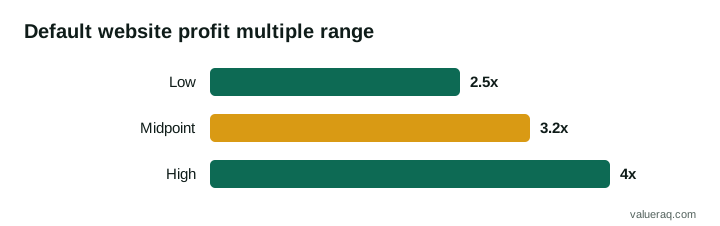
VALUERAQ's default range for a website is 2.5 to 4.0 times yearly profit, with 3.2 as the midpoint. It is a published platform assumption, not measured market data. The reasoning and every adjustment are set out in the methodology.
A worked example
A website earns $2,000 a month after all costs, before the owner is paid. The domain is a short .com that an appraisal tool would value at a few thousand dollars.
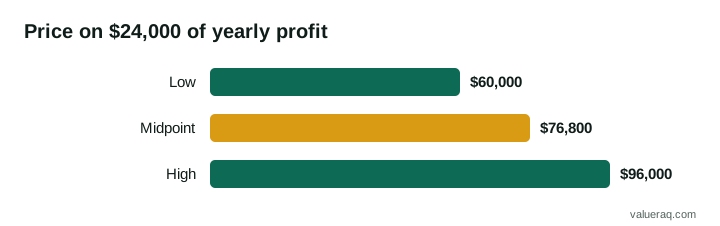
- Yearly profit: $2,000 × 12 = $24,000.
- At 2.5 times: $24,000 × 2.5 = $60,000.
- At 3.2 times: $24,000 × 3.2 = $76,800.
- At 4.0 times: $24,000 × 4.0 = $96,000.
The name may nudge the site toward the top of the range, but the profit supplies almost all of the value. A site that earns nothing has nothing for the multiple to act on, however good the name. In that case the value rests on the name, the content and the audience, which is an appraisal and negotiation question, not a multiple.
Reading an appraisal sensibly
If you run a name through a free tool, do three things with the result. First, run it through two or three tools and note the spread, because a wide gap tells you the figure is soft. Second, search for what the words in the name mean to a buyer: does a company or a product category plainly need this name? Third, decide your own walk-away price before any conversation starts. An appraisal should help you set that price, not replace your judgment of it. If you are selling a name alone, expect the sale to take as long as it takes to find the one buyer who needs it.
What moves a website's value besides the name
- Trend. Rising profit supports a higher multiple and falling profit lowers it.
- Age. A longer record is easier to believe.
- Traffic sources. A site that gets nearly all its visits from one search engine or one channel carries more risk than one with several sources.
- Owner hours. A business that needs the owner every day is harder to hand over.
- Income sources. Ads, affiliate links, products and leads each have different risks.
The website valuation guide goes through each factor, and seven worked examples show how different site types come out.
When an appraisal is useful
An appraisal is still helpful in a few cases:
- Buying or selling a bare name with no site or income.
- Deciding whether to renew a name you hold but do not use.
- Setting a starting point for talks, with the understanding that it is only a starting point.
- Checking an asking price that seems far from any reason.
For a formal figure needed for tax, a loan, a legal dispute or a partner buyout, hire a qualified professional. The SBA also advises having an attorney review the sales agreement.
How to sell a domain together with its website
When you sell the whole business, the domain is transferred as part of it. Before listing, confirm that you own the registration, that the account email is one you control, and that no transfer lock or renewal issue will delay the handover. Our guide on how to sell a website covers the steps, and how to transfer a website to a new owner covers the handover itself.
Mistakes to avoid
| Mistake | A better approach |
|---|---|
| Treating a free appraisal as a price | Use it as a rough guide and check it against other tools |
| Valuing an earning site on its name | Value it on profit, then consider the name a small extra |
| Quoting one tool's figure as fact | Compare several, and ask what each is based on |
| Ignoring renewal and transfer details | Check registrar status before you list |
| Expecting a multiple to work on zero profit | Use an asset or audience approach instead |
A quick checklist before you rely on an appraisal
- Run the name through at least two tools and note the range.
- Look for named, dated sales of similar names.
- Check for trademark conflicts.
- Decide your walk-away price in advance.
- Confirm you can transfer the name, as covered in the handover section above.
Frequently asked questions
Is a free domain appraisal accurate?
It is an estimate from the features of the name. Free tools can differ from each other by a large margin, and none of them can tell you what a particular buyer will pay. Use the result as a guide only.
Does VALUERAQ appraise domain names?
No. VALUERAQ values earning online businesses. The Website Valuation Tool needs a positive profit and will not give a figure for a bare domain.
Does a good domain raise my website's value?
It can help, mainly by making the site easier to remember and trust. But the profit, the trend and the risks usually decide the multiple, so do not expect the name alone to move the price much.
What if my site earns very little?
Then a profit multiple gives a small number. Buyers may value the content, audience and name instead, and the price depends on what the specific buyer plans to do with them. See how to value a business with no profit.
Do I need a professional appraiser?
Not to set expectations or check an asking price. For tax, lending or legal use, yes.
Is a short .com always worth more?
Usually a short, common-extension name is easier to resell, but demand still decides. A short name nobody needs may sit unsold.
Sources
- Internal Revenue Service, Publication 561, Determining the Value of Donated Property: the definition of fair market value.
- U.S. Small Business Administration, Close or sell your business: valuation approaches and intangible assets.
- VALUERAQ, Valuation methodology: the default ranges used in the examples.
Next step
Enter your website's profit and traffic into the free Website Valuation Tool to see a low, midpoint and high value.
Written by VALUERAQ Editorial Team. The VALUERAQ editorial team writes and maintains the platform's guides, methodology and glossary. Every guide is reviewed against the published methodology before publication and when the methodology changes.