Key takeaway
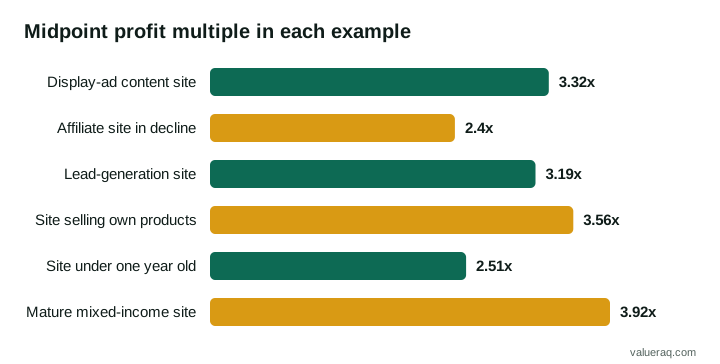
Two websites with the same profit can be worth very different amounts. In the examples below, the multiple applied to yearly profit runs from 2.40 for an affiliate site in decline to 3.92 for a mature site with several income sources. That gap is the difference between about 29 months of profit and about 47 months of profit for the same dollar earned.
Every figure on this page comes from the website valuation tool using VALUERAQ's published default assumptions. They are estimates, not appraisals and not records of real sales.
Quick answer: website value by monthly profit
If you only want a ballpark, find your average monthly profit in the table. The figures use VALUERAQ's default range of 2.5 to 4.0 times yearly profit (30 to 48 times monthly profit), before any adjustment for age, growth, workload or traffic risk.
| Monthly profit | Yearly profit | Low (2.5×) | Midpoint (3.2×) | High (4.0×) |
|---|---|---|---|---|
| $500 | $6,000 | $15,000 | $19,200 | $24,000 |
| $1,000 | $12,000 | $30,000 | $38,400 | $48,000 |
| $2,500 | $30,000 | $75,000 | $96,000 | $120,000 |
| $5,000 | $60,000 | $150,000 | $192,000 | $240,000 |
| $10,000 | $120,000 | $300,000 | $384,000 | $480,000 |
"Profit" means what is left after every business cost but before you pay yourself. A site with revenue but no profit is not on this table; see example 7 below.
For a figure that reflects your own site, enter your numbers in the website worth calculator. It takes about a minute and needs no sign-up.
The method in three lines
- Yearly profit = average monthly net profit × 12. Profit here means SDE: revenue minus all costs, before the owner pays themselves.
- Multiple = a default range of 2.5 (low), 3.2 (midpoint) and 4.0 (high) for websites, moved up or down by fixed rules.
- Value = yearly profit × multiple, shown as a low, midpoint and high figure.
Valuing a business from a multiple of its earnings is one form of what the U.S. Small Business Administration calls the market approach, which "compares your business to other similar businesses that have recently sold." The SBA lists it beside an income approach and an assets approach. For small websites the earnings multiple is the usual starting point because it needs only figures the owner already has. The full step-by-step method is in the website valuation guide; this page shows it applied.
What moves the multiple
The tool adjusts the multiple with five rules for a website. Each rule adds or subtracts a percentage, and the percentages are multiplied together. The total adjustment can't go below 0.5 or above 1.4.
| Factor | What lowers the multiple | What raises it |
|---|---|---|
| Business age | Under 1 year: −20%. 1 to 2 years: −10% | 4 years or more: +5% |
| Revenue trend, last 12 months | Down more than 20%: −25%. Down 5% to 20%: −12% | Up 5% to 25%: +8%. Up 25% to 75%: +15%. Above 75%: +20% |
| Owner hours a week | Over 40: −10%. 20 to 40: −5% | Under 10: +5% |
| Share of traffic from the largest source | Over 80%: −12%. 60% to 80%: −6% | No bonus; 60% or less is the baseline |
| How the site earns | Affiliate: −3% | Own products or mixed income: +3% |
These are VALUERAQ editorial assumptions, published in the methodology. They are not averages from a sales database.
Why the rules of thumb you read online disagree
Search this question and you'll see "20 to 50 times monthly revenue", "24 to 36 times monthly", "2 to 3 times yearly income" and more, sometimes on the same page. Most of the gap comes from three mix-ups, not from real disagreement:
- Monthly or yearly. 36 times monthly profit is the same as 3 times yearly profit. Divide a monthly multiple by 12 to compare.
- Revenue or profit. A multiple of revenue looks lower for the same price, because revenue is bigger than profit. A site with $5,000 revenue and $2,000 profit priced at $72,000 is "14 times monthly revenue" and "36 times monthly profit" at once. Buyers of content and affiliate sites price on profit.
- Which site. A range covers everything from a two-year-old single-source site to a nine-year-old brand. Your site sits somewhere inside it, and the adjustments above decide where.
Once you convert every quote to "times yearly profit", most of them land between about 2 and 4.
Seven worked examples
1. A display-ad content site
A four-year-old recipe site earns $3,200 a month from display ads and keeps $2,400 after hosting and freelance writers. Revenue is up 3% on last year. The owner spends 8 hours a week on it. Google search sends 70% of visits.
- Yearly profit: $2,400 × 12 = $28,800
- Adjustments: age +5%, trend 0%, owner hours +5%, one source at 70% −6%, display ads 0%
- Adjustment factor: 1.05 × 1.05 × 0.94 = 1.036
- Multiple: 2.59 low, 3.32 midpoint, 4.15 high
- Value: $75,000 to $119,000, midpoint $96,000
2. An affiliate site in decline
A three-year-old product review site earns $6,000 a month in affiliate commission and keeps $5,000. Revenue is down 10% on last year. The owner works 12 hours a week. Search sends 85% of visits.
- Yearly profit: $5,000 × 12 = $60,000
- Adjustments: age 0%, trend −12%, owner hours 0%, one source at 85% −12%, affiliate −3%
- Adjustment factor: 0.88 × 0.88 × 0.97 = 0.751
- Multiple: 1.88 low, 2.40 midpoint, 3.00 high
- Value: $113,000 to $180,000, midpoint $144,000
This site earns more than twice as much as the recipe site, yet its midpoint is only 1.5 times higher. Falling revenue and heavy reliance on one traffic source cost it about a quarter of its multiple.
3. A lead-generation site
A five-year-old site collects enquiries for home-improvement contractors and sells them for $9,000 a month. Profit is $5,500. Revenue is flat. The owner spends 25 hours a week on sales calls and account management. No traffic source is above 55%.
- Yearly profit: $5,500 × 12 = $66,000
- Adjustments: age +5%, trend 0%, owner hours −5%, concentration 0%, lead generation 0%
- Adjustment factor: 1.05 × 0.95 = 0.997
- Multiple: 2.49 low, 3.19 midpoint, 3.99 high
- Value: $165,000 to $263,000, midpoint $211,000
The age bonus is cancelled by the owner's workload. A buyer has to do those 25 hours or pay someone to.
4. A site that sells its own products
A site that is two and a half years old sells its own digital templates. Revenue is $7,000 a month and profit is $4,200. Revenue is up 20%. The owner works 15 hours a week. The largest traffic source is 45%.
- Yearly profit: $4,200 × 12 = $50,400
- Adjustments: age 0%, trend +8%, owner hours 0%, concentration 0%, own products +3%
- Adjustment factor: 1.08 × 1.03 = 1.112
- Multiple: 2.78 low, 3.56 midpoint, 4.45 high
- Value: $140,000 to $224,000, midpoint $179,000
5. A site under one year old
A ten-month-old affiliate site already earns $1,200 a month and keeps $900. Revenue is up 60% on its early months. The owner works 15 hours a week. Search sends 90% of visits.
- Yearly profit: $900 × 12 = $10,800
- Adjustments: age −20%, trend +15%, owner hours 0%, one source at 90% −12%, affiliate −3%
- Adjustment factor: 0.80 × 1.15 × 0.88 × 0.97 = 0.785
- Multiple: 1.96 low, 2.51 midpoint, 3.14 high
- Value: $21,000 to $34,000, midpoint $27,000
Fast growth doesn't make up for a short history. With less than a year of records, a buyer can't rule out a seasonal peak or a one-off spike, so this result carries more uncertainty than the others.
6. A mature site with mixed income
A nine-year-old hobby site earns $15,000 a month from ads, affiliate links and a paid membership, and keeps $11,000. Revenue is up 8%. The owner works 5 hours a week because editors run it day to day. The largest traffic source is 40%.
- Yearly profit: $11,000 × 12 = $132,000
- Adjustments: age +5%, trend +8%, owner hours +5%, concentration 0%, mixed income +3%
- Adjustment factor: 1.05 × 1.08 × 1.05 × 1.03 = 1.226
- Multiple: 3.07 low, 3.92 midpoint, 4.91 high
- Value: $405,000 to $648,000, midpoint $518,000
7. A site that loses money
A two-year-old site earns $2,000 a month and costs $2,200 a month to run. The tool returns no estimate. A multiple of earnings can't value a business with no earnings; a loss multiplied by anything is still a loss.
Sites like this do sell, but on other grounds: the domain, the content, the email list or the traffic. Those are judged case by case, and no calculator can do it reliably. If your site is close to break-even, the more useful question is what it would earn after cutting costs a buyer wouldn't need.
The examples side by side
| Example | Yearly profit | Midpoint multiple | Midpoint value |
|---|---|---|---|
| 1. Display-ad content site | $28,800 | 3.32 | $96,000 |
| 2. Affiliate site in decline | $60,000 | 2.40 | $144,000 |
| 3. Lead-generation site | $66,000 | 3.19 | $211,000 |
| 4. Site selling own products | $50,400 | 3.56 | $179,000 |
| 5. Site under one year old | $10,800 | 2.51 | $27,000 |
| 6. Mature mixed-income site | $132,000 | 3.92 | $518,000 |
| 7. Loss-making site | −$2,400 | None | No estimate |
What a calculator can't see
A multiple is quick, and that is also its weakness. The Corporate Finance Institute notes that multiples reduce complex information to a single value and consider a company's position only for a certain period. For a website, the things a multiple misses are usually these:
- Quality of the records. Profit you can prove from ad network and bank statements is worth more to a buyer than profit in a spreadsheet.
- Where the traffic really comes from. Two sites at "70% from search" differ a great deal if one relies on three pages and the other on three hundred.
- Costs left out. Unpaid family help, a personal software licence or the owner's own writing all become real costs for a buyer.
- One-off spikes. A single viral month lifts a 12-month average without lifting what the site will earn next year.
Treat the result as a starting range for a conversation, then check it against what buyers ask about in due diligence.
Why free "website worth" checkers give strange numbers
Tools that ask only for a domain name can't see your profit. They guess traffic from public signals and apply an assumed earning rate per visitor, so two sites with the same traffic get the same figure even if one earns ten times more. Treat their output as a curiosity, not a value. Any estimate a buyer would take seriously starts from profit you can prove.
What lowers a website's value
Buyers look for these problems first, and each one pulls the multiple down or ends the deal:
- A troubled domain history. Check old versions of the site on the Internet Archive's Wayback Machine. A past life as a spam or adult site can carry over into search.
- Falling traffic or income. A downward 12-month trend costs more than any other single factor in the examples above.
- One traffic source. Above 80% from a single source, one search update or policy change can halve the income.
- Income that depends on you. Guest-post sales, consulting or anything tied to your name may not transfer to a buyer.
- Records that can't be checked. Profit without ad-network, affiliate or bank statements behind it is often discounted heavily or ignored.
How to raise the value before you sell
The same factors work in reverse. In the order most owners can act on them:
- Clean up the records. Twelve months of profit you can prove from source statements.
- Cut your own hours. Write down how each task is done so a buyer, or a freelancer, can take over.
- Add a second traffic source. An email list or a social channel reduces the single-source discount.
- Add a second income stream. A site with mixed income gets a small bonus in the method above.
- Fix technical problems. Broken pages, slow loading and errors are cheap to fix and easy for buyers to spot.
The guide to increasing website value before selling covers each step in more depth.
How to get your own number
- Add up net profit for the last 12 months and divide by 12. Leave your own pay out of the costs.
- Compare the latest three months of revenue with the same three months a year ago to get the trend.
- Check your analytics for the share of visits from your largest source.
- Count the hours you really spend each week.
- Enter the figures in the website worth calculator for a quick answer, or in the full website valuation tool to see every adjustment.
If you plan to sell, the guide to selling a website covers what to prepare.
Frequently asked questions
How much is a website that makes $1,000 a month worth?
If $1,000 is monthly profit, yearly profit is $12,000. On VALUERAQ's default range of 2.5 to 4.0 times yearly profit that is $30,000 to $48,000 before adjustments. A young site or one that relies on a single traffic source would come out lower, and an older, growing site higher.
Is a website valued on revenue or on profit?
Content, affiliate, ad-funded and lead-generation websites are valued on profit, because costs vary so much from one site to the next. Revenue multiples are mainly used for subscription software. The guide to revenue and profit multiples explains when each applies.
Why do some people quote a monthly multiple, such as 35 times?
It is the same idea in different units. A multiple of 35 times monthly profit equals about 2.9 times yearly profit. To convert, divide a monthly multiple by 12.
Can I value a website that has traffic but no income?
Not with an earnings multiple. A site with no profit is priced on its assets, such as the domain, content and audience, and that depends on what a particular buyer would do with them.
What is a website with 10,000 visitors a month worth?
Visitors alone don't set the value; profit does. Two sites with 10,000 monthly visitors can be worth very different amounts if one earns from a few well-paid affiliate offers and the other from low-paying display ads. Work out what the traffic earns after costs, then use the table at the top of this page.
What is the cost approach, and when is it used?
The cost approach values a site at what it would cost to build again: content, design, development and the time to reach its current traffic. Buyers use it mainly for sites with little or no profit, where an earnings multiple gives nothing to work with. It usually gives a lower figure than a profitable site would get from a multiple.
How accurate is a website worth calculator?
It is as accurate as the figures entered and no more. It applies fixed rules to your numbers and can't check your records, your traffic quality or the market on a given day. Use it to set expectations, not to set a final price.
Sources
- U.S. Small Business Administration, Close or sell your business: the income, market and assets approaches to valuation.
- Corporate Finance Institute, Multiples analysis: what multiples are and their limits.
- VALUERAQ, Valuation methodology: the default multiples and every adjustment rule used in the examples.
- Internet Archive, Wayback Machine: past versions of a website, used to check a domain's history.
Next step
Enter your own figures and get a low, midpoint and high value in under a minute.
Written by VALUERAQ Editorial Team. The VALUERAQ editorial team writes and maintains the platform's guides, methodology and glossary. Every guide is reviewed against the published methodology before publication and when the methodology changes.