Key takeaway
A valuation is only as good as the profit figure it multiplies. Every dollar of yearly profit that turns out to be overstated costs a buyer several dollars of price: at 3 times yearly profit, a $10,000 overstatement is $30,000 overpaid. Financial due diligence exists to find that gap before you sign.
This checklist covers the money only. For traffic, code, accounts, legal transfer and the rest, see the full due diligence guide. The U.S. Small Business Administration recommends a "thorough, objective investigation" of any business you plan to buy, with an attorney and an accountant; this list helps you prepare for that work and ask better questions.
Before you start
Ask the seller for these at the start, so you can see how organised the business is:
- Profit and loss statements for the last 24 months, by month.
- Read-only access, or screen-shared exports, from every place money comes in: payment processor, ad network, affiliate dashboards, marketplace seller account, billing system.
- Bank statements for the account the business is paid into, for the same months.
- Tax returns for the last two years. The SBA lists financial statements and tax returns among the documents to evaluate.
- A list of add-backs with the evidence for each.
- A list of every recurring cost: hosting, software, contractors, ad spend, fees.
Sign a confidentiality agreement first. A seller who refuses to share any of this after an agreement is in place is telling you something.
Step 1: Prove the revenue
The aim is to see revenue at its source, not as typed into a spreadsheet.
- [ ] Twelve or more months of revenue, from the systems that generate it. Trailing twelve months is the usual basis.
- [ ] Exports match the profit and loss statement month by month. Small timing differences are normal; unexplained gaps are not.
- [ ] Refunds and chargebacks are taken off. Gross sales are not revenue.
- [ ] One-off income is separated. A single large sponsorship or bulk order should not be treated as a monthly rate.
- [ ] Revenue by source. What share comes from each program, product, customer or channel? Anything above roughly a third from one source deserves a closer look.
- [ ] The trend inside the year. Compare the last three months with the first three. A falling trend means the 12-month figure overstates what you will receive.
- [ ] Run rate claims checked. If the seller quotes one recent month multiplied by 12, ask why that month is typical. See run rate.
Red flags: screenshots instead of exports; a payment account in someone else's name; revenue that jumps just before the sale; reluctance to show a particular month.
Step 2: Test every cost
Costs are where profit is most often overstated, usually by leaving things out rather than inventing them.
- [ ] Every recurring cost is listed, including tools paid on a personal card.
- [ ] Contractors and freelancers are named, with what they cost and whether they will stay.
- [ ] Advertising spend is included in full. Revenue bought with ads that stop at the sale will stop too.
- [ ] Payment, platform and marketplace fees are included.
- [ ] Annual bills are spread across the year. A yearly hosting or software bill paid in one month can make the other eleven look better.
- [ ] Costs that will rise after the sale are noted, such as introductory pricing that ends or a discount tied to the seller.
- [ ] The owner's own work is costed. How many hours a week, doing what, and what would it cost to pay someone to do it?
Step 3: Challenge the add-backs
Add-backs turn reported profit into SDE, the figure most small online businesses are priced on. Each one should have evidence and should genuinely not recur.
| Add-back | Usually accepted when | Usually rejected when |
|---|---|---|
| Owner's salary | It is clearly the owner's pay | The buyer must hire someone to do the same work |
| One-off redesign or migration | It happened once and is documented | It happens every year or two |
| Personal expenses | They are clearly personal and documented | They are tools the business needs |
| Legal or accounting for a one-off event | The event is over | It is routine bookkeeping |
| Depreciation and amortization | They are accounting entries | — |
Then recalculate SDE yourself with only the add-backs you accept. The difference between your SDE and the seller's is often the most important number in the whole process.
Step 4: Match it to the bank
Exports and statements can both be edited. Bank statements are much harder to fake, and they show what actually arrived.
- [ ] Payouts from each source appear in the bank on the expected dates and in the expected amounts.
- [ ] Totals by month from the bank are close to the revenue on the profit and loss statement, after fees and timing.
- [ ] No unexplained money in or out. Transfers between the owner's accounts should be labelled.
- [ ] The account belongs to the business or the seller, not a third party.
If the bank doesn't support the revenue, stop and ask why before anything else.
Step 5: Check what could follow you
In an asset sale, the buyer takes the business and the seller keeps the company and its debts. That protects you from most old liabilities, but not all.
- [ ] Prepaid customers. Annual subscriptions, gift cards or orders paid but not yet delivered are obligations you inherit. Agree how they are handled in the price.
- [ ] Stock. Count it, value it at cost, and check it matches what is being paid for.
- [ ] Contracts that transfer. Supplier terms, sponsor agreements and software licences: can they move to you, and on what terms?
- [ ] Sales tax or VAT. If the business sells to customers in many places, ask how tax has been collected. Questions here are for your accountant; rules differ by country and state.
- [ ] Disputes and claims. Open chargebacks, refund requests, platform warnings or legal letters.
Questions to ask the seller directly
Documents answer most questions, but a short call answers the rest faster. Ask, and write down the answers:
- What was the best month in the last year, and why?
- What was the worst month, and why?
- Which costs would you cut if you kept the business, and which would you add?
- Which income sources have changed their terms in the last two years?
- What do you do each week that nobody else does?
- Is anything about to change: a price rise, a lost customer, a platform policy?
Compare the answers with the figures. A seller whose story matches the bank statements is far easier to buy from than one whose story keeps changing.
Step 6: Put the results into the price
Once the checks are done, write down three numbers:
- Verified yearly profit, using only revenue you have proved, every real cost, and the add-backs you accept.
- The multiple that profit deserves, given age, trend, owner workload and concentration. The business multiple calculator shows what the asking price implies.
- The price that follows, and the terms that protect you: an escrow service, part of the price held back for a period, or part paid later if results hold.
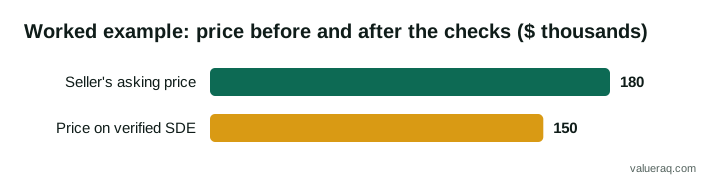
A worked example: a seller lists a site at $180,000 on stated SDE of $60,000, a multiple of 3.0.
- Due diligence finds $6,000 a year of ad spend left out of costs and rejects a $4,000 "one-off" redesign that happens every year.
- Verified SDE: $60,000 − $6,000 − $4,000 = $50,000.
- At the same multiple of 3.0, the price becomes $150,000. The $30,000 difference is the value of the checks.
Red flags and how to check each
| Red flag | How to check it | What it may mean |
|---|---|---|
| Screenshots instead of exports | Ask for read-only access or a screen-shared export of the same period | The figures may have been edited |
| Payouts that do not appear in the bank | Match each payout to a deposit by date and amount | Revenue may be overstated or paid elsewhere |
| Revenue jumps just before listing | Compare the last three months with the same months a year earlier | A short-term push to lift the price |
| Refunds or chargebacks far above normal | Read the refund and dispute reports for each month | Product, quality or fraud problems |
| One source brings most of the income | Split revenue by source and customer | Losing it could remove most of the profit |
| Costs that look too low | List every tool, contractor and ad account and compare with the P&L | Costs left out or paid personally |
| Add-backs that repeat every year | Check whether the same item appears in prior years | Not one-off, so profit is overstated |
| Account owned by a third party | Check the name on the payment and bank accounts | The accounts may not transfer |
Record each finding with the evidence you saw. A short log is easier to negotiate from than memory.
What to do with your findings
| Finding | Reasonable response |
|---|---|
| A small gap with a clear explanation | Note it and continue |
| Profit lower than stated after your own SDE recalculation | Re-price using your verified figure (see the worked example above) |
| Income you cannot verify | Treat it as zero, or ask for it to be paid later if it appears |
| Prepaid customers or open disputes | Agree in writing how they are handled in the price |
| A risk that could repeat, such as one dominant source | Ask for part of the price to be held back or paid later |
| A gap the seller cannot explain, or refusal to show records | Walk away |
A written offer that quotes your verified figures is hard to argue with, and a seller who answers calmly is usually a seller worth buying from.
How long it takes
For a small online business with organised records, the financial checks can be done in one to two weeks of part-time work. Disorganised records take longer and are themselves information about how the business is run. Agree an exclusivity period with the seller so you aren't racing another buyer while you check.
Frequently asked questions
What documents are needed for financial due diligence?
Monthly profit and loss statements for at least 12 months, exports from every revenue source, bank statements for the same period, tax returns, a list of recurring costs and a documented list of add-backs.
How many months of figures should I check?
At least 12, so every season is included. Twenty-four is better for spotting a trend. For a business less than a year old, check every month it has and treat the figures with more caution.
Can I do financial due diligence myself?
You can do much of the checking on this list yourself, and it will make professional help faster and cheaper. The SBA suggests involving an attorney and an accountant, especially for tax, contracts and the purchase agreement.
What is the most common problem found?
Overstated profit, usually from costs left out or add-backs that recur. That is why recalculating SDE yourself matters more than any single document.
Should I walk away if I find a problem?
Not always. Many problems become a lower price or better terms. Walk away when the seller can't explain a gap between the bank and the reported revenue, or refuses to let you check.
Which findings are deal-breakers?
Unexplained differences between the bank and the reported revenue, accounts that are not in the seller's name, and a refusal to let you check records. Most other findings can be handled through price or terms.
Sources
- U.S. Small Business Administration, Buy an existing business or franchise: investigation, documents to review and professional help.
- VALUERAQ, Valuation methodology: how SDE and multiples are used in the tools.
Next step
Once the profit is verified, check what multiple the asking price implies.
Written by VALUERAQ Editorial Team. The VALUERAQ editorial team writes and maintains the platform's guides, methodology and glossary. Every guide is reviewed against the published methodology before publication and when the methodology changes.