Key takeaway
A buyer pays for revenue they can see, not revenue you describe. Proof means 12 months or more of records from the place the money first arrives, matched to your bank deposits, laid out month by month on one sheet. Revenue you cannot prove is usually priced at zero, or argued down, so the work is worth doing before you list.
This guide is written for sellers. It shows what to gather, how to reconcile it, how to handle each type of income, and what to do when the numbers do not match. If you are on the buying side, read how to verify website revenue instead. All figures in the worked example are made up for illustration. The multiple used comes from VALUERAQ's published default range, described in the methodology, and is an assumption, not market data.
Why buyers ask for proof
Almost every listing is a claim until it is checked. The buyer is about to pay a multiple of your yearly profit, so a small overstatement in monthly revenue becomes a large overstatement in price. Buyers know this, and the more careful ones will not move forward on a screenshot.
The U.S. Small Business Administration advises anyone buying a business to carry out a "thorough, objective investigation". You can treat that as a description of what you will face. A seller who arrives with the investigation already half done tends to get faster, cleaner offers, because the buyer has less to dig for and less reason to suspect something is hidden.
There is a second reason. Proof protects you. When a figure is written down with its source, a later dispute about what you said before the sale has an answer on paper.
What counts as proof (and what does not)
Not all evidence is equal. The closer a record is to the original system, and the harder it is to edit, the more weight it carries.
| Evidence | Strength | Why |
|---|---|---|
| Read-only access to the payment processor, ad network or affiliate dashboard | Strongest | The buyer sees the live source and no one can edit it |
| Original statements or payout reports downloaded straight from the source | Strong | Dated, named and issued by a third party |
| Bank statements showing the matching deposits | Strong | Proves the money arrived, not just that it was reported |
| Tax returns or financial statements prepared by an accountant | Strong, for the periods covered | Independent review, filed with an authority |
| A spreadsheet you built from the above | Useful as a map | Helps the buyer navigate, but is only as good as the records behind it |
| A screenshot of a dashboard | Weak | Easy to edit and shows one moment |
| A verbal figure or a number in a listing | A claim | Needs everything above to back it up |
The pattern to remember: a spreadsheet and a screenshot summarize proof, they are not proof. Always keep the originals ready to hand over.
The six-step proof pack
Step 1: Choose your period
Pick the last 12 full months, and add more if you have them. A full year covers every season, which matters if income peaks around certain months. Our guide on how many months of data buyers want explains when 24 months helps. Use calendar months and keep the same period for every source, so the totals line up.
Step 2: List every income source
Write down every place money comes from, including the small ones. A typical content or ecommerce business might have a payment processor, an ad network, one or more affiliate programs, a sponsorship, and sometimes a marketplace payout. Missing a source now means losing it from the price later, because a buyer will not count income that appears for the first time during due diligence.
Step 3: Download the source records
For each source, export the monthly payout or earnings report for the whole period. Save the original file, with its original name, and do not edit it. Where a platform allows it, create a read-only login or a read-only user for the buyer to use later, once they have signed a non-disclosure agreement.
Step 4: Match each payout to a bank deposit
Take each payout and find the matching deposit in your bank statement. Amounts should agree to the cent, and dates should fall within a few days. Mark every pair. When a payout is split, held or delayed, write one line explaining why. A short note now saves a long email thread later.
Step 5: Build one reconciliation sheet
Create a single sheet with one row per month and one column per source, plus a column for the bank deposits and one for the difference. This is the page the buyer will read first. A layout that works:
| Month | Payments | Ads | Affiliate | Total reported | Bank deposits | Difference |
|---|---|---|---|---|---|---|
| Month 1 | $3,600 | $1,500 | $600 | $5,700 | $5,700 | $0 |
| Month 2 | $3,600 | $1,500 | $600 | $5,700 | $5,700 | $0 |
| Month 3 | $3,600 | $1,500 | $600 | $5,700 | $5,700 | $0 |
Use real figures, not rounded ones, and continue for all 12 months. Add a total row at the bottom.
Step 6: Explain the exceptions
Any month that sits well above or below the others needs a one-line reason: a promotion, a lost affiliate program, a refund wave, a one-off sponsorship. Buyers are not alarmed by explained variation. They are alarmed by silence.
A worked example
A seller lists a site and states revenue of $6,000 a month, which is $6,000 × 12 = $72,000 a year. The seller builds a proof pack. For a typical month the records show:
- Payment processor payouts: $3,600
- Ad network payments: $1,500
- Affiliate statements: $600
- Other income with no statement: $300
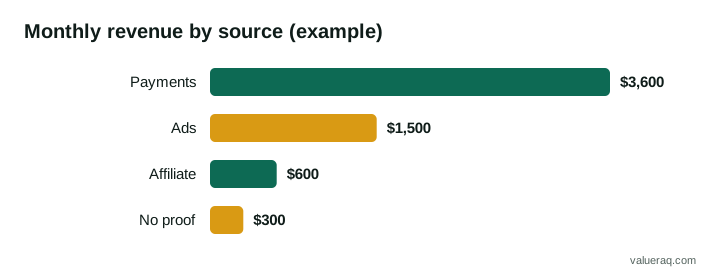
Add up the three documented sources: $3,600 + $1,500 + $600 = $5,700 a month. The bank deposits agree. The "other income" of $300 a month has no statement, no invoice and no deposit that can be tied to it.
- Proven revenue: $5,700 × 12 = $68,400 a year.
- Unproven revenue: $300 × 12 = $3,600 a year.
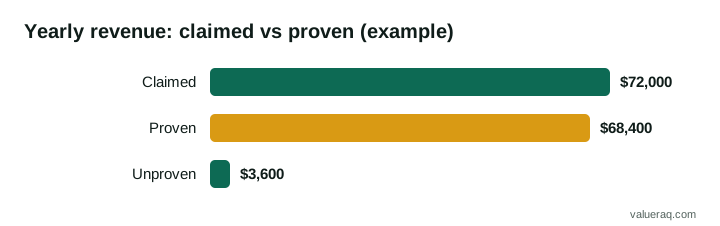
The gap looks small, at 5% of the claim ($3,600 ÷ $72,000). But a buyer values profit, not revenue, and if every unproven dollar were profit, a buyer using VALUERAQ's default midpoint of 3.2 times profit for a website would be adding $3,600 × 3.2 = $11,520 to the price for income nobody has shown. A careful buyer will not pay it.
The seller has three choices. Chase down the missing statement, which might be a cash-in-hand client or a payment app that was never connected. Remove the $300 from the listing and price on the proven figure. Or keep it in as clearly labeled "unverified" income and accept that buyers may discount it to nothing. All three are better than leaving it in the headline figure and having it found in due diligence.
Proof by income type
Each kind of income leaves a different trail. Use this table to know where to look.
| Income type | Best source | Matching evidence | Common trap |
|---|---|---|---|
| Card or online store sales | Payment processor payout reports | Bank deposits | Mixing gross sales with net payouts after fees and refunds |
| Display ads | Ad network payment history | Bank deposits | Counting estimated earnings that have not been paid yet |
| Affiliate commissions | Each program's earnings statement | Bank deposits or network payouts | Counting pending commissions that may be reversed |
| Subscriptions | Billing system report of active subscribers | Payment processor payouts | Counting MRR from customers who have canceled |
| Sponsorships and one-off deals | Signed agreement and invoice | Bank deposit | Presenting a single payment as repeating income |
| Services or consulting | Invoices | Bank deposits | Income that depends on you personally |
Two points matter most. First, use cash received, not income that is pending or estimated. Second, tell the buyer which income repeats and which does not, because a recurring revenue stream and a one-off payment are priced very differently.
From revenue to profit
Revenue proof is the first half. Buyers who value on earnings also need proof of costs, because the multiple applies to profit. Gather invoices, card statements and subscriptions for every expense you intend to claim. Be especially careful with add-backs, which are personal or one-off costs you ask the buyer to ignore. BizBuySell notes that some add-backs can unrealistically overvalue the company. Each one should have a receipt and a plain reason. The how to calculate SDE guide walks through the arithmetic.
When your records do not match
Records do not always agree, and that is fixable if you handle it openly.
- Timing differences. A payout may be reported in one month and deposited in the next. Show both dates and keep the period consistent.
- Fees and refunds. Decide whether you report gross sales or net payouts, state which, and use the same basis throughout.
- Missing history. If a platform deleted old statements, ask its support for a copy, and show bank deposits for the gap.
- Changed accounts. If you moved from one processor to another, include both sets of records and mark the switch date.
- Cash or off-platform income. Without documents, treat it as unproven and price accordingly.
Never alter a record to make the totals agree. A visible, explained difference costs you little. A discovered edit can cost you the sale.
Sharing your proof safely
Send the reconciliation sheet first, and give access to the underlying records only when the buyer is serious and has signed an NDA. The data room checklist explains how to share in stages, and what documents buyers ask for lists the rest of the pack. Remove customer personal details unless they are needed, and give read-only access wherever you can, so nothing can be changed by mistake. On VALUERAQ, sellers can ask for a revenue verified status on a listing, which means our team has compared the evidence they provide with the stated revenue. It is a check on the evidence supplied, not a guarantee of future results, and a buyer should still check the records before paying.
A pre-listing checklist
- Twelve full months of source records, saved unedited
- Every income source listed, including the small ones
- Each payout matched to a bank deposit
- One reconciliation sheet, with totals and differences
- A one-line note for every unusual month
- Recurring and one-off income separated
- Expense invoices for every cost and add-back
- Read-only access ready to grant after an NDA
- A headline revenue figure that equals proven revenue
Frequently asked questions
Is a screenshot enough to prove my revenue?
No. A screenshot is easy to edit and shows one moment in time. Use it as an illustration only, and back it up with source statements and bank deposits that a buyer can check.
How far back should the records go?
At least the last 12 full months, so every season is covered. If the business is younger than that, show everything you have and say so plainly. Expect a buyer to pay less for a shorter history.
Do I need an accountant to prepare proof of revenue?
You can build the reconciliation yourself if your records are tidy. An accountant helps when income comes from many sources, when you have changed systems, or when the price is large. Their review also makes your figures easier for a buyer to trust.
What if part of my income has no paperwork?
List it separately and label it unverified. Most buyers will price it at zero. If you can recover statements or invoices later, add them and the income can return to the headline figure.
Should I show my tax returns?
Buyers often ask for them later in the process, once they are serious. They are private, so share them only after an NDA, and ask an accountant what applies in your situation.
Sources
- U.S. Small Business Administration, Buy an existing business or franchise.
- BizBuySell Learning Center, Add-Backs for Seller's Discretionary Earnings.
Next step
Once your revenue is proven, enter it into the free Website Valuation Tool to see the range a buyer is likely to work from.
Written by VALUERAQ Editorial Team. The VALUERAQ editorial team writes and maintains the platform's guides, methodology and glossary. Every guide is reviewed against the published methodology before publication and when the methodology changes.