Key takeaway
A Shopify store sells when a buyer can see, with evidence, how much profit it makes, what comes with it and how easily they can run it. The price is usually yearly net profit × a multiple, plus sellable stock at cost. Most of the work in a sale is not the listing. It is the records and the clean handover on either side of it.
This guide walks through the sale in order, from preparation to the day the buyer takes over. It uses worked numbers from VALUERAQ's published default assumptions, which are estimates and not records of real sales. For how the value itself is built, read how to value a Shopify store.
Step 1: Decide whether and when to sell
Sellers who prepare for a few months usually have a smoother sale than those who list in a hurry. Look at three things first.
- Trend. A store whose profit is steady or rising is easier to sell than one that has fallen for several quarters. A buyer will look at the last 12 months month by month.
- Seasonality. If most of your profit comes in a few months, say so, and show a full year so the buyer sees the whole cycle.
- Your role. If the store only runs because you are in it every day, the buyer is paying for your time as well as the business. Write down what you do each week and which of those jobs can be handed to someone else.
Step 2: Pull together 12 months of records
Buyers want to confirm that the profit is real. The U.S. Small Business Administration advises anyone buying a business to carry out a "thorough, objective investigation", and lists financial statements, tax returns, contracts, cash flow and inventory among the things to check. Prepare these before you list:
| Record | What it shows |
|---|---|
| Monthly profit and loss for 12 to 24 months | Sales, product cost, shipping, fees, ads and other costs |
| Sales report by channel | How much comes from search, ads, email, social and marketplaces |
| Payment processor payouts matched to bank deposits | That the revenue reached your account |
| Refund and chargeback history | Product quality and customer satisfaction |
| Stock list with cost per item | What is sellable, slow-moving or obsolete |
| Supplier agreements and prices | Whether the supply is secure and transferable |
| Advertising account history | What the store spends to win each order |
The longer list is in what documents buyers ask for.
Step 3: Work out the profit buyers will use
Buyers of small stores price the business on SDE, the profit left after all running costs and before the owner's pay. Build it from the last 12 months:
- Start with net sales after refunds and discounts.
- Subtract the cost of goods, shipping you paid, payment and platform fees, and advertising.
- Subtract other running costs such as software, contractors and customer service.
- Add back the owner's own pay and costs that are truly personal or one-off.
Be strict with the add-backs. BizBuySell warns that "some add-backs can unrealistically overvalue the company", and a buyer will ask for proof of each. A cost that repeats every year is not a one-off.
Step 4: Clean up the store, the stock and the accounts
A tidy store is quicker to check and easier to trust.
- Stock. Count it. Separate items that sell regularly from slow-moving or damaged stock, because buyers rarely pay full cost for items that may not sell.
- Suppliers. Make sure you can introduce the buyer to each supplier, and that any open orders and unpaid invoices are listed.
- Accounts. List every account the store depends on: the domain, the store platform, the payment processor, email tools, advertising accounts, social profiles and any apps. Know which can be handed over and which the buyer must open themselves.
- Loose ends. Settle open customer disputes, and remove personal expenses from the store's books.
Step 5: Price the store
The working formula is value = yearly net profit × multiple, plus sellable stock at cost. VALUERAQ's default range for an ecommerce business is 2.0 to 3.5 times yearly profit, with 2.7 as the midpoint. It is a published platform assumption, not market data. The reasoning is in the methodology.
A worked example
A store earns $5,000 a month in profit after all costs, before the owner is paid. It holds $20,000 of stock at cost, of which $3,000 is slow-moving.
- Yearly profit: $5,000 × 12 = $60,000.
- At 2.0 times: $60,000 × 2.0 = $120,000.
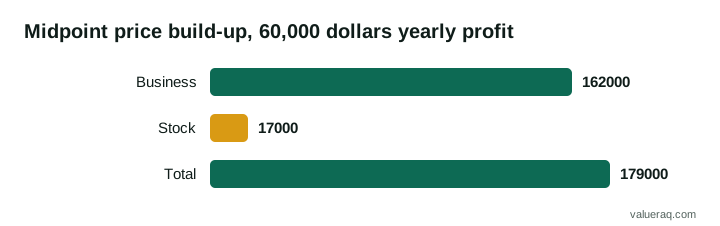
- At 2.7 times: $60,000 × 2.7 = $162,000.
- At 3.5 times: $60,000 × 3.5 = $210,000.
- Sellable stock: $20,000 − $3,000 = $17,000.
- Midpoint price with stock: $162,000 + $17,000 = $179,000.
Where the store lands inside the range depends on fulfillment method, reliance on one sales channel, store age and your weekly hours. Run the Ecommerce Valuation Tool to see each adjustment and its reason. Whatever number you choose, be ready to explain it, since buyers compare an asking price against the profit behind it. The resulting range is an estimate, not a promise of what a buyer will pay.
Step 6: Write the listing
Lead with facts a buyer can check: yearly profit and revenue, the trend, the sales channels and how much time the store takes. Say what is included, why you are selling, and the known risks. Keep the website address and customer details private until you have spoken to a serious buyer. The short version is in how to write a business-for-sale listing.
On VALUERAQ listing a business is free and every listing is reviewed against the marketplace rules before it goes live. You can also request ownership and revenue verification to help buyers trust the figures.
Step 7: Handle buyer checks
Expect a buyer to ask for the records in step 2, for read-only access to sales and traffic reports, and for calls with you. Share information in stages: summary figures first, then detail once the buyer has made a written offer. Ask for proof of funds before you open the books.
Agree the main terms in a letter of intent: the price, what is included, how stock is counted and priced, the payment method, the handover period and any support you will give. Have a lawyer review the sale agreement. The SBA also suggests hiring an attorney and an accountant when buying or selling a business.
Step 8: Close through escrow and hand over
Use an independent escrow service so the buyer's money is held until the assets move. Read how escrow works for website sales for the sequence. VALUERAQ is not part of the sale and takes no commission, but it does not handle payment either.
Agree a handover order and a checklist: the domain, the store account, payment and shipping settings, supplier introductions, advertising and email accounts, and your documents and files. Stay available for an agreed period to answer questions, because the first weeks are when a buyer finds the gaps. Ask an accountant how the sale will be taxed before you agree a price, since the rules depend on where you live.
What to expect after the handover
The sale does not end on the closing date. Plan the first 30 days with the buyer: who answers customer messages, who places the next supplier order, and who watches the advertising accounts. Agree the support period in writing, including how many hours you will give and by what means the buyer can reach you. A clear plan protects both sides, because most disputes after a sale come from tasks that nobody was asked to do.
If you are paid partly later, for example through an earnout or seller financing, remember that part of your price now depends on how the buyer runs the store. Compare offers on the amount that is certain, not on the headline price.
Common mistakes to avoid
- Listing before the records are ready, so the first buyer question stalls the sale.
- Counting slow-moving stock at full cost.
- Adding back costs that repeat every year.
- Relying on a single sales channel without saying so.
- Promising results the buyer will get. Describe the past, not the future.
Frequently asked questions
How long does it take to sell a Shopify store?
It depends on the price, the quality of your records and how many buyers are looking. Preparing the records before you list is the step you control, and it shortens the time buyers need to check the store.
Is stock included in the asking price?
Often it is priced separately, at cost, on top of the business. Agree in writing how stock is counted and what happens if the count differs on the handover day.
Do I need an accountant or a lawyer?
It is wise to have both. An accountant can check your add-backs and explain tax, and a lawyer can review the sale agreement. VALUERAQ provides valuation tools and a marketplace, not legal or tax advice.
Can I sell a store that does not make a profit?
Yes, but it is priced differently, on assets, audience or strategic value instead of a profit multiple. Our tool values on earnings and will tell you when the profit entered is zero or negative.
Sources
- U.S. Small Business Administration: Buy an existing business or franchise
- U.S. Small Business Administration: Close or sell your business
- BizBuySell Learning Center: Add-Backs for Seller's Discretionary Earnings
- VALUERAQ's methodology for the default multiples
Next step
Enter your store's profit, fulfillment and stock into the free Ecommerce Valuation Tool to get a range you can explain to buyers.
Written by VALUERAQ Editorial Team. The VALUERAQ editorial team writes and maintains the platform's guides, methodology and glossary. Every guide is reviewed against the published methodology before publication and when the methodology changes.