
Key takeaway
A blog is worth what it earns and how safely it will keep earning. Visitors, followers and the number of posts are only useful because they explain where the profit comes from and whether it will last. Start with twelve months of real profit, apply a range of multiples, then move the range up or down for the risks a buyer will notice: one traffic source, one income stream, a declining trend, or an owner who does everything.
Why profit comes first
It is tempting to value a blog on its audience. A site with 100,000 monthly visitors sounds valuable. But two blogs with the same traffic can earn very different amounts, and a buyer is paying for the earnings, not the visits.
The U.S. Small Business Administration lists three approaches to valuation: the income approach "looks at projected revenue and accounts for potential risks", the market approach "compares your business to other similar businesses that have recently sold", and the assets approach "subtracts total business liabilities from the total value of all assets" (SBA). For a small blog the assets, such as a domain and a theme, are worth little compared with the income. That makes the income approach the natural starting point, usually in the form of a multiple of yearly profit.
Corporate Finance Institute describes multiples as using "different financial metrics from comparable companies to value a target company", and notes that the method "only considers the company's position for a certain time period" (CFI). For a blog, that is a reminder to use a full year of figures, so one lucky month does not set the price.
Step 1: Work out the profit
Add up twelve months of revenue from every source, then subtract the costs of running the site. Count the costs a new owner would actually pay: hosting, writers, tools, and paid promotion. Do not subtract the owner's own pay.
This figure is the seller's discretionary earnings, or SDE. If you need help with the add-backs, see how to calculate SDE. BizBuySell warns that "some add-backs can unrealistically overvalue the company" (BizBuySell), so include only costs you can document.
Buyers will ask for proof. Platform statements for ads, affiliate dashboards and bank deposits should agree with the figures you quote. See how to verify website revenue.
Step 2: Choose a multiple range
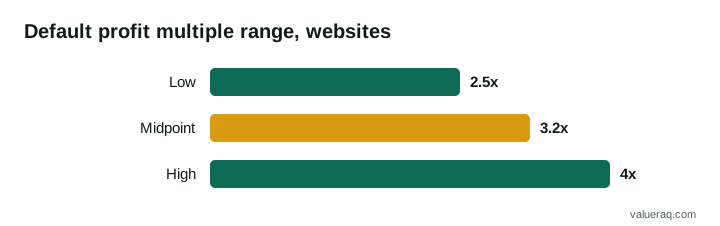
VALUERAQ's default range for an established website is 2.5× to 4× yearly profit, with a midpoint of 3.2×. That range is a platform assumption, described on the methodology page. It is not a measured market average, and a particular sale can fall outside it.
Many sellers hear prices quoted in months of profit. 3.2× yearly profit is 38.4 months of profit (3.2 × 12).
Step 3: Adjust for what is specific to a blog
The adjustments below are the ones VALUERAQ's website tool applies. Each is a percentage change to the multiple. They are published rules, not market data.
| Factor | Condition | Effect on the multiple |
|---|---|---|
| Age | Under 1 year | −20% |
| Age | 1 to under 2 years | −10% |
| Age | 2 to under 4 years | 0% |
| Age | 4 years or more | +5% |
| Revenue trend | Falling more than 20% | −25% |
| Revenue trend | Falling 5% to 20% | −12% |
| Revenue trend | Within 5% either way | 0% |
| Revenue trend | Growing over 5% to 25% | +8% |
| Largest traffic channel | Over 80% | −12% |
| Largest traffic channel | Over 60% to 80% | −6% |
| Owner time | Over 40 hours a week | −10% |
| Owner time | Over 20 to 40 hours | −5% |
| Owner time | Under 10 hours | +5% |
| Main income | Affiliate | −3% |
| Main income | Own products or mixed income | +3% |
The adjustments multiply together. For example, +5% for age and −6% for traffic concentration gives 1.05 × 0.94 = 0.987.
Traffic sources
Most blogs depend on search. If over 80% of visits come from one search engine, one ranking update could change the income. A buyer sees that as risk and pays less. A blog that also has an email list, direct visitors or several referral sources is safer. How to confirm traffic claims is covered in how to verify website traffic.
Earnings mix
Display ads pay per visit, affiliate links pay when readers buy, and products or services pay directly. An affiliate programme can change its commission or close, which is why the default rules take 3% off an affiliate-led site. A mix of sources, or an owned product, makes the earnings more dependable.
Content quality and ownership
A buyer wants to know that the posts belong to the seller. Articles written by freelancers should have clear transfer terms, and images should be licensed. Content that is out of date, thin, or copied from elsewhere is a liability, not an asset. These points do not change the formula, but they decide whether a buyer accepts the profit figure at all, and in practice affect the price negotiated.
Owner time
A blog that takes 5 hours a week to run is easier to hand over than one that takes 35. Written processes, a team of writers, and a documented publishing schedule all lower the time a new owner must find.
Worked example 1: a healthy blog
A five-year-old home-cooking blog earns $48,000 in revenue over twelve months and spends $12,000 on hosting, writers and tools, leaving $36,000 profit. Revenue is up 10% on last year. Display ads are the main income. 75% of visits come from search and the owner spends 12 hours a week.
- Yearly profit: $48,000 − $12,000 = $36,000
- Age: 5 years, +5%
- Trend: +10%, so +8%
- Traffic: 75% from one channel, −6%
- Owner time: 12 hours, 0%
- Display income: 0%
- Adjustment factor: 1.05 × 1.08 × 0.94 = 1.066
- Multiples: 2.5 × 1.066 = 2.67, 3.2 × 1.066 = 3.41, 4.0 × 1.066 = 4.26
- Value: $95,900 to $153,500, midpoint $122,800
Worked example 2: the same profit, more risk
A second blog also earns $36,000 profit, but its situation is different. It is five years old, revenue is down 10%, 90% of visits come from one search engine, and the owner works 25 hours a week.
- Age +5%, trend −12%, owner time −5%, traffic −12%, display income 0%
- Adjustment factor: 1.05 × 0.88 × 0.95 × 0.88 = 0.772
- Multiples: 2.5 × 0.772 = 1.93, 3.2 × 0.772 = 2.47, 4.0 × 0.772 = 3.09
- Value: $69,500 to $111,200, midpoint $89,000
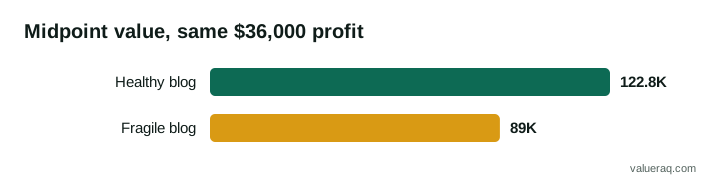
The two blogs earn the same today, but the midpoint values differ by about $33,800 ($122,800 − $89,000). The gap comes entirely from how safe the profit looks. These two blogs are illustrations, not real businesses.
What does not add much value
Several things that feel important rarely move the price on their own. A high post count does not matter if the posts earn nothing. A large social following that does not lead to income is weak support. A well-known domain name helps only when it comes with profit. If the blog loses money, use the approach in how to value a business with no profit.
How to raise the value before selling
The steps follow from the table above. Add a second traffic source such as an email list. Add a second income stream. Document how posts are commissioned, edited and published so a new owner can run the site. Keep clean records for at least twelve months. For a wider look at other site types, see the worked website examples and the general website valuation guide.
Limits of any estimate
A formula cannot see your records, the quality of your content, or what a particular buyer will pay on a given day. Treat the range as a starting point for a conversation. A real sale may come in below or above it, and the SBA recommends that an attorney review the sales agreement.
Frequently asked questions
How much is a blog making $1,000 a month worth?
If $1,000 a month is profit, yearly profit is $12,000. At the default 2.5× to 4× range, before adjustments, that is $30,000 to $48,000, with a midpoint of $38,400 (12,000 × 3.2). Adjustments for age, trend and risk can move this up or down.
Do I value a blog on revenue or profit?
Profit. Revenue is useful for checking the figures, but a blog with high costs can have low profit. See revenue vs profit multiples.
Does the domain have its own value?
A domain is part of the sale, but it is rarely a large share of the price unless it is a short, brandable name. The blog's profit usually decides the value.
Does a new blog have any value?
A blog under a year old has a short record, which lowers the multiple by 20% in the default rules. A buyer is mostly paying for potential, which is harder to price.
How often should I update my estimate?
Update it when the profit trend changes, when a traffic source changes, or before you list. Rerunning the figures each quarter is a sensible habit.
Sources
- U.S. Small Business Administration, Close or sell your business: the income, market and assets approaches.
- Corporate Finance Institute, Multiples analysis: what multiples are and their limits.
- BizBuySell Learning Center, Add-Backs for Seller's Discretionary Earnings: what add-backs are and why they must be documented.
- VALUERAQ, Valuation methodology: the default multiples and adjustment rules used in the examples.
Next step
Enter your own profit, traffic mix and owner hours to see a low, midpoint and high value for your blog.
Written by VALUERAQ Editorial Team. The VALUERAQ editorial team writes and maintains the platform's guides, methodology and glossary. Every guide is reviewed against the published methodology before publication and when the methodology changes.