Key takeaway
There is no single "good" profit margin for an online business. A good margin is one that is high enough to leave real profit after every cost, that has been steady or rising, and that makes sense for the kind of business. A content site, a software product and an online store spend their money in very different places, so their margins look different even when all three are healthy.
Margin also matters for a second reason. Small online businesses are usually priced as a multiple of profit, so for the same revenue a higher margin means a larger profit and a higher price. This guide explains the three margins people mix up, shows the arithmetic on one example store, compares the business models in plain terms and then follows margin through to the sale price.
Every dollar figure here is an invented illustration of arithmetic. None of it is market data, and none of it is an average for any industry.
The three margins people mix up
"Profit margin" is a loose phrase. It can mean any of three measures, and a seller who quotes one while a buyer is thinking of another will talk past each other.
| Margin | Formula | What it leaves out |
|---|---|---|
| Gross margin | (revenue − cost of goods sold) ÷ revenue | Everything that is not a direct cost: marketing, software, staff, overheads |
| Operating margin | operating income ÷ revenue | Interest and income taxes |
| Net profit margin | net profit ÷ revenue | Nothing: it is the bottom line |
Each one answers a different question. Gross margin asks whether the product itself is worth selling. Operating margin asks whether the whole operation, with its advertising and tools and people, makes money. Net profit margin asks what the owners keep after financing and tax.
The matching glossary pages explain the pieces: gross margin, gross profit, operating income, net profit and cost of goods sold.
A fourth margin buyers actually use
For small, owner-run businesses, buyers often work from seller's discretionary earnings (SDE), which is profit before the owner's pay and personal costs. SDE margin = SDE ÷ revenue. It is not the same as net profit margin. If a listing says "40% margin", ask which profit figure sits on top of that division.
Worked example: one store, four margins
Take a hypothetical online store with $300,000 of revenue over the last twelve months.
| Line | Amount | Margin |
|---|---|---|
| Revenue | $300,000 | |
| Cost of goods sold (products, shipping to customers) | $150,000 | |
| Gross profit | $150,000 | 50% |
| Advertising | $55,000 | |
| Software and tools | $10,000 | |
| Contractors | $20,000 | |
| Owner's pay | $30,000 | |
| Other operating costs | $5,000 | |
| Total operating expenses | $120,000 | |
| Operating income | $30,000 | 10% |
| Interest and income taxes | $12,000 | |
| Net profit | $18,000 | 6% |
The arithmetic:
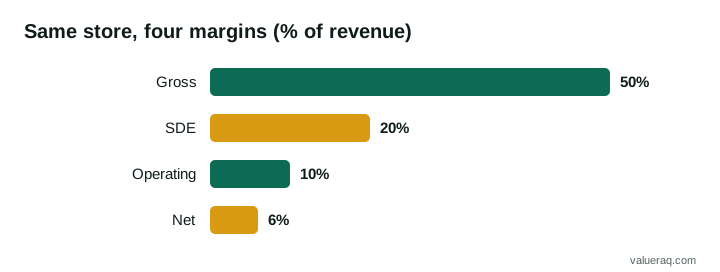
- Gross profit = $300,000 − $150,000 = $150,000. Gross margin = $150,000 ÷ $300,000 = 50%.
- Operating expenses = $55,000 + $10,000 + $20,000 + $30,000 + $5,000 = $120,000.
- Operating income = $150,000 − $120,000 = $30,000. Operating margin = $30,000 ÷ $300,000 = 10%.
- Net profit = $30,000 − $12,000 = $18,000. Net profit margin = $18,000 ÷ $300,000 = 6%.
- SDE = operating income + owner's pay = $30,000 + $30,000 = $60,000. SDE margin = $60,000 ÷ $300,000 = 20%.
One store, four honest "margins": 50%, 20%, 10% and 6%. If a seller says "20%" and a buyer hears "6%", they will not agree on a price, and neither is wrong about the arithmetic. Always ask which profit figure sits on top of the division.
Why there is no single good number
Where an online business spends its money depends on what it sells. These are typical patterns, not benchmarks.
| Business model | Where most of the cost sits | What that means for margin |
|---|---|---|
| Content site (ads, affiliate links) | Writers, hosting, tools | Little cost of goods sold, so gross margin is high; the gap between gross and net depends on content and staff costs |
| Online store | Products, shipping, advertising | Gross margin is capped by product cost; advertising often decides how much is left |
| SaaS or AI product | Hosting, support, model or API fees | Gross margin is usually high, and API or compute costs are the thing to watch in AI products |
| Newsletter | Writing time, email tools, promotion | Low direct costs; margin mostly reflects how much the owner is paid |
| Mobile app | App store fees, developers, support | Store fees come out before you see the revenue |
| Marketplace | Payment processing, support, trust and safety | Revenue may be only the fee, not the whole sale |
So a 30% net margin might be ordinary for a lean content site and unusual for a store that ships physical goods. Quoting a single "good" figure for all online businesses would mislead. Without a published source, this guide does not give industry averages. If you need a comparison, take the margins of several similar businesses from their own records.
What VALUERAQ's tools do with margin
The SaaS and AI valuation tools ask for gross margin and adjust their range on it. VALUERAQ's default adjustments are: under 50% lowers the range by 15%, 50% to under 70% lowers it by 7%, 70% to 80% leaves it unchanged, and above 80% raises it by 5%. These are defaults from the methodology, set by VALUERAQ, not market data. The profit-based tools (website, ecommerce, newsletter and app) value the business on annual profit, so margin works through the profit figure itself.
Why margin matters in a valuation
Buyers of small online businesses mostly pay a multiple of annual profit. VALUERAQ's default range for a website is 2.5x to 4.0x annual profit, with a midpoint of 3.2x (see the methodology). Revenue alone does not set the price; profit does, and margin is the bridge between them.
Profit = revenue × margin, and value ≈ profit × multiple.
Here is the same revenue at three margins, valued at VALUERAQ's website default range. Suppose three websites each earn $240,000 a year in revenue.
| Site | Margin (SDE ÷ revenue) | Annual profit | Low (2.5x) | Midpoint (3.2x) | High (4.0x) |
|---|---|---|---|---|---|
| A | 20% | $48,000 | $120,000 | $153,600 | $192,000 |
| B | 35% | $84,000 | $210,000 | $268,800 | $336,000 |
| C | 50% | $120,000 | $300,000 | $384,000 | $480,000 |
The arithmetic for site B: $240,000 × 35% = $84,000; $84,000 × 2.5 = $210,000; × 3.2 = $268,800; × 4.0 = $336,000. Site C earns two and a half times the profit of site A on identical revenue, and its midpoint value is $384,000 against $153,600.
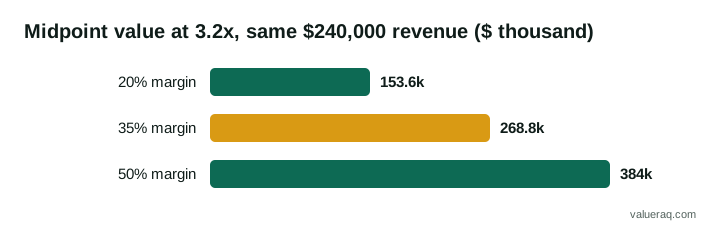
These are illustrations of the method, not predictions of a sale price. A real offer also reflects traffic sources, customer concentration, age and growth. For how the multiple and revenue relate, see revenue vs profit multiples and what multiple websites sell for.
Trend counts as much as level
A buyer looks at the direction of margin as well as its size. Corporate Finance Institute notes that a multiples approach "only considers the company's position for a certain time period". A single year's margin is a snapshot, so buyers ask for month-by-month figures.
Compare two stores that both averaged 25% over the year:
| Store | First quarter margin | Last quarter margin | What a buyer asks |
|---|---|---|---|
| X | 20% | 30% | What improved, and will it hold? |
| Y | 30% | 20% | What got worse, and has it stopped? |
Both average 25%, yet the buyer's confidence differs. Falling margin often points to rising advertising costs, supplier price increases or discounting. Rising margin can come from lower costs or better pricing, but also from cutting spending that was supporting growth, so ask what changed.
What can make a margin look better than it is
- Add-backs. BizBuySell defines add-backs as "expenses added back to a company's bottom-line profits when determining Seller's Discretionary Earnings (SDE) or EBITDA", and warns that "some add-backs can unrealistically overvalue the company". Ask for proof of each one. See how to calculate SDE.
- An unpaid owner. If the owner does the work and takes no salary, net margin looks high. A buyer who must hire someone will earn less.
- Costs pushed to another period. Prepaid or delayed expenses can flatter one year.
- Revenue counted gross. If the business collects money for others and keeps only a fee, margin on the full amount is misleading. Read gross merchandise value for that distinction.
How to improve margin before a sale
- Raise prices or average order value where customers will accept it. See average order value.
- Cut costs that do not bring in revenue, such as unused software and low-return advertising.
- Negotiate supplier costs or shipping rates for stores.
- Document the real owner's pay, so profit is not hiding a missing salary.
- Keep clean month-by-month records, so a buyer can see the trend.
More ideas are in increase website value before selling.
A short checklist
- Write down which margin is being quoted: gross, operating, net or SDE.
- Recalculate it from the profit and loss statement. How to read a profit and loss statement shows where each line sits.
- Look at twelve months, month by month.
- Compare with similar businesses' own records, not a single industry average.
- Re-run the value at a lower margin to see how sensitive the price is.
- Ask a qualified accountant before relying on any figure for a deal.
Frequently asked questions
What is a good net profit margin for an online business?
It depends on the model and on what is counted. A lean content site and a store that ships products will not have the same margin, so no single figure is right for all. A better test is whether the margin is steady or rising, whether the profit is real after paying for the work, and how it compares with similar businesses you can see records for.
What is the difference between gross margin and net margin?
Gross margin only subtracts direct costs, such as the cost of the goods sold. Net margin subtracts every cost, including advertising, tools, staff, interest and taxes. In the worked example, the same store has a 50% gross margin and a 6% net margin.
Does a higher margin always mean a higher price?
Not on its own. For the same revenue, higher margin means higher profit, and profit is what the multiple is applied to. But a buyer also weighs trend, risk, traffic sources and the owner's role. A high margin that is falling, or that depends on an unpaid owner, may be valued more cautiously.
Should I use revenue or profit to value my business?
For small online businesses, profit is the more common basis. Revenue can be worth looking at when profit is thin or reinvested, as with some SaaS businesses. See revenue vs profit multiples.
Sources
- BizBuySell Learning Center, Add-Backs for Seller's Discretionary Earnings: the definition of add-backs and the warning about overvaluation.
- Corporate Finance Institute, Multiples analysis: the note that multiples consider a certain time period only.
- VALUERAQ, Valuation methodology: the default website range, the SaaS gross margin adjustments and their stated limits.
Next step
To see how profit and margin feed a value range, try one of the free calculators with your own 12-month averages.
Written by VALUERAQ Editorial Team. The VALUERAQ editorial team writes and maintains the platform's guides, methodology and glossary. Every guide is reviewed against the published methodology before publication and when the methodology changes.