
Key takeaway
A site that earns from display ads is priced on what it keeps, not on what it bills. Take the average monthly profit, multiply by 12, and apply a multiple. Then ask whether the ad income will still be there next year. That second question is where most of the price is won or lost.
In VALUERAQ's default rules, a website's base range is 2.5x to 4.0x annual profit, with a midpoint of 3.2x. These are VALUERAQ's own default assumptions, described in the methodology. They are not market data, and a real buyer may pay more or less. Display advertising is treated as the baseline, so the adjustments come from the traffic, the history and the owner's workload rather than from the ads themselves.
Why ad income is valued differently from other income
Display ad income is real, but it is rented. You do not set the rates. An ad network or exchange fills your ad slots with advertisers' ads and pays you, and what it pays can change with the season, advertiser demand and the country your visitors are in. Programs such as Google AdSense work this way: you supply the visitors and the space, and the network decides the price per view or click.
That is why buyers look past the revenue line. Two sites can each bill $5,000 a month and be worth very different amounts if one has steady, varied traffic and the other depends on a single search ranking. Our display advertising entry explains how payment per 1,000 views and per click works.
Step 1: Start from profit, not revenue
Content sites are normally priced on seller's discretionary earnings (SDE), which is profit before the owner pays themselves. The steps are in how to calculate SDE.
For an ad site, count the revenue from the ad network, then subtract the real costs of running the site: hosting, tools, writers, ad-management fees and anything else you pay a third party. Add back only costs that belong to you personally and would not pass to a buyer. BizBuySell warns that "some add-backs can unrealistically overvalue the company" (BizBuySell), so a buyer will challenge every add-back. See add-backs for the usual categories.
Use the average of the last 12 months, not the best month. Ad rates are often seasonal, and one strong quarter can mislead both sides.
Step 2: Understand RPM and why buyers watch it
RPM is revenue per 1,000 visits. The formula is revenue divided by visits, multiplied by 1,000. If a site earns $5,000 from 200,000 visits in a month, its RPM is $5,000 ÷ 200,000 × 1,000 = $25.
RPM matters for two reasons.
First, it tells you how revenue moves when traffic moves. If RPM stays steady, doubling the visits roughly doubles the income. If RPM drops while traffic grows, the growth added little.
Second, it shows how steady the income is. A buyer will want the monthly RPM for the whole record, because a sudden drop or jump needs an explanation. Be clear about the definition you use. Some reports are based on page views and some on sessions, and the two give different numbers for the same site.
Step 3: Check the traffic behind the ads
Ad income follows visits, so a buyer verifies visits first. The checks are described in how to verify website traffic, and they usually include read-only access to analytics and the search console. A buyer then looks at:
- Where visits come from. A large share of unpaid search visits, called organic traffic, is valuable but fragile if it depends on a few pages.
- How many pages bring the traffic. If three pages bring most of the visits, the site is riskier than one with traffic spread across hundreds.
- The trend. A flat or growing line supports the price. A falling line lowers it. The guide on valuing a website with falling traffic covers that case.
- Visits from one country. Ad rates differ by country, so a shift in the visitor mix can change RPM without any change in traffic.
Step 4: Apply the multiple and the adjustments
VALUERAQ's website rules start from the 2.5x to 4.0x annual profit range and adjust it for a handful of factors. The ones that matter most for an ad site are:
| Factor | Condition | Effect on the multiple |
|---|---|---|
| Channel concentration | Over 80% of traffic or sales from one channel | −12% |
| Channel concentration | Over 60% to 80% from one channel | −6% |
| Business age | Under 1 year | −20% |
| Business age | 1 to under 2 years | −10% |
| Business age | 4 years or more | +5% |
| Revenue trend | Down more than 5% year on year | −12% (−25% if down more than 20%) |
| Revenue trend | Up more than 5% to 25% | +8% |
| Owner involvement | Over 40 hours a week | −10% |
| Owner involvement | Under 10 hours a week | +5% |
| Monetization | Display advertising | 0% (baseline) |
The adjustments multiply together, and the total is capped at −50% and +40%. The full table is on the methodology page. For how these ranges compare with other online business types, see what multiple websites sell for.
Worked example: a $5,000-a-month ad site
This is a made-up site used to show the arithmetic. It is an illustration, not a market figure.
- Monthly ad revenue: $5,000
- Monthly profit after hosting, tools and writers: $3,200
- Annual profit: $3,200 × 12 = $38,400
- Age: 4 years (+5%)
- Revenue change over 12 months: +3% (flat, 0%)
- Owner time: 15 hours a week (0%)
- Share of visits from one search engine: 85% (−12%)
- Monetization: display ads (0%)
The adjustment factor is 1.05 × 1.00 × 1.00 × 0.88 × 1.00 = 0.924.
| Low | Midpoint | High | |
|---|---|---|---|
| Default multiple | 2.5x | 3.2x | 4.0x |
| Adjusted (× 0.924) | 2.31x | 2.96x | 3.70x |
| Value ($38,400 × multiple) | about $89,000 | about $114,000 | about $142,000 |
Midpoint check: $38,400 × 2.96 = $113,664, shown as about $114,000.
What changes the answer
Now change one thing at a time and keep everything else the same.
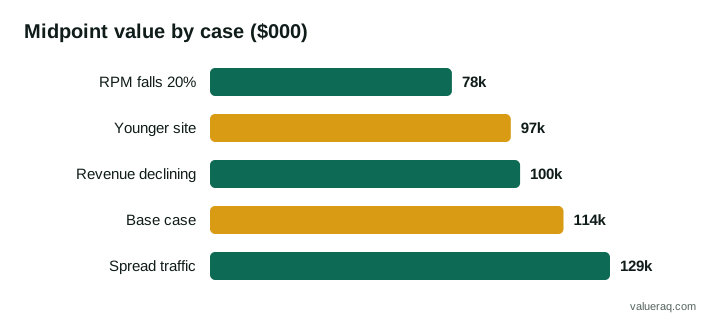
| Case | What changes | Adjusted midpoint multiple | Midpoint value |
|---|---|---|---|
| Base case | 85% of visits from one source | 2.96x | about $114,000 |
| Spread traffic | Largest source falls to 55% (no penalty, factor 1.05) | 3.36x | about $129,000 |
| Younger site | Age 1.5 years (−10%) instead of 4 | 2.53x | about $97,000 |
| Revenue declining | Revenue down 10% (−12%) | 2.60x | about $100,000 |
| RPM falls 20% | Revenue $4,000, profit $2,200 | 2.96x | about $78,000 |
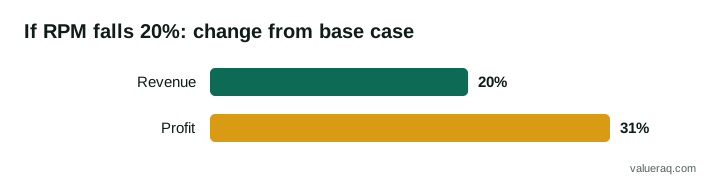
The last row deserves a closer look. If RPM falls by 20% on the same 200,000 visits, revenue drops from $5,000 to $4,000, a fall of $1,000. Costs stay at $1,800 a month ($5,000 − $3,200), so profit drops from $3,200 to $2,200, a fall of 31%. The value follows profit: $2,200 × 12 = $26,400, and $26,400 × 2.96 = $78,144, shown as about $78,000. A 20% fall in RPM took about 31% off the price. This is why buyers care so much about RPM: fixed costs turn a modest revenue drop into a larger profit drop.
Ad network risk, direct deals and the seasons
Three things about ad income are easy to miss when the revenue line looks healthy.
Network risk. Most small sites are paid by one ad network. If that account is suspended or its rules change, income can stop until a replacement is in place, and the replacement may pay less. Take the example site above ($38,400 of annual profit, about $114,000 at the adjusted midpoint). If a new network pays 30% less, revenue falls from $5,000 to $3,500 a month. Costs stay at $1,800, so profit falls to $1,700 a month, or $20,400 a year. At the same 2.96x multiple that is $20,400 × 2.96 = $60,384, about $60,000. Buyers price this risk in, so showing a clean account history and a second network that has been tested helps.
Direct deals and network ads. Income from a network is paid by the platform and follows its rules. Income from a direct deal, such as a sponsor paying a set fee, rests on an agreement between the owner and one advertiser. Buyers ask for the contract, its length, whether it passes to a new owner and how much of the income depends on one sponsor. Direct income that is documented and renewed can be steadier than network income. Direct income with no written terms is worth less than it looks.
Seasonal ad rates. Many ad sites earn more in some months than others, because advertisers spend differently through the year. Suppose a site earns $4,000 a month for nine months and $7,000 a month for three strong months. Its real year is 9 × $4,000 + 3 × $7,000 = $57,000. A seller who annualizes the strong months claims $7,000 × 12 = $84,000, which is 47% too high. This is why the 12-month average is the figure to use. The pattern is an illustration, so check the months in your own records.
A traffic and RPM sense-check
Before accepting a revenue claim, divide it by the visits. A seller says the site earned $8,000 last month on 150,000 visits. RPM = $8,000 ÷ 150,000 × 1,000 = $53.33. If the earlier months were near $25, ask what changed: a new ad layout, a one-off deal, a change in the visitors' countries, or a month of unusually high rates. A jump you cannot explain is a reason to look at the raw reports.
What makes an ad site worth more
You cannot change the ad rates, but you can change the things around them. Over a year or two, these steps tend to help a sale:
- Widen the traffic base. Bring in visits from other sources, such as email, direct visits and other search engines. See organic traffic for the basics.
- Spread the income. Adding another revenue source, such as affiliate links or your own product, reduces the risk of one ad network cutting your pay.
- Cut your own hours. Document the work, hire help and write down the process so a buyer can run the site.
- Keep clean records. Twelve or more months of ad network reports, bank deposits and analytics that agree with each other.
- Fix any warning from an ad network. An unresolved policy issue is a red flag for a buyer.
More ideas are in how to increase website value before selling.
Common mistakes when valuing an ad site
- Valuing revenue instead of profit. Ad revenue before costs overstates what the buyer gets to keep.
- Using the best month. Use the 12-month average.
- Ignoring where the traffic comes from. One source above 80% costs 12% of the multiple in VALUERAQ's default rules.
- Treating RPM as fixed. It moves with the season and the ad market, so test the price at a lower RPM.
- Forgetting the ad network's terms. A buyer will check that the account can be transferred or replaced, and that it is in good standing. Read the network's own help pages for its current rules.
How to use this on your own site
Collect 12 months of ad revenue, costs and visits. Work out annual profit and RPM by month. Then enter profit, revenue change, the largest traffic source and your weekly hours into the Website Valuation Tool, which shows each adjustment and the resulting range. For the broader picture, read website valuation methods and how to value a blog. When you are ready to talk to buyers, expect them to ask for the records listed in what documents buyers ask for.
VALUERAQ's estimate is a starting range, not an appraisal and not a guaranteed price. For a large sale, the U.S. Small Business Administration suggests that buyers consider hiring an attorney and an accountant (SBA).
Frequently asked questions
How much is a website with display ads worth?
It depends on profit, not ad revenue. In VALUERAQ's default rules, a website is valued at 2.5x to 4.0x annual profit before adjustments, then moved up or down for traffic mix, age, trend and owner time. In the worked example above, $38,400 of annual profit gave a midpoint of about $114,000.
What is a good RPM?
There is no single good number, because RPM depends on the topic, the visitors' countries, the ad layout and the season. A better test is whether your RPM is steady over 12 months and whether you can explain any big change.
Do buyers care about the ad network?
Yes. They want to see that the account is in good standing, that payments match your bank deposits and that nothing in the network's rules blocks a handover. Ask the network how an account is transferred or replaced when a site is sold.
Is traffic or profit more important?
Profit sets the price, and traffic is the evidence that profit will continue. A buyer who cannot verify traffic will usually lower the offer or walk away.
Can I sell a site that has lost traffic?
Yes, but expect a lower multiple. Show the cause, the steps you have taken and the recent trend. See how to value a website with falling traffic.
How do seasons affect a site's value?
Ad rates and traffic often move through the year. Value the site on the average of 12 full months, not on the strongest quarter, or the price will be too high and the buyer will notice.
Are direct ad deals worth more than network ads?
Not automatically. A direct deal can be steadier if it is in writing, renewed and spread across several advertisers. If one sponsor pays most of the income or there is no contract, the buyer will treat it as risky.
Sources
- U.S. Small Business Administration: Buy an existing business or franchise
- BizBuySell Learning Center: Add-backs for Seller's Discretionary Earnings
- VALUERAQ methodology
Next step
Enter your own profit, traffic mix and growth in the free Website Valuation Tool to see how each factor moves the range.
Written by VALUERAQ Editorial Team. The VALUERAQ editorial team writes and maintains the platform's guides, methodology and glossary. Every guide is reviewed against the published methodology before publication and when the methodology changes.