
Key takeaway
An affiliate website is usually valued the same way as other small websites: yearly net profit multiplied by a multiple. What makes affiliate sites different is where the risk sits. The income comes from programs the owner does not control, and the traffic often comes from one search engine. Both can change without warning, so buyers look closely at them.
In VALUERAQ's default method, the affiliate label alone takes only 3% off the multiple. A heavy reliance on one traffic source (up to 12% off) and a falling revenue trend (up to 25% off) matter far more. The multiples in this guide are VALUERAQ's default assumptions, described in the methodology. They are not market data, and a real buyer may pay more or less.
What makes an affiliate website different
An affiliate site earns commission when a visitor clicks a link and buys from another company. The owner does not hold stock, ship products or handle customer service. That is the appeal: low costs and a simple business. See affiliate marketing for the basic terms.
The same setup creates three risks that a buyer has to price:
- Program risk. The merchant sets the commission rate, the cookie window and the rules. It can change them or close the program. VALUERAQ's default rules note that affiliate programs "can change commission rates or close."
- Traffic risk. Many affiliate sites rely on organic search. If one search engine sends most of the visits, a ranking change can cut revenue quickly.
- Concentration inside the income. One merchant may produce most of the commission. Losing it would hurt more than losing one of several.
None of these makes an affiliate site a bad business. They are the reasons a buyer asks more questions than for, say, a site that sells its own products.
Step 1: Work out yearly net profit
The base figure is annual net profit, also called SDE (seller's discretionary earnings): profit before the owner pays themselves. For a website, VALUERAQ uses average monthly net profit over the last 12 months, multiplied by 12.
For an affiliate site the main costs are usually:
- Writers or editors
- Hosting and software (SEO tools, email service)
- Paid traffic, if any
- Freelancers for links, design or technical work
Use a full year, not the best few months. A site that earns $9,000 in one strong month and $2,000 in the rest has a very different profit from one that earns $3,500 every month. The trailing twelve months view smooths out seasons and one-off spikes.
Be careful with add-backs. BizBuySell warns that "some add-backs can unrealistically overvalue the company" (BizBuySell). If you add back a cost, a buyer will ask for the document behind it. See add-backs.
Step 2: Start from the default multiple range
VALUERAQ's default range for a website is 2.5 to 4.0 times yearly profit, with a midpoint of 3.2. This is an editorial assumption, not an average from a transaction dataset. Corporate Finance Institute describes the multiples approach as one that "utilizes different financial metrics from comparable companies to value a target company" (CFI), and also lists oversimplification and comparability as weaknesses. Two sites with the same profit can deserve different multiples.
That is why the range is then adjusted for the facts of each site.
Step 3: Adjust for the factors that matter
These are the adjustments in VALUERAQ's default website rules that affect an affiliate site most. Effects multiply together.
| Factor | Band | Effect on multiple |
|---|---|---|
| Monetization | Affiliate commissions | −3% |
| Monetization | Display ads or lead generation | 0% |
| Monetization | Own products, or mixed income with no source over 60% | +3% |
| Channel concentration | Over 80% of traffic from one source | −12% |
| Channel concentration | Over 60% to 80% | −6% |
| Channel concentration | 60% or less | 0% |
| Revenue trend | Down more than 5% to 20% | −12% |
| Revenue trend | Down more than 20% | −25% |
| Revenue trend | Within ±5% | 0% |
| Revenue trend | Up more than 5% to 25% | +8% |
| Business age | 4 years or more | +5% |
| Owner involvement | Under 10 hours a week | +5% |
The combined adjustment is limited to between ×0.5 and ×1.4. The full list is in the methodology.
Notice the size of each effect. Going from affiliate to mixed income moves the multiple by about 6 percentage points between the two bands. Moving from 85% of traffic in one channel to 55% moves it by 12. A site whose revenue is falling loses more again.
A worked example
A content website earns $6,000 a month in revenue and $3,500 a month in profit, so yearly profit is $42,000 ($3,500 × 12). It is four years old, revenue has been flat, the owner works about 15 hours a week, and all income is affiliate commission.
The table changes one thing at a time. Profit is held at $42,000 in every row, which is an assumption, since real changes usually cost money or time.
| Case | What differs | Combined factor | Midpoint multiple | Midpoint value |
|---|---|---|---|---|
| A (base) | 70% of visits from one source | 1.05 × 0.94 × 0.97 = 0.957 | 3.06× | $129,000 |
| B | 85% of visits from one source | 1.05 × 0.88 × 0.97 = 0.896 | 2.87× | $120,000 |
| C | 55% of visits from one source | 1.05 × 1.00 × 0.97 = 1.019 | 3.26× | $137,000 |
| D | 55% from one source and mixed income | 1.05 × 1.00 × 1.03 = 1.082 | 3.46× | $145,000 |
| E | As A, but revenue down 10% | 1.05 × 0.88 × 0.94 × 0.97 = 0.842 | 2.70× | $113,000 |
Check case A: the midpoint multiple is 3.2 × 0.957 = 3.06, and $42,000 × 3.06 = $128,700, shown as $129,000. The full range for case A runs from about $101,000 to $161,000, which comes from the low (2.5) and high (4.0) base multiples.
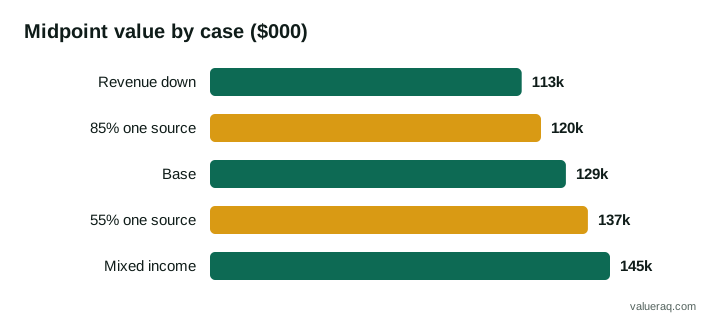
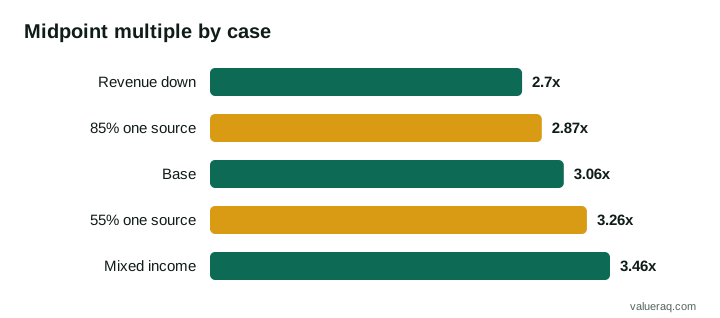
The gap between the best and worst case is $32,000 on the same $42,000 of profit. The lesson is that how safe the profit looks can matter as much as how big it is. This is an illustration under VALUERAQ's default assumptions, not a prediction of any sale price.
What buyers ask about an affiliate site
Expect these questions in due diligence:
- Which programs pay you, and how much from each? Have a table by merchant for the last 12 months.
- Do you have written terms or notices from each program? A buyer wants to know whether commissions have changed and whether the account can move to a new owner. Read each program's rules on transfers before you list.
- Where does the traffic come from? Analytics and search console screenshots help. See how to verify website traffic.
- Which pages earn the most? If three articles produce most of the revenue, say so. A buyer will find out anyway.
- What happens if a program closes? A short replacement plan shows you have thought about it.
The U.S. Small Business Administration advises buyers of existing businesses to carry out a "thorough, objective investigation" and to consider hiring an attorney and an accountant (SBA). Sellers who prepare for that investigation tend to have smoother deals.
Program risk and seasons, with numbers
What happens when one program cuts its rate. Suppose an affiliate site earns $60,000 a year in commissions, with $18,000 of costs, so profit is $42,000. One merchant provides 70% of the commissions: $42,000. The other merchants provide $18,000. If that merchant halves its commission rate, its income falls to $21,000. Total commissions become $21,000 + $18,000 = $39,000, and profit becomes $39,000 − $18,000 = $21,000. A cut that touched only one program halved the profit. At the 3.2x midpoint of the default range, before any adjustments, the value goes from $42,000 × 3.2 = $134,400 to $21,000 × 3.2 = $67,200. A site whose income is spread across several programs would lose far less.
Cookie windows. A cookie window is how long a click stays valid for a sale. A shorter window means fewer visits that later buy are credited to the site. Buyers ask for the current terms of each program and for any notice that changes them.
Seasonal income. Many affiliate sites earn more at certain times of year, for example when shoppers buy gifts. Say a site earns $2,000 a month for ten months and $6,000 a month for two. Its year is 10 × $2,000 + 2 × $6,000 = $32,000. Costs are $1,000 a month, or $12,000, so profit is $20,000 and the midpoint value is $20,000 × 3.2 = $64,000. If a seller annualizes the two strong months, $6,000 × 12 = $72,000, subtracts the same costs and arrives at $60,000 profit, the value would read $192,000, three times higher. Use the full 12 months.
Product category and content quality
Two factors decide how durable the income is, and neither shows up in a revenue figure.
- Product category. Some products are bought once, and some are bought repeatedly. A site recommending a one-off purchase must keep finding new readers, while a site for something people re-buy can earn from the same audience again. Buyers also ask whether the category is exposed to one merchant, a price war or sharp swings in demand.
- Content quality. Buyers look at whether pages are accurate, up to date and written from real use, whether the best-earning pages still match what people are searching for, and whether the site depends on a few articles. Old pages with dead links, expired offers or product names that no longer exist are a warning sign.
Revenue attribution checks buyers run
Attribution means showing which pages and which programs produced the income. Expect a buyer to ask for:
- Payout reports from each network or merchant for the last 12 months.
- Bank deposits that match those reports, month by month.
- A table of income by program, so concentration is visible.
- Income by page, matched to the traffic each page receives.
- Evidence that no income comes from methods the programs forbid.
If you can supply these in one tidy file, due diligence is quicker and the buyer has less reason to lower the offer. See how to verify website revenue.
Ways to improve an affiliate site's value
Most of these take months, so start well before you list.
- Add programs for the same readers. If the main merchant is 70% of commission, a second and third reduce the damage from one change.
- Widen your traffic. An email list, a newsletter or a second search source reduces the traffic concentration penalty. See how to increase website value before selling.
- Add something you own. A digital product or a paid tool turns part of the income into revenue you control.
- Document your tasks. Fewer owner hours make a handover easier and add 5% to the multiple under 10 hours a week.
- Keep records clean. Twelve months of statements from each network, and your expenses in one place.
If traffic is already falling, find out why before you list. See how to value a website with falling traffic.
Common mistakes when valuing an affiliate site
- Using the best month. Use 12 months of profit, not a peak.
- Ignoring program rules. If a program's rules limit transfers, say so before a buyer finds out.
- Counting revenue as profit. Commission paid to you is revenue. Writers, tools and links come out before profit.
- Treating a multiple as a promise. A multiple is a starting point for talks. Deal terms such as earn-outs or seller financing can change what you receive.
- Comparing with a different kind of site. A site with its own products and an affiliate site with the same profit are not the same risk.
How to use this on your own site
Gather your last 12 months of revenue and costs, the share of visits from your biggest source, your revenue change over the year and your weekly hours. Enter them into the Website Valuation Tool, and you will see each adjustment applied. For more examples of different site types, read website worth examples, and for the general process see website valuation.
Frequently asked questions
Are affiliate websites worth less than other websites?
In VALUERAQ's default rules, only slightly: affiliate income takes 3% off the multiple compared with display ads or lead generation. The larger effects come from traffic concentration and the revenue trend. A buyer may weigh program risk more heavily, so treat the tool's result as an estimate.
What multiple do affiliate websites sell for?
VALUERAQ's default range for websites is 2.5 to 4.0 times yearly profit, adjusted for the site's facts. That range is an editorial assumption and not a statistic from completed sales.
Can I sell my affiliate accounts to a buyer?
It depends on each program's own terms. Read them and ask the merchant or network about a change of account owner before you list.
How many months of records do I need?
Twelve months is the normal minimum. Include statements from every network and payment account, and your expense records.
Does the tool guarantee a sale price?
No. It gives a low, midpoint and high estimate from the figures you enter. The price a buyer accepts depends on the buyer, the deal terms and the market.
What is a cookie window, and why do buyers ask about it?
It is the period during which a click on an affiliate link can still earn a commission. A shorter window credits fewer sales. Buyers ask because the merchant can change it, and the terms affect how much of the visitors' buying the site is paid for.
Sources
- U.S. Small Business Administration, Buy an existing business or franchise
- BizBuySell Learning Center, Add-Backs for Seller's Discretionary Earnings
- Corporate Finance Institute, Multiples analysis
- VALUERAQ methodology
Next step
Enter your own figures in the free Website Valuation Tool to see a low, midpoint and high value for your site.
Written by VALUERAQ Editorial Team. The VALUERAQ editorial team writes and maintains the platform's guides, methodology and glossary. Every guide is reviewed against the published methodology before publication and when the methodology changes.