Key takeaway
There is no honest single answer to "how long does it take to sell an online business?" Any average you read without a named source should be treated with caution, and this page does not quote one. What can be said is that every sale passes through the same six stages, and each stage has a short list of things that make it slower.
Most of those delays are in the seller's hands. Missing records, an asking price the numbers cannot support and slow replies to a buyer's questions account for much of the time a sale drags. The buyer's funding and the legal paperwork are the parts you control least.
The timeline later in this guide is an invented example, built to show how delays add up. It is not a statistic and not a promise about your sale.
The six stages of a sale
| Stage | What happens | What slows it down |
|---|---|---|
| 1. Prepare | Gather records, agree an asking price, write the listing | Messy books, no clear price, unclear ownership of accounts |
| 2. Find a buyer | List the business, answer enquiries, screen buyers | A price above the range, thin listing, slow replies |
| 3. Letter of intent | Agree price and main terms in writing | Gaps between what each side expects, deal structure |
| 4. Due diligence | Buyer checks the figures, accounts and assets | Missing documents, figures that do not match |
| 5. Contract and escrow | Sign the sale agreement, fund escrow | Legal edits, buyer funding, payment method |
| 6. Handover | Move accounts, domain, code and know-how | Accounts not in the seller's name, no written process |
The stages overlap a little in real sales, but they happen in this order. A delay early in the list is passed on to every stage after it.
Stage 1: Prepare
Preparation is the stage a seller controls completely, and it is the one most often rushed.
The U.S. Small Business Administration (SBA) tells owners selling a business to "Use business valuation to set a monetary value." Do that first. A price you can explain with figures avoids weeks of back-and-forth later. A free estimate from a valuation tool gives a low, midpoint and high figure to anchor on, and the methodology shows how it was reached.
Then gather the evidence a buyer will ask for. The SBA's guide for buyers lists financial statements and tax returns among the documents to evaluate, and says to ask about contracts, leases, existing cash flow and inventory. Having them ready before you list is the single biggest time-saver. The data room checklist sets out what to collect, folder by folder.
Check who owns what. If the domain, the app store account, the payment processor or the hosting sits in a freelancer's name, fix that now. Transfers take as long as the slowest account.
Stage 2: Find a buyer
Once the listing is live, the pace depends on how many suitable buyers see it and how quickly you answer them.
A listing is slower when it hides the facts a buyer needs, such as how the business earns money, how many hours it takes each week, and where its traffic or sales come from. It is also slower when the price is out of line with the figures. Buyers who run their own numbers will compare the asking price with annual profit before they write to you.
Your choice of route changes this stage most. A broker, a marketplace and a direct sale all reach buyers differently, as broker vs marketplace vs selling directly explains. If you list on a marketplace, check its rules for how long a review takes before a listing goes live. On VALUERAQ, listings are reviewed before they appear, and the marketplace rules describe the checks.
Reply to messages promptly. A buyer comparing three businesses tends to move forward with the one that answers first and answers fully.
Stage 3: Letter of intent
When a buyer is serious, the two sides usually put the main terms in a letter of intent: price, how it is paid, what is included, and a period during which you deal only with that buyer. That last part is an exclusivity period, and it matters for timing because it pauses other offers. Keep it short, and make sure it ends if the buyer stalls.
This stage is quick when both sides agree on the price and slow when they do not. If the gap is about growth that has not yet happened, a structure such as an earnout may close it, but it adds terms to negotiate. The deal structures guide compares the common options.
Stage 4: Due diligence
Due diligence is the buyer's check of what you have told them. The SBA describes it as a "thorough, objective investigation", and it names the letter of intent, a confidentiality agreement, the sales agreement and any purchase price adjustment as documents that professionals can help with.
This is usually where a sale slows down most, because it is where claims meet records. Three things stretch it:
- Figures that do not match. Revenue in the listing, in the payment processor and in the tax return must agree, or you must be able to explain why not.
- Aggressive add-backs. BizBuySell warns that "some add-backs can unrealistically overvalue the company". Expect a buyer to question every one, so keep a receipt or a statement behind each.
- Slow answers. Each question left open for a few days adds days to the whole sale.
The due diligence guide shows what buyers check and in what order.
Stage 5: Contract and escrow
After due diligence, the lawyers or the two parties turn the letter of intent into a sale agreement. The SBA recommends that an attorney review the sales agreement, and it also suggests hiring an accountant. Both take time to schedule, so book them while due diligence is running, not after.
The buyer then pays into escrow, an independent holder who releases the money when the agreed handover is complete. How escrow works for website sales covers the steps. Delays here usually come from the buyer's funds: a bank transfer that needs approval, or financing that is not yet in place. Ask for proof of funds early in the process.
Stage 6: Handover
Handover is the move of the domain, hosting, code, social accounts, email lists and payment accounts, plus the training the buyer needs. It is quicker when each account already sits in your name, and when you have written down how the business runs. See how to transfer a website to a new owner for the checklist.
Agree a transition period in the contract so both sides know how long you will help after the money has moved.
Worked example: how delays add up
The numbers below are invented to show the arithmetic. They are not averages.
A content website earns $4,000 a month in net profit. That is $4,000 × 12 = $48,000 a year. VALUERAQ's default range for a website is 2.5x to 4.0x annual profit, before adjustments, so the unadjusted range is:
- Low: $48,000 × 2.5 = $120,000
- Midpoint: $48,000 × 3.2 = $153,600, shown as about $154,000
- High: $48,000 × 4.0 = $192,000
These are VALUERAQ's own default assumptions, not market data. The multiples are set out in the methodology.
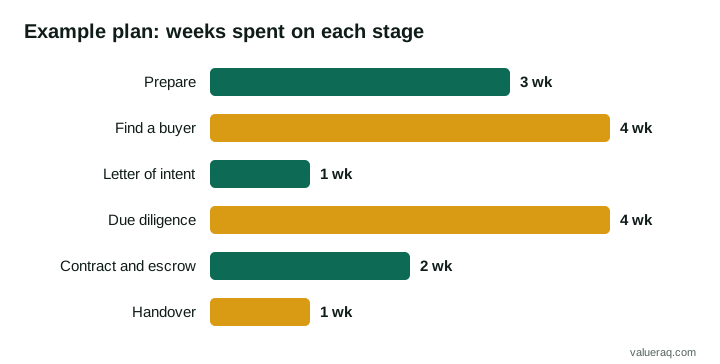
Plan A: a prepared seller. Records are ready and the price sits inside the range.
| Stage | Weeks |
|---|---|
| Prepare | 3 |
| Find a buyer | 4 |
| Letter of intent | 1 |
| Due diligence | 4 |
| Contract and escrow | 2 |
| Handover | 1 |
| Total | 15 |
3 + 4 + 1 + 4 + 2 + 1 = 15 weeks.
Plan B: records are missing. The seller needs 2 extra weeks to rebuild the books before listing, and buyers then need 2 extra weeks in due diligence to get answers. 15 + 2 + 2 = 19 weeks.
Plan C: records missing and the price too high. The seller asks $250,000. That is $250,000 ÷ $48,000 = 5.2 times annual profit, above the 4.0x top of the default range. Buyers hesitate, and the listing needs 6 extra weeks to attract a serious offer. 19 + 6 = 25 weeks.
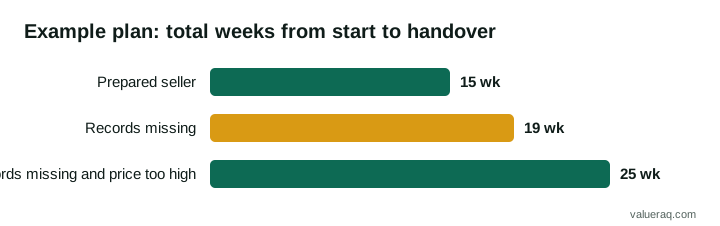
The extra 10 weeks between Plan A and Plan C came from two things the seller could have settled before listing. Nothing here predicts how long your sale will take, but the pattern is the useful part: early gaps are passed down the line.
How the route you choose changes the timeline
These are patterns, not numbers. How long each route takes depends on the business, the price and the buyer.
| Route | Where time is usually spent | Where it can save time |
|---|---|---|
| Marketplace listing | Waiting for the right buyer to find the listing; listing review | Buyers can message you directly; you set your own pace |
| Broker | Preparing a detailed sale pack and screening buyers | The broker handles enquiries and chases the paperwork |
| Direct sale to someone you know | Agreeing a price without outside evidence | No search stage at all |
The stages after the letter of intent (due diligence, contract, escrow, handover) look much the same on every route. The route mainly changes stage 2.
After closing: handover and earnout time
A sale is not over when the money is released. Check what the contract says about two things:
- Transition period. The days or weeks you agree to answer questions and teach the buyer. A transition period in writing stops it from stretching without limit.
- Earnout or holdback. If part of the price is paid later, your involvement can last for months or longer. An earnout ties a payment to results after closing, and a holdback keeps part of the price back until conditions are met. Add the length of these to your own plan for when you will be fully finished.
Checklist: what speeds a sale up and what slows it down
Speeds it up:
- A price you can explain with figures from a valuation tool and the methodology.
- 12 to 24 months of records, ready before you list.
- Domain, app store account, hosting and payment accounts all in your own name.
- Proof of funds requested from the buyer early.
- Answers to buyer questions within a day or two.
Slows it down:
- Changing the asking price after buyers have seen it.
- Figures that differ between the listing, the payment processor and the tax return.
- Add-backs with nothing behind them.
- Booking a lawyer or accountant only after due diligence ends.
- A long exclusivity period with a buyer who is slow to move.
What you control and what you do not
| You control | You partly control | You do not control |
|---|---|---|
| Records and account ownership | Which buyers see the listing | A buyer's funding and bank timing |
| Asking price | How fast you answer | Legal advisers' schedules |
| Written handover notes | The length of exclusivity | A buyer who changes their mind |
If a quick sale matters more to you than the top price, say so to yourself before you list, and set the asking price near the lower half of your range. If the price matters more, plan for a longer timeline and keep the business running well in the meantime, because earnings that fall during a sale invite a lower offer. When to sell an online business covers timing the decision itself.
Frequently asked questions
Can I sell an online business in a few weeks?
Possibly, if the records are ready, the price matches the figures and the buyer has funds. Each stage still has to happen. Rushing due diligence tends to bring a lower price or a failed sale.
Which stage takes the longest?
For many sellers it is finding the right buyer or due diligence. It depends on the sale. Finding a buyer is slow when the price is high or the listing is thin, and due diligence is slow when records are incomplete.
Does the way I sell change the timeline?
Yes. A broker, a marketplace listing and a direct sale reach buyers differently and involve different amounts of your own time. Compare them in broker vs marketplace vs selling directly before you choose.
What is the best way to avoid delays?
Value the business first, collect your records into a data room, put accounts in your own name and answer buyers quickly. These steps cost little and remove the most common causes of delay.
Does selling an online business take longer than selling a local shop?
There is no reliable single comparison, and this guide does not quote one. The stages are the same for both. Online sales add account and domain transfers, which are quick when everything is already in your name and slow when it is not.
How long should I leave the listing up before changing the price?
Decide the review point before you list, not after the first quiet week. Look at how many buyers wrote, how many asked for records and how many made offers. Many enquiries but no offers points to the price. Few enquiries points to the listing or the route. Changing the price more than once can make buyers doubt the figures.
Sources
- U.S. Small Business Administration, Close or sell your business: valuation and legal review when selling.
- U.S. Small Business Administration, Buy an existing business or franchise: investigation, documents and professional help.
- BizBuySell, Add-backs and SDE: why add-backs get questioned.
- VALUERAQ, Valuation methodology: the default multiples used in the example.
Next step
When your records are ready, you can list your business for free and see how buyers respond.
Written by VALUERAQ Editorial Team. The VALUERAQ editorial team writes and maintains the platform's guides, methodology and glossary. Every guide is reviewed against the published methodology before publication and when the methodology changes.