Key takeaway
Buying an ecommerce business is different from buying a content site because you are also buying stock, suppliers and a way of getting customers that you do not control. The safest route is to treat the seller's profit figure as a claim to be tested: rebuild it from payment and sales reports, count the stock yourself, ask what happens if the main sales channel or the main supplier disappears, and pay through escrow only when the handover is agreed in writing.
For the full process across every kind of online business, see our guide to buying a business online.
The figures below are examples built from VALUERAQ's published default assumptions. They are estimates, not records of real sales.
What you are actually buying
A store is a bundle of five things, and each can be bought well or badly.
- A sales engine. The storefront, any marketplace listings, the email list, the social accounts and the advertising accounts that bring customers in.
- Products and a supply chain. Your own designs, a private-label product, resold goods or a dropshipping arrangement where the supplier ships for you.
- Stock. Goods in a warehouse, with a third-party logistics provider or at a marketplace's fulfillment centers.
- Customer data and reviews. Order history, repeat buyers and the reviews that make new shoppers trust the store.
- Know-how. How the owner buys, prices, advertises and handles returns.
The U.S. Small Business Administration advises a "thorough, objective investigation" before buying an existing business, and suggests you "Consider hiring an attorney and an accountant." That advice fits a store as well as a shop on the high street. Its guide to buying an existing business lists financial statements and tax returns among the documents to evaluate, and tells buyers to ask about contracts, leases, existing cash flow and inventory.
Step 1: Decide what kind of store fits you
Stores differ in how much work and risk they carry, so decide before you browse.
| Store type | What you take on | Main risk to check |
|---|---|---|
| Own brand, own stock | Ordering, quality control, storage or a logistics partner | Stock that does not sell; one factory |
| Dropshipping | Supplier relationships, customer service, advertising | Suppliers the buyer does not control |
| Resale of other brands | Buying terms and margins | Losing a brand's permission to sell |
| Marketplace-led store | Listings, reviews, marketplace fees | Account suspension or rule changes |
Ask two honest questions. How many hours a week can you give it? And can you cover a bad month without selling stock at a loss? Write the answers down, because they set your price ceiling and your shortlist.
Step 2: Screen listings in ten minutes
Most listings can be ruled out quickly. On each one, look for:
- Twelve months of profit, not one good month. Seasonal stores swing widely, so a trailing-twelve-month figure is the fair starting point, and a single peak month misleads.
- Net profit after all costs, including advertising, returns, refunds, storage fees and payment fees.
- Where sales come from. One marketplace or one ad channel supplying most of the revenue is a concentration risk.
- Owner hours. A store that takes 40 hours a week of the owner's time is a job, not an investment.
- How the price compares with profit. Divide the asking price (excluding stock) by annual profit. If it sits far above the 2.0 to 3.5 times range described in the next section, ask why.
Joining and browsing on VALUERAQ is free, and every listing is reviewed before it goes live. You can message sellers privately from your account and attach files such as proof of funds.
Step 3: Work out what the store should cost
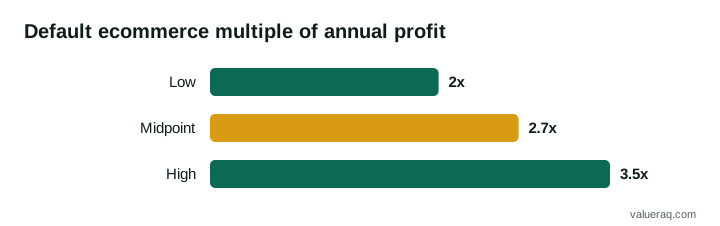
VALUERAQ's default range for an ecommerce business is 2.0 to 3.5 times annual net profit, with 2.7 as the midpoint, before adjustments. This is a published editorial assumption, not market data. The reasoning is in the methodology, and the ecommerce valuation guide explains each adjustment.
Three of the default adjustments matter most when buying a store:
- Third-party logistics adds 3% to the multiple, because it is easier to hand over. Dropshipping takes off 8%, because the business depends on suppliers the buyer does not control.
- If more than 60% but no more than 80% of traffic or sales comes from one channel, the multiple falls by 6%. Above 80% it falls by 12%.
- Owner time of more than 20 hours a week takes off 5%. More than 40 hours takes off 10%.
These adjustments are multiplied together, and the combined effect is capped at minus 50% and plus 40%.
Stock is treated separately. It is normally added on top at cost after a stock count, and it is not multiplied. The Ecommerce Valuation Tool shows the estimate with and without inventory, and the Business Multiple Calculator lets you test a multiple against your own figures.
Step 4: Rebuild the profit figure
A seller's profit is usually a figure from a spreadsheet. Yours should come from source reports.
- Sales. Ask for reports from the store platform and from each marketplace, by month and by product.
- Payouts. Match the payment processor's payouts to bank deposits. Sales that never reach the bank are a warning sign.
- Costs. Check supplier invoices, shipping, storage, software, refunds, chargebacks and advertising statements.
- Add-backs. BizBuySell defines add-backs as "expenses added back to a company's bottom-line profits when determining Seller's Discretionary Earnings (SDE) or EBITDA", and warns that "some add-backs can unrealistically overvalue the company." Accept personal costs that a new owner will really not pay, and question anything else. See add-backs and how to calculate SDE.
Look at gross margin too. A store with falling margin and flat sales is losing ground even while profit looks steady. The financial due diligence checklist goes through every step in more depth.
Step 5: Count the stock
Stock is often the biggest check in the deal after the price, and the easiest to get wrong.
- Ask for an inventory list with quantities, unit cost, date bought and where each item sits.
- Count it, or send someone to count it, at or just before closing. For goods held by a logistics provider, ask for the provider's own stock report instead of the seller's.
- Value it at cost, not at the selling price.
- Set aside stock that will not sell: damaged, expired, out of season or very slow-moving items.
- Read the inventory turnover. If the store holds two years of stock for a product that sells in months, you would be paying cash for goods that sit on a shelf.
Agree in writing how the count will work and what happens to the price if the count differs from the list.
Example: pricing stock by how fast it sells
Sort the counted stock by age and agree a rate for each band before closing. These figures are made up, and the rates are an example of a negotiated split, not a standard.
| Stock band | Cost at the count | Rate agreed | Buyer pays |
|---|---|---|---|
| Sold within about 3 months | $12,000 | 100% | $12,000 |
| Sells slowly (3 to 12 months) | $6,000 | 50% | $3,000 |
| Older than 12 months or damaged | $2,000 | 0% | $0 |
| Total | $20,000 | $15,000 |
Check: 12,000 + 3,000 + 0 = 15,000, so the buyer pays $5,000 less than the list. The point is to pay full price only for goods you expect to sell.
Step 6: Check suppliers, channels and accounts
This is where stores differ most from other online businesses.
Suppliers. Ask for the contracts or emails that set prices, minimum orders and lead times. Find out whether the supplier will keep supplying the new owner on the same terms, and whether the seller has a second supplier. A single factory with no written terms is a risk you should price in.
Sales channels. If a marketplace brings in most of the sales, ask how long the account has been active, whether it has ever been suspended, and whether the marketplace allows the account to change hands. Each platform has its own rules, so read them rather than trusting the seller. VALUERAQ's platform risk entry explains why one channel can sink a store.
Advertising accounts. Ask for the spend and the return by month for the last twelve months. A store whose profit depends on advertising at a loss-free break-even point is fragile. See return on ad spend.
Customers. Ask for repeat purchase rates and average order value. A store living on one-time buyers must keep paying to find new ones.
Supplier and fulfillment checks at a glance
| What to check | What to ask for | Warning sign |
|---|---|---|
| Supplier terms | Written prices, minimum orders and lead times | Terms agreed only by chat message |
| Supplier continuity | A statement that the supplier will serve the new owner | The seller is the only contact |
| Backup supplier | A second quote or a past order | One factory for every product |
| Fulfillment | The provider's contract and its own stock report | Stock figures only from the seller |
| Returns and defects | Return rate by month and the reasons | Rising returns after a supplier change |
| Shipping costs | Cost per order for the last twelve months | Margin that depends on a carrier discount that ends |
A worked example
A hypothetical branded store is listed with these figures.
| Metric | Seller's figure |
|---|---|
| Monthly net profit | $5,000 (annual $60,000) |
| Fulfillment | Third-party logistics |
| Growth, last 12 months | 4% |
| Largest channel | 70% of sales |
| Age | 3 years |
| Owner time | 15 hours a week |
| Inventory at cost | $28,000 |
The adjustments. Third-party logistics adds 3%. A largest channel above 60% but no more than 80% takes off 6%. Growth of 4%, an age of three years and 15 owner hours a week all sit in the baseline bands. Combined: 1.03 × 0.94 = 0.968.
The adjusted multiples. 2.0 × 0.968 = 1.94, 2.7 × 0.968 = 2.61 and 3.5 × 0.968 = 3.39.
On the seller's profit. $60,000 × 2.61 = about $157,000 at the midpoint, within a range of about $116,000 to $203,000. Adding the $28,000 of stock gives about $185,000.
What the buyer finds. Rebuilding the profit from payment reports shows $400 a month of refunds and ad costs that the seller left out, so true monthly profit is $4,600 (annual $55,200). The stock count finds $4,000 of damaged goods, so counted stock is $24,000.
On the checked figures. $55,200 × 2.61 = about $144,000 at the midpoint. Adding $24,000 of stock gives about $168,000.
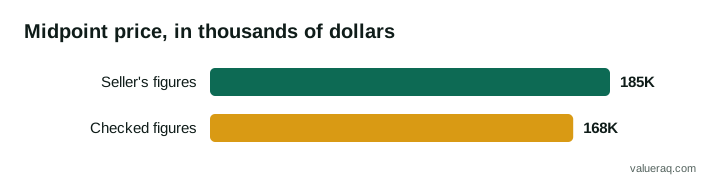
Checking saved about $17,000 at the midpoint. The point is not that sellers cheat. Missed costs and uncounted stock are ordinary errors, and they matter because profit is multiplied. These numbers are illustrative, not market data.
Step 7: Agree terms in writing
A short letter of intent can set the price, what is included and the checking period. The final purchase agreement should state:
- The price for the business, the method for counting stock and what is paid for it.
- Exactly which assets transfer: the store, domain, social accounts, email list, supplier contracts where allowed, designs and listings.
- The seller's transition period and how much help they give.
- A non-compete so the seller does not open the same store next week.
- Any seller financing or earnout.
Have a lawyer review the agreement. Terms, tax treatment and consumer rules vary by country and by deal, so take local advice before you sign.
Step 8: Pay through escrow and take over
Pay through an independent escrow service, and release the money when the agreed assets and logins have moved. VALUERAQ does not handle the payment and takes no commission on sales. Our guide to how escrow works covers the steps.
Then work through the handover in order:
- Move the store platform account and domain to your name, and change every password.
- Move payment processor, shipping and logistics accounts, since payouts must go to you.
- Take over the supplier relationships, with the seller making the introductions.
- Transfer advertising and analytics accounts, or open new ones with the seller's history shared.
- Run the first orders with the seller on hand.
The website transfer guide has a fuller checklist.
Your first 100 days after closing
A store keeps selling while you learn it, so change little at first and measure everything. This plan is a starting point, not a rule.
| Days | Focus | What to do |
|---|---|---|
| 1 to 14 | Keep it running | Process orders with the seller on hand, check every payout lands in your account, and answer customers the same way as before |
| 15 to 45 | Learn the numbers | Rebuild monthly profit from your own reports, track returns, and compare the stock list with the shelf |
| 46 to 75 | Secure the supply | Place an order with each supplier on the agreed terms and get a second quote for the top products |
| 76 to 100 | Make one change | Pick a single improvement, such as a product page or a shipping option, and test it against the earlier months |
Write down what you changed and when, so a drop in sales can be traced to its cause.
Common mistakes
- Paying a multiple on revenue. Profit is the base, not sales.
- Taking the seller's stock figure on trust. Count it.
- Ignoring the main channel's rules. If the account cannot move to you, the store may lose its sales.
- Skipping the second supplier question. One supplier is a single point of failure.
- Rushing the first 90 days. Keep what worked, and change one thing at a time.
Frequently asked questions
How much does it cost to buy an ecommerce business?
It depends on profit, margins, risk and stock. VALUERAQ starts from a default of 2.0 to 3.5 times annual net profit and adjusts for the factors above, with stock added separately at cost. Use the Ecommerce Valuation Tool to estimate a range for a specific store.
Is inventory included in the price?
Usually not. It is normally paid for on top of the earnings-based price, at the seller's cost, after a stock count. Put the counting method in the agreement.
Is it safe to buy an online store?
It can be, with checks. Verify the sales and payouts at the source, count the stock, read the channel's rules, use escrow and take advice from a lawyer and an accountant. See the buyer safety page.
Should I buy a dropshipping store?
It depends on the supplier. VALUERAQ's default takes 8% off the multiple for dropshipping, because the supplier controls fulfillment. A store with stable, written supplier terms is safer than one with an informal arrangement.
How do I value the inventory when I buy a store?
Count it, value it at cost, and pay full cost only for stock you expect to sell. Slow or damaged goods are usually paid at a lower rate or left out, as the stock table above shows.
What should I do first after buying an ecommerce store?
Keep the store running as it was, confirm that payouts reach you and learn the true monthly profit before changing prices or products. The 100-day plan above sets out the order.
How long does it take to buy an ecommerce business?
It varies with the size of the store and how quickly the seller shares records. Allow time for the stock count, the supplier checks and the account transfers, and do not let a seller's deadline cut them short.
Sources
- U.S. Small Business Administration, Buy an existing business or franchise: investigating a business before buying and getting professional help.
- BizBuySell, Add-backs and SDE: how add-backs work and their risks.
- VALUERAQ, Valuation methodology: the default multiples and adjustment rules used in the example.
Next step
Browse ecommerce stores for sale on VALUERAQ, read each seller's figures and message them privately.
Written by VALUERAQ Editorial Team. The VALUERAQ editorial team writes and maintains the platform's guides, methodology and glossary. Every guide is reviewed against the published methodology before publication and when the methodology changes.