Key takeaway
A marketing agency is a service business, and buyers price it on what it earns, not on what it bills. Start with seller's discretionary earnings (SDE), decide whether the buyer must hire someone to do the owner's job, then apply a multiple that rises or falls with three things: recurring retainers, client concentration and owner dependence.
Revenue alone tells you little. Two agencies that each bill $600,000 a year can be worth very different amounts if one keeps its clients on twelve-month retainers and the other lives on one-off projects that must be sold again every quarter.
This guide shows the formula, a worked example with every step of the arithmetic, and the checks a buyer will run. The figures are made up to show the method. VALUERAQ publishes default ranges for websites, apps, newsletters, ecommerce, SaaS and AI businesses on the methodology page, but it has no default range for agencies, so the example below tests several multiples instead of claiming one. Nothing here is market data or a promise of a price.
Why an agency is valued differently from a website
A website or a software product can earn money while its owner sleeps. An agency earns money when people do the work. That changes what a buyer is paying for:
- The work is delivered by people. If the team leaves, the revenue can leave with it.
- Clients often know the owner, not the brand. The relationship may not transfer.
- Revenue is often project-based. A project ends, and the agency must win another.
- Costs rise with revenue. To take on more clients you hire more staff, so profit does not grow as quickly as sales.
Buyers therefore look for the same things as in any small business sale, with extra attention to people and contracts. The U.S. Small Business Administration describes three common approaches to valuation: the income approach "looks at projected revenue and accounts for potential risks," the market approach "compares your business to other similar businesses that have recently sold," and the assets approach "subtracts total business liabilities from the total value of all assets" (SBA). For an agency with few physical assets, the income and market approaches do most of the work, and in practice that means an earnings multiple.
Step 1: Work out SDE
SDE is the total pre-tax income one working owner can take from the business. Start with net profit and add back the owner's pay and benefits, interest, taxes, depreciation and amortization, personal costs and one-off costs. Our guide on how to calculate SDE lists each step, and the add-backs page explains which ones buyers accept.
BizBuySell defines add-backs as "expenses added back to a company's bottom-line profits when determining Seller's Discretionary Earnings (SDE) or EBITDA," and warns that "some add-backs can unrealistically overvalue the company" (BizBuySell). Keep an invoice or bank statement behind every add-back.
Use the last twelve months of profit and loss, and treat freelancers and contractors who do client work as a real cost. They are not an add-back.
Step 2: Decide between SDE and EBITDA
In many agencies the owner also does a job: leading accounts, selling, or doing the creative work. A buyer who is also an owner-operator may be happy to take that job. A buyer who is an investor, or who already runs another business, will need to hire someone.
- SDE is used when the buyer will work in the business. The owner's pay is added back in full.
- EBITDA (earnings before interest, taxes, depreciation and amortization) is used when the buyer will hire a manager. The cost of that manager is deducted from the add-back.
Our guide on SDE vs EBITDA explains how to choose, and valuing a business with EBITDA covers that route. Show both figures in the listing. It lets each kind of buyer see their own number.
Step 3: A worked example
An agency billed $600,000 in the last twelve months. Its profit and loss, with made-up figures, looks like this:
| Line | Amount |
|---|---|
| Revenue | $600,000 |
| Delivery team (staff and contractors, owner excluded) | −$300,000 |
| Owner's pay | −$90,000 |
| Software and tools | −$30,000 |
| Office or coworking | −$24,000 |
| Advertising | −$20,000 |
| Other costs (includes $6,000 personal costs and an $8,000 one-off legal bill) | −$36,000 |
| Depreciation | −$4,000 |
| Loan interest | −$2,000 |
| Net profit | $94,000 |
Check: 600,000 − 300,000 − 90,000 − 30,000 − 24,000 − 20,000 − 36,000 − 4,000 − 2,000 = 94,000.
Now add back what a new owner would not have to pay:
| Step | Amount |
|---|---|
| Net profit | $94,000 |
| + Owner's pay | $90,000 |
| + Depreciation | $4,000 |
| + Loan interest | $2,000 |
| + Personal costs | $6,000 |
| + One-off legal bill | $8,000 |
| SDE | $204,000 |
Check: 94,000 + 90,000 + 4,000 + 2,000 + 6,000 + 8,000 = 204,000.
Suppose the owner is also the head of client services, and a replacement would cost $80,000 a year. For a buyer who will hire that person, earnings are $204,000 − $80,000 = $124,000.
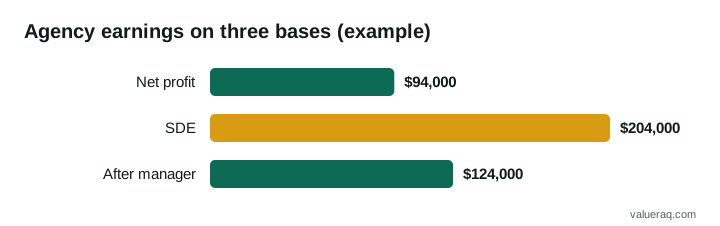
The gap between $94,000 and $204,000 is why a seller should never value an agency on reported profit alone, and why a buyer should never accept SDE without asking who will do the owner's job.
Testing the multiple
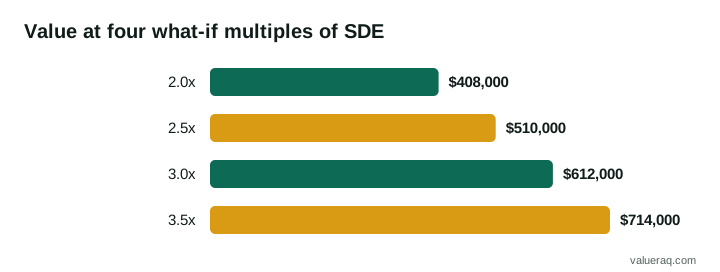
There is no single multiple for agencies, so test a range. These multiples are what-if values chosen for the arithmetic. They are not market data and not a VALUERAQ default.
| Multiple of SDE | Value on $204,000 SDE |
|---|---|
| 2.0× | $408,000 |
| 2.5× | $510,000 |
| 3.0× | $612,000 |
| 3.5× | $714,000 |
Each line is $204,000 multiplied by the multiple, for example 204,000 × 2.5 = 510,000.
The Corporate Finance Institute notes that multiples are useful for quick calculations but have limits: one is that comparable companies may use different accounting methods (Corporate Finance Institute). Treat the range as a starting point for a conversation, and read how our revenue vs profit multiples guide explains why profit is the better base here.
Step 4: Decide where in the range you sit
What moves an agency toward the top or the bottom of a range is the quality of its earnings. These are the checks a buyer will run.
| What the buyer checks | Stronger sign | Weaker sign |
|---|---|---|
| Recurring revenue | Most revenue on retainers with written terms | Most revenue from one-off projects |
| Client concentration | No client above a small share of revenue | One or two clients pay most of the bills |
| Owner dependence | Account managers hold the client relationships | The owner is the main contact for every client |
| Team | Documented roles, staff who have stayed | One star employee or freelancer does the key work |
| Margins | Steady or rising margin per service | Margin falls as revenue grows |
| Client churn | Clients stay for years | Many clients leave within a year |
| Contracts | Written agreements that allow transfer | Handshake agreements |
Retainers versus projects
Suppose $420,000 of the $600,000 comes from monthly retainers and $180,000 from projects. Retainers are 420,000 ÷ 600,000 = 70% of revenue. A buyer is more confident about the 70%, because it repeats, and will question the other 30%. See recurring revenue for how buyers define it.
Client concentration
If the largest client pays $150,000 a year, that client is 150,000 ÷ 600,000 = 25% of revenue. Losing that one client would cut revenue by a quarter, and with the same costs, profit would fall by much more. Buyers often respond with a lower multiple or an earnout. Our customer concentration entry explains how to measure it.
Owner dependence
If every client has the owner's mobile number, the agency may lose clients when the owner leaves. The cure is to move relationships to account managers before a sale and to document how work is done. The key person risk page covers this, and a transition period in the contract can help.
Step 5: Check working capital and unpaid invoices
Agencies often invoice after the work is done, so a lot of money may be owed by clients on the day of the sale. Ask how the contract treats unpaid invoices and how much cash the business needs to run. The working capital page explains how buyers think about that.
A checklist before you list or make an offer
- Twelve months of profit and loss, with a written list of add-backs.
- SDE and the earnings after paying a manager, side by side.
- A client list showing each client's share of revenue and contract end date.
- The split between retainer and project revenue, month by month.
- A staff and contractor list with roles, pay and how long each has stayed.
- Copies of client agreements, and a check that they can be transferred.
- A note on what the owner does each week, and who could take it over.
Our valuation mistakes guide lists errors that cost sellers money, and due diligence explains what a buyer will check after an offer.
Using a calculator for an agency
A calculator is a quick way to test a multiple against a price. VALUERAQ's business multiple calculator turns an asking price and an earnings figure into a multiple, so you can see where a price sits in the range you are testing. VALUERAQ's valuation tools estimate websites, apps, newsletters, ecommerce, SaaS and AI businesses, so for an agency use the arithmetic above and treat any result as a starting point, not an appraisal.
Frequently asked questions
What multiple does a marketing agency sell for?
It depends on the agency, and no single figure fits all of them. Retainer revenue, spread-out clients and a team that can run without the owner support a higher multiple. The opposite supports a lower one. Test a range, as the table above does, and ask a business broker or accountant for comparable sales.
Is an agency valued on revenue or profit?
On profit, usually SDE or EBITDA. Revenue shows the size of the agency, but a buyer pays for what is left after the team is paid.
Should I use SDE or EBITDA for my agency?
Use SDE if the buyer will work in the business, and EBITDA if the buyer will hire someone for the owner's role. Show both so each kind of buyer sees a number that fits.
Can I sell an agency if the owner does all the client work?
You can, but expect a lower price or a longer handover. Moving client relationships to other people before you list is the single most useful step.
Sources
- U.S. Small Business Administration, Close or sell your business
- BizBuySell, Add-Backs for Seller's Discretionary Earnings
- Corporate Finance Institute, Multiples analysis
- VALUERAQ, methodology
This guide is general information, not financial, tax or legal advice. Ask an accountant or lawyer before you buy or sell.
Next step
Once you have your SDE, turn an asking price into a multiple of it.
Written by VALUERAQ Editorial Team. The VALUERAQ editorial team writes and maintains the platform's guides, methodology and glossary. Every guide is reviewed against the published methodology before publication and when the methodology changes.