
Key takeaway
A valuation is only as good as the numbers and the method behind it. The same website can look worth $64,000 or $320,000 depending on a few choices, and most of those choices are mistakes that are easy to avoid once you know them.
This guide covers nine errors that owners and buyers make when working out what an online business is worth. Each one comes with the arithmetic, so you can see how far it moves the answer. The multiples used are VALUERAQ's own default assumptions from the methodology, not market data. For a website the default range is 2.5x to 4.0x annual profit, with a midpoint of 3.2x. Nothing here is financial, tax or legal advice.
Mistake 1: Valuing on revenue instead of profit
Revenue is what comes in. Profit is what is left for the owner. Two businesses with the same revenue can be worth very different amounts because a buyer pays for what the business earns, not what it takes in.
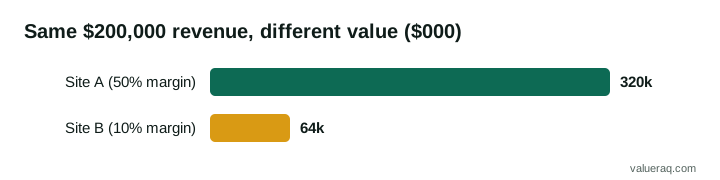
Take two websites, each with $200,000 in annual revenue:
- Site A keeps 50% as profit: $100,000. At the 3.2x midpoint: $100,000 x 3.2 = $320,000.
- Site B keeps 10% as profit: $20,000. At the same multiple: $20,000 x 3.2 = $64,000.
A revenue multiple can be useful when a business has no positive profit yet. Corporate Finance Institute notes that the revenue multiple "ignores profitability and cash flow generation" (CFI). For most small online businesses, profit is the better base. See revenue vs profit multiples for when each one fits.
Mistake 2: Ignoring how much time the owner puts in
A business that needs 50 hours a week from its owner is a job, not an asset. The buyer will either do that work or pay someone to do it.
VALUERAQ's default rules adjust the multiple for owner time: more than 40 hours a week lowers it by 10%, and under 10 hours a week raises it by 5%. With $50,000 of annual profit and the 3.2x midpoint:
- Over 40 hours: 3.2 x 0.90 = 2.88x, so $50,000 x 2.88 = $144,000.
- Under 10 hours: 3.2 x 1.05 = 3.36x, so $50,000 x 3.36 = $168,000.
Same profit, a $24,000 gap. If you are selling, writing down your routines before you list shows buyers what the work involves. See how to increase website value before selling.
Mistake 3: Annualizing one good month
A single strong month tells you what is possible, not what is typical. Multiplying it by twelve gives a figure that no 12-month record supports.
Corporate Finance Institute describes a run rate as taking "current revenue in a certain period" and converting it "to an annual figure", and lists seasonality and one-off events among the risks (CFI).
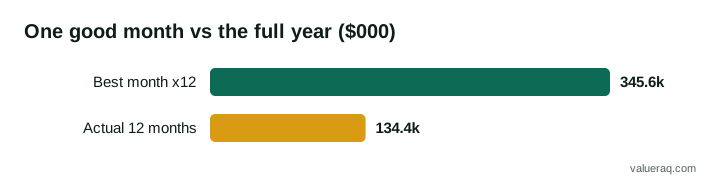
Suppose a site earns $3,000 profit in each of 11 months and $9,000 in one month (a viral post, say):
- Actual 12 months: 11 x $3,000 + $9,000 = $42,000. At 3.2x: $134,400.
- Best month x 12: $9,000 x 12 = $108,000. At 3.2x: $345,600.
Use the trailing twelve months instead. Corporate Finance Institute gives the formula as the latest fiscal year plus the current year to date, minus the prior-year same period (CFI). See trailing twelve months and run rate.
Mistake 4: Applying a multiple to the wrong measure
A profit multiple belongs on profit. A multiple quoted for one measure (say seller's discretionary earnings) does not carry over to another (say EBITDA, or revenue) without changing the number.
Using the same $200,000-revenue idea at a smaller scale: a site with $120,000 revenue and $36,000 profit is worth $36,000 x 3.2 = $115,200 on the profit basis. Apply that 3.2x to revenue by mistake and you get $120,000 x 3.2 = $384,000, more than three times higher.
The same trap appears between SDE and EBITDA, which treat the owner's pay differently. Check which one a quoted multiple refers to, and read SDE vs EBITDA and how to calculate SDE.
Mistake 5: Accepting add-backs without checking them
Add-backs are expenses added back to profit because they would not continue under a new owner. Done honestly, they show true earning power. Done loosely, they inflate it.
BizBuySell defines add-backs as "expenses added back to a company's bottom-line profits when determining Seller's Discretionary Earnings (SDE) or EBITDA" and warns that "some add-backs can unrealistically overvalue the company" (BizBuySell).
A buyer should ask for the receipt or contract behind every add-back. A seller should only claim what can be shown. At 3.2x, every $1,000 of add-back that does not hold up removes $3,200 from the price. See add-backs.
Mistake 6: Overlooking dependence on one source of income
A business that gets nearly all of its traffic or sales from one place is exposed to that place changing its rules.
VALUERAQ's default rules lower the multiple by 6% when over 60% to 80% of traffic or sales come from one channel, and by 12% when it is over 80%. With $50,000 profit and the 3.2x midpoint:
- Diversified: $50,000 x 3.2 = $160,000.
- Over 80% from one channel: 3.2 x 0.88 = 2.816x, so $50,000 x 2.816 = $140,800.
A $19,200 difference comes from something many owners never measure. Check the share of your largest channel before you price.
Mistake 7: Treating a default multiple as market data
Published multiples are assumptions or averages, and averages hide a lot. VALUERAQ says plainly that its ranges are "editorial default assumptions" and not drawn from a transaction dataset. They are a starting point, not what a buyer will pay.
Corporate Finance Institute makes a related point about multiples generally: they let you "make quick computations to assess a company's value", but the method "only considers the company's position for a certain time period" (CFI). Real prices depend on the buyer, the deal terms and the negotiation.
Mistake 8: Ignoring age and trend
Two businesses with the same profit are not equal if one is six months old and falling and the other is five years old and growing. Under VALUERAQ's default rules:
- Under one year of history: -20%. One to under two years: -10%. Four or more years: +5%.
- Revenue down more than 20%: -25%. Declining by 5% to 20%: -12%. Growing above 5% to 25%: +8%.
Adjustments multiply. Take a site with $50,000 profit, 1.5 years old (x0.90), with revenue declining 12% (x0.88) and 85% of traffic from one source (x0.88):
- Combined factor: 0.90 x 0.88 x 0.88 = 0.697.
- Multiple: 3.2 x 0.697 = 2.23x.
- Value: $50,000 x 2.23 = about $111,500, against $160,000 with no adjustments.
Buyers read the same signals, so an owner who ignores them is surprised by the offers. For why trend matters, see how to value a website with falling traffic.
Mistake 9: Quoting a single number, and a price that ignores the deal
A valuation is a range, because inputs are estimates and buyers differ. A single figure looks precise and is not. VALUERAQ shows a low, midpoint and high value for this reason.
The price is also not the whole deal. A $120,000 price paid all in cash is a different outcome from the same price with part deferred or tied to future results. See deal structures for online business sales.
The nine mistakes at a glance
| # | Mistake | What goes wrong | Better habit |
|---|---|---|---|
| 1 | Valuing on revenue | Margin is ignored | Start from profit |
| 2 | Ignoring owner time | A job is priced as an asset | Record hours and routines |
| 3 | One good month x 12 | Peak treated as normal | Use trailing 12 months |
| 4 | Wrong multiple basis | SDE, EBITDA and revenue mixed up | Match the multiple to its measure |
| 5 | Unchecked add-backs | Profit inflated | Keep proof for each one |
| 6 | One-channel dependence | Risk not priced | Measure the largest share |
| 7 | Default as market data | False certainty | Treat as a starting point |
| 8 | Ignoring age and trend | Same profit, different risk | Apply and explain both |
| 9 | One number, ignoring terms | Looks precise, is not | Use a range and read the terms |
A short checklist before you trust a number
- Is the base profit (or recurring revenue for software), averaged over 12 months?
- Does every add-back have a document behind it?
- Does the multiple match the measure it came from?
- Have you adjusted for age, trend, owner hours and concentration, and written down why?
- Is the answer a range, and does the deal structure change what you would actually receive?
To see these steps applied to different site types, read website worth examples, then try the matching valuation tool.
Frequently asked questions
What is the most common valuation mistake?
Using revenue where profit belongs. It is common because revenue is the number people see first, and it can overstate value several times over for a low-margin business.
Should I use the highest multiple I can find?
No. A higher multiple does not make a business more valuable, only your figure bigger. Buyers will test it against profit, age, trend and risk.
Is a valuation tool the same as an appraisal?
No. VALUERAQ's results are estimates from the inputs you provide and are not appraisals or advice. Inputs are not verified.
How often should I revalue my business?
When something material changes, such as a new revenue source, a traffic drop or a change in your own hours, and before you list it for sale.
Do I need an accountant?
For a sale, yes. The SBA suggests considering an accountant and an attorney when buying an existing business, and recommends an attorney review a sales agreement (SBA).
Sources
- Corporate Finance Institute: Enterprise Value to Revenue Multiple
- Corporate Finance Institute: Revenue Run Rate
- Corporate Finance Institute: Trailing Twelve Months
- Corporate Finance Institute: Multiples analysis
- BizBuySell: Add-Backs for Seller's Discretionary Earnings
- U.S. Small Business Administration: Buy an existing business or franchise
- VALUERAQ methodology
Next step
Try a free valuation tool to see your own range, with every step shown.
Written by VALUERAQ Editorial Team. The VALUERAQ editorial team writes and maintains the platform's guides, methodology and glossary. Every guide is reviewed against the published methodology before publication and when the methodology changes.