Key takeaway
A micro-SaaS is a very small software business, often run by one person or a pair of founders, with a few dozen to a few hundred paying customers. Its price is usually worked out two ways: a multiple of annual recurring revenue (ARR), and a multiple of annual profit. When the two answers are far apart, the profit figure is the one a buyer who plans to live off the income will care about most.
Three things move the price more at this size than at a larger company. Churn is noisy because each customer is a large share of the base. The founder's weekly hours are part of what the buyer must replace. And one big customer can be a quarter of revenue.
The figures below are examples built from VALUERAQ's published default assumptions. They are estimates, not records of real sales, and the business in the example is invented.
What counts as a micro-SaaS
There is no official line. In this guide, a micro-SaaS is a subscription software product with these traits:
- Monthly recurring revenue (MRR) in the hundreds or low thousands of dollars, not tens of thousands.
- One to three people behind it, with the founder doing development, support and marketing.
- A narrow product for one job or one type of customer.
- A customer base small enough that you can name most of the accounts.
Stripe defines MRR as "The total amount of money a company can expect to receive from its existing customers each month." That is the starting number for everything below. Multiply it by 12 to get ARR.
Nothing changes in the method when a product is small. What changes is how much the inputs wobble. A product with 40 customers does not behave like a product with 4,000.
The two ways to price it
1. A multiple of ARR
This is the method VALUERAQ's SaaS Valuation Tool uses. The default range is 2.0x to 5.0x ARR, with a midpoint of 3.5x. Those are the website's own assumptions, set out in the methodology. They are not market data.
Value = MRR × 12 × multiple
The tool then adjusts the multiple up or down for revenue trend, churn, gross margin, customer concentration, age and owner hours. The combined adjustment is limited to between ×0.5 and ×1.4.
2. A multiple of annual profit
Here the number is SDE (seller's discretionary earnings): profit before the owner pays themselves. BizBuySell explains that "Add-backs are expenses added back to a company's bottom-line profits when determining Seller's Discretionary Earnings (SDE) or EBITDA," and warns that "some add-backs can unrealistically overvalue the company." For a one-person product, the owner's own pay is the biggest add-back, so the SDE figure is close to what the founder actually takes home.
VALUERAQ notes that profit-focused buyers often compare a price with 3x to 5x annual profit. That is a platform assumption, not market data.
Why a micro-SaaS leans on profit
On a larger SaaS company, a buyer may pay for growth that has not yet reached the profit line. On a micro-SaaS there is often no team to cut and no growth budget to shift. What the product earns after hosting and tools is close to what the next owner gets, so buyers tend to ask what the income is and how long it will last.
For the full comparison of methods, including discounted cash flow, read SaaS valuation methods. This page focuses on what is different when the business is small.
Churn is noisy at small scale
Churn is the share of customers who cancel in a period. Stripe describes it as "The percentage of total customers who discontinue using a product or service during a given period."
With thousands of customers, one month's churn is a stable number. With 40 customers it is not:
| Customers who cancel in a month | Monthly churn (out of 40) | VALUERAQ churn band |
|---|---|---|
| 1 | 1 ÷ 40 = 2.5% | 2% to 5%, baseline (no change) |
| 2 | 2 ÷ 40 = 5.0% | 2% to 5%, baseline (no change) |
| 3 | 3 ÷ 40 = 7.5% | Over 5% to 8%, multiple cut by 10% |
| 4 | 4 ÷ 40 = 10.0% | Over 8%, multiple cut by 20% |
Two extra cancellations in one month move the product from "baseline" to "high churn." A buyer will not read one bad month as the truth, so ask for the full history. Look at the monthly cancellations over the last 12 months and the average, not at a single month.
Two habits help a seller here. Show churn as a count and as a percentage, so the buyer can see that "7.5%" means three people. And explain each cancellation you can: a customer who closed their own business is a different story from one who switched to a rival.
Stripe also defines net revenue retention as "The percentage of revenue that is retained from existing customers over a given period of time." For a product with upgrades, it can tell a better story than raw churn. See SaaS metrics buyers check for how buyers read both.
Founder dependence
In VALUERAQ's rules, owner hours work like this:
| Owner hours per week | Effect on the multiple |
|---|---|
| Under 10 | +5% |
| 10 to 20 | 0% (baseline) |
| Over 20 to 40 | −5% |
| Over 40 | −10% |
The reason is simple. A buyer who takes over a product that needs 45 hours a week of work is buying a full-time job as well as a business. The more of that job sits in the founder's head, the harder the handover.
For a micro-SaaS the risk is concentrated. One person often holds the code, the customer relationships and the knowledge of why things were built as they were. This is key person risk. Sellers can lower it by writing down how the product is deployed, how support is handled and what the regular maintenance tasks are, before they list.
Customer concentration
When a product has 40 customers, a single account can be a large slice of revenue. VALUERAQ adjusts for the largest customer's share:
- Over 30% of revenue: multiple cut by 12%.
- Over 15% to 30%: cut by 6%.
- 15% or less: no change.
A buyer will ask whether that customer is on a contract, how long they have been a customer and what happens if they leave. See customer concentration for more.
Worked example: a $3,000 MRR product
A hypothetical micro-SaaS, two years old, built and run by one founder. Every figure is invented.
- MRR: $3,000, from 40 customers at about $75 a month.
- Monthly net profit (SDE): $1,800.
- Revenue growth over the last 12 months: 8%.
- Monthly churn: 2.5% (one cancellation in 40).
- Gross margin: 85%.
- Largest customer: 5% of revenue.
- Owner hours: 20 a week.
Step 1: ARR. $3,000 × 12 = $36,000.
Step 2: adjust the multiple. Churn, concentration, age and owner hours are all in their baseline bands, so they change nothing. Revenue growth of 8% falls in "above +5% to +25%," which adds 8%. Gross margin above 80% adds 5%.
Combined factor = 1.08 × 1.05 = 1.134.
Step 3: apply it to the default range.
| Case | Default multiple | Adjusted multiple | Value |
|---|---|---|---|
| Low | 2.0x | 2.27x | about $82,000 |
| Midpoint | 3.5x | 3.97x | about $143,000 |
| High | 5.0x | 5.67x | about $204,000 |
The midpoint is $36,000 × 3.969 = $142,884, which the tool rounds to $143,000.
Step 4: the profit cross-check. Annual profit is $1,800 × 12 = $21,600. The midpoint price divided by profit is $143,000 ÷ $21,600 = 6.6x.
At the 3x to 5x profit reference, the same business would price like this:
- 3 × $21,600 = $64,800
- 5 × $21,600 = $108,000
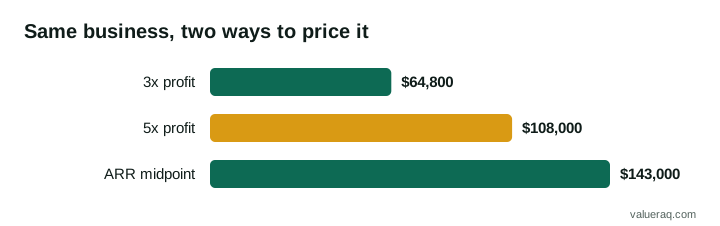
The ARR midpoint sits $35,000 above the top of the profit range ($143,000 − $108,000). That gap is the lesson. At 6.6x profit, the price depends on the product growing or on the buyer paying for time saved. A buyer who wants income now will argue for a number nearer the profit range. A seller should expect that conversation and be ready with growth and retention records.
What moves the example
Change one input at a time and the midpoint moves like this:
| Change | Adjustment | New factor | New midpoint |
|---|---|---|---|
| Three cancellations in the month (7.5% churn) | Churn −10% | 1.08 × 0.90 × 1.05 = 1.021 | about $129,000 |
| Owner works 45 hours a week | Owner hours −10% | 1.08 × 0.90 × 1.05 = 1.021 | about $129,000 |
| Largest customer is 35% of revenue | Concentration −12% | 1.08 × 0.88 × 1.05 = 0.998 | about $126,000 |
Take the churn row as an example: $36,000 × 3.5 × 1.021 = $128,646, shown as about $129,000.
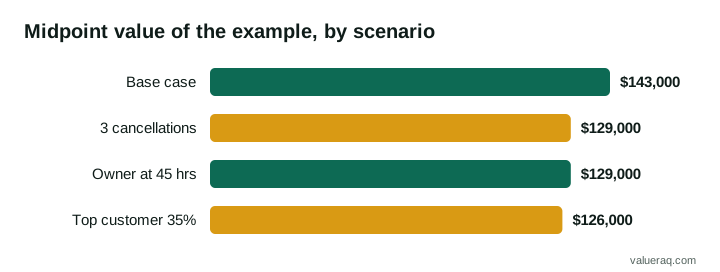
Any one of these costs the seller $14,000 to $17,000 at the midpoint. Each is something a seller can work on before listing: keep churn records, document the work, and reduce reliance on one account.
Selling or buying a micro-SaaS: practical steps
If you are selling:
- Export 12 months of billing data and calculate churn as a count and a percentage.
- Write a one-page handover: hosting, deployment, support routine, third-party accounts.
- Reduce your weekly hours where you can, and be able to show it.
- Know your SDE and be ready to explain every add-back.
If you are buying:
- Rebuild MRR from the payment processor, not from a dashboard screenshot.
- Ask for the cancellation history and the reasons given.
- Ask how many hours the founder really spends, and on what.
- Check what happens to the product if the largest customer leaves.
The U.S. Small Business Administration advises "thorough, objective investigation" before buying an existing business, and says: "Consider hiring an attorney and an accountant." That applies to a $50,000 software product as much as to a larger one. For the sale process, see how to sell a SaaS business. For the single-page version of the price question, see what is a fair price for a small SaaS.
Limits of these numbers
The multiples here are VALUERAQ's default assumptions. They are not an appraisal, and no market sales data sits behind them. A real price also reflects the buyer's alternatives, the quality of the code, any licences, and the terms of the deal. Treat the range as a starting point for a conversation, not a promise of what a buyer will pay.
This page covers very small products. For the general method, see how to value a SaaS company, and for a SaaS business valuation on your own figures use the SaaS valuation tool.
Frequently asked questions
Is a micro-SaaS valued on ARR or on profit?
Both are used. ARR gives a range based on the subscriptions. Profit shows what the next owner would earn. For very small products, buyers often give profit more weight, so check the implied profit multiple before you settle on an asking price.
How many customers does a micro-SaaS need to be worth buying?
There is no fixed number. What matters is whether revenue is steady and spread out. A product with 40 customers and low churn can be steadier than one with 200 customers and a high cancellation rate. Ask for the history, not the count.
Does founder involvement reduce the price?
In VALUERAQ's rules it can. Over 40 hours a week of owner time cuts the multiple by 10%, and under 10 hours adds 5%. Documentation and a handover period can help close that gap.
Can I use the free tool for a very small product?
Yes. Enter your MRR and, for a better estimate, profit, growth, churn, margin, largest-customer share, age and owner hours. The SaaS valuation calculator gives a range, not an appraisal.
Sources
- Stripe, Essential SaaS metrics: definitions of MRR, churn and net revenue retention.
- BizBuySell, Add-backs and SDE: how add-backs work and their risks.
- U.S. Small Business Administration, Buy an existing business or franchise: investigating a business before buying and getting professional help.
- VALUERAQ, Valuation methodology: the default multiples and adjustment rules used in the example.
Next step
Enter your MRR, churn and owner hours in the free SaaS Valuation Tool to see a range for your own product.
Written by VALUERAQ Editorial Team. The VALUERAQ editorial team writes and maintains the platform's guides, methodology and glossary. Every guide is reviewed against the published methodology before publication and when the methodology changes.