Key takeaway
A Shopify store is worth what its profit, its stock and its risks say, not what its sales page says. The working price is usually yearly net profit × a multiple, plus sellable stock at cost. Most of a buyer's effort goes into proving that the profit is real and that it will survive the change of owner.
This guide walks through a purchase in order: what you are actually buying, where to look, what to check, how to price the store and how to take it over safely. The price examples use VALUERAQ's published default assumptions. They are estimates, not records of real sales.
What you are buying
A Shopify store is a bundle, and the bundle differs from one deal to the next. Before you talk price, write down which of these come with the store:
- The store itself: theme, products, pages and customer and order history.
- The domain name and the email addresses on it.
- Apps and subscriptions the store depends on, and the monthly cost of each.
- Supplier relationships, or the stock already in a warehouse.
- Advertising accounts, social profiles and the email list.
- Written processes, product photos, and the seller's help for a handover period.
Customers' personal data is covered by privacy rules that depend on where they live, so ask the seller what can legally be passed on. A lawyer can answer that for your case.
Step 1: Set a budget and decide what you want
Decide how much cash you can spend and how many hours a week you can give. A store that needs 40 hours a week is a job, and the price should reflect that. A store that needs 5 hours a week with a team or agency behind it costs more because the owner's time is already replaced.
Also choose the model you understand. A store that holds its own stock needs cash for reorders. One that ships direct from a supplier ties up less money but gives you less control over delivery times. VALUERAQ's ecommerce valuation guide explains how the fulfillment model changes the price.
Step 2: Find stores for sale
You can browse reviewed listings on VALUERAQ's businesses for sale pages, choose the ecommerce category and filter by price, profit and age. Each listing shows the seller's figures and the multiples the asking price implies. Save a search, and a free account will email you when a matching listing appears.
You can also approach a store owner directly. Whichever way you find it, treat the first number you see as the seller's opening ask, not as a value.
Step 3: Ask for the records
The U.S. Small Business Administration advises anyone buying a business to carry out a "thorough, objective investigation", and lists financial statements, tax returns, contracts, cash flow and inventory among the things to review. For a Shopify store, ask for:
- Monthly profit and loss statements for the last 12 to 24 months.
- Shopify's sales reports by month, product and sales channel.
- Payment processor payout reports matched to bank deposits.
- Refund, return and chargeback history.
- A stock list with the cost of each item.
- Supplier agreements, price lists and open orders.
- Advertising account history, including spend and results by month.
A seller who cannot produce these is asking you to pay for a number you cannot check. The fuller list is in what documents buyers ask for. Share your own information in stages and sign a non-disclosure agreement before you see anything private.
Step 4: Run the 10-point Shopify check
General due diligence applies to every business. These ten checks are the ones that matter most for a Shopify store.
| Check | What to look for | Why it matters |
|---|---|---|
| Profit trend | Month-by-month profit over 12 to 24 months | A falling line lowers the price. Seasonal peaks need a full year of data |
| Repeat customers | Share of orders from returning buyers | Repeat buyers cost less to win than new ones |
| Advertising reliance | Share of sales that stop when ads stop | A store that only sells while paying for clicks is riskier |
| Sales channels | Split between search, email, social and marketplaces | One channel can change its rules overnight |
| Apps and monthly costs | Every paid app and its fee | Hidden software costs reduce real profit |
| Theme and code | Whether the theme is licensed and who built any custom work | You need the right to keep using it |
| Payment history | Disputes, held payouts and processor warnings | A flagged processor account may not carry over to you |
| Suppliers | Contracts, lead times, minimum orders, a backup supplier | A supplier who leaves can stop the business |
| Stock | Count, condition and cost of what is sellable | Slow-moving items are not worth full cost |
| Owner's role | Weekly tasks the seller does personally | Tasks that cannot be handed over become your job |
For the deeper list, read digital business due diligence and red flags when buying a website. A listing that cannot answer a basic question, or that refuses to let you see sales reports directly, deserves the same care as a fake website listing.
Step 5: Work out the profit you are really buying
Small stores are priced on SDE, the profit left after all running costs and before the owner's pay. Rebuild it yourself from the records:
- Start with net sales after refunds and discounts.
- Subtract the cost of goods, shipping the store paid, payment and platform fees, and advertising.
- Subtract other running costs such as apps, software, contractors and customer service.
- Add back only the owner's pay and costs that are truly personal or one-off.
Be strict with the add-backs. BizBuySell warns that "some add-backs can unrealistically overvalue the company". A cost that repeats every year is not a one-off. If you need to hire someone to do the owner's job, subtract that wage too, because it is a real cost to you.
Step 6: Price the store
The working formula is value = yearly net profit × multiple, plus sellable stock at cost. VALUERAQ's default range for an ecommerce business is 2.0 to 3.5 times yearly profit, with 2.7 as the midpoint. It is a published platform assumption, not market data. The reasoning is in the methodology.
A worked example
A store earns $4,000 a month in profit after all costs, before the owner is paid. It holds $15,000 of stock at cost, of which $3,000 is slow-moving. All figures are invented to show the arithmetic.
| Step | Calculation | Result |
|---|---|---|
| Yearly profit | $4,000 × 12 | $48,000 |
| Business at 2.0 times | $48,000 × 2.0 | $96,000 |
| Business at 2.7 times | $48,000 × 2.7 | $129,600 |
| Business at 3.5 times | $48,000 × 3.5 | $168,000 |
| Sellable stock | $15,000 − $3,000 | $12,000 |
| Midpoint price with stock | $129,600 + $12,000 | $141,600 |
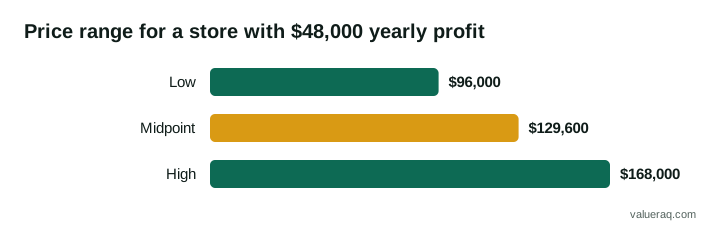
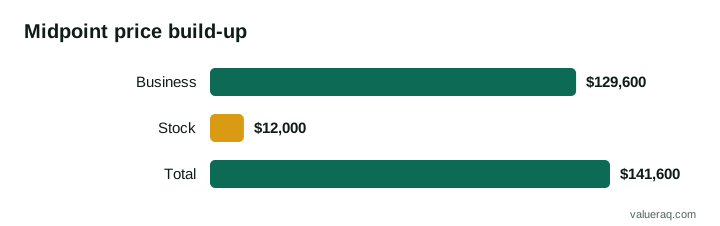
At the midpoint, you would be paying about 2.7 years of profit for the business. That is a way to judge risk: the longer the payback, the more you depend on the store lasting. A store that depends on one ad account, one supplier or the seller's daily work should sit toward the low end of the range. A store with steady repeat customers and a handover plan can justify the high end.
For comparison, BizBuySell reports a "Median sold earnings multiple: 3.28" across 1,661 sold website and ecommerce listings from 2021 to 2025. That figure covers a broad mix of businesses and is a different measure from VALUERAQ's default range, so use it as context rather than a target. Run the Ecommerce Valuation Tool to see each adjustment and its reason. The resulting range is an estimate, not a promise of what a seller will accept.
Step 7: Make an offer and agree the terms
Put your main terms in a letter of intent before spending money on lawyers:
- The price, and how stock is counted and priced on the handover day.
- What is included: store, domain, accounts, supplier contacts, files and social profiles.
- How the price is paid. Some deals pay part later, through seller financing or an earnout. Compare offers on the amount that is certain.
- A handover period, with the hours the seller will give.
- A non-compete agreement, so the seller cannot open a copy of the store next door.
- Statements the seller confirms are true, called representations and warranties.
The SBA suggests that you consider hiring an attorney and an accountant. Have a lawyer review the sale agreement and an accountant check the tax treatment. VALUERAQ provides valuation tools and a marketplace, not legal or tax advice.
Step 8: Pay through escrow and take over
Use an independent escrow service so your money is held until the assets move. Read how escrow works for website sales for the sequence. VALUERAQ is not part of the sale, takes no commission and does not handle the payment.
Agree a handover order and tick each item off:
- Confirm the stock count with the seller.
- Move the store and the domain name into your control.
- Reconnect payment and shipping settings in your own accounts.
- Re-link apps, email tools and advertising accounts under your own logins.
- Meet the suppliers, with the seller present.
- Release the escrow once both sides confirm the list is complete.
Do not assume payment accounts and advertising accounts move across automatically. Many are tied to the person or business behind them, so plan to open your own and ask the seller to help you connect them. The same applies to the apps. A longer walk-through is in how to transfer a website to a new owner.
Your first 30 days
The first month is when most surprises appear. Keep the seller available and change very little at first.
- Week 1: Check every order is shipping, every customer message is answered and every account is under your control.
- Week 2: Review the first supplier orders and pay the first invoices yourself.
- Week 3: Compare sales, ad spend and returns with the same weeks last year.
- Week 4: Decide what to change. Start with the biggest risk you found in the checks.
Common mistakes to avoid
- Paying for a headline profit figure without rebuilding it from the records.
- Counting slow-moving stock at full cost.
- Skipping the ad-dependence check, then finding that sales stop when spending stops.
- Assuming a supplier, a payment account or an app will carry over without asking.
- Paying outside escrow because the seller says they are in a hurry.
Frequently asked questions
How much does a Shopify store cost to buy?
It depends on the profit. A common starting range is yearly net profit times 2.0 to 3.5, plus sellable stock at cost. A store earning $48,000 a year would land between $96,000 and $168,000 for the business alone on those multiples. These are estimates, not a guaranteed price.
Is it safe to buy a Shopify store?
It is as safe as the checks you run. Ask for reports from the sales platform itself, match payouts to bank deposits, use a written agreement and pay through an independent escrow service. Follow the steps in VALUERAQ's buyer safety page.
Do I need an accountant or a lawyer?
It is wise to have both. An accountant can check the profit and the tax treatment, and a lawyer can review the sale agreement.
What if the store makes no profit?
Then a profit multiple does not apply. Loss-making stores are usually priced on stock, audience or other assets, and the risk is much higher. Our tool values on earnings and will tell you when the profit entered is zero or negative.
Is the stock included in the asking price?
Often it is priced separately, at cost, on top of the business. Agree in writing how stock is counted and what happens if the count differs on the handover day.
Sources
- U.S. Small Business Administration: Buy an existing business or franchise
- BizBuySell Learning Center: Add-Backs for Seller's Discretionary Earnings
- BizBuySell Learning Center: Website and ecommerce valuation benchmarks
- VALUERAQ's methodology for the default multiples
Next step
Enter a store's profit, fulfillment and stock into the free Ecommerce Valuation Tool to see whether the asking price sits inside a range you can defend.
Written by VALUERAQ Editorial Team. The VALUERAQ editorial team writes and maintains the platform's guides, methodology and glossary. Every guide is reviewed against the published methodology before publication and when the methodology changes.