Key takeaway
An ecommerce business sells when a buyer can see, with records, how much profit it earns on every channel, what stock and supplier relationships come with it, and how much of the work depends on you. The working price is yearly net profit × a multiple, plus sellable stock at cost.
This guide covers the whole sale for any store, whatever it runs on and wherever it sells. If your store is on Shopify, read how to sell a Shopify store alongside it. If most of your sales come through Amazon, read Amazon FBA business valuation. All numbers here come from VALUERAQ's published default assumptions or from simple arithmetic. They are estimates, not records of real sales.
What you are actually selling
Before you set a price, decide what goes in the sale. Ecommerce sales are messier than selling a blog because physical things, contracts and several accounts are involved. The U.S. Small Business Administration notes that a business's value can include intangible assets like brand presence, intellectual property and customer information, not only what it owns outright.
| Part of the sale | What it usually includes | Common question |
|---|---|---|
| The brand | Name, logo, domain, social accounts, product photos | Does the buyer also get your email list? |
| The storefront | Store platform account, theme, apps, product listings | Which paid apps transfer and which restart on the buyer's plan? |
| Marketplace accounts | Seller accounts, listing history, reviews | Can the platform's rules allow the account to change hands? |
| Stock | Units on hand and in transit, at cost | Counted when, and who bears the loss if counts differ? |
| Suppliers | Contacts, price sheets, any contracts | Will the supplier keep your terms for the new owner? |
| Customer data | Customer list and order history | Is it shared in line with your privacy policy? |
| Your time | Support period after closing | How many weeks of handover help are included? |
Writing this list first prevents the most common late-stage argument: the buyer assumed something was included that you thought was extra.
Step 1: Decide the timing and your exit goal
Selling is easier from strength. Look at three things before you start:
- Trend. Steady or rising profit over 12 months is simpler to sell than a store that has fallen for several quarters.
- Season. If most profit arrives in a few months, show a full year so the buyer sees the whole cycle.
- Your role. If you do the buying, customer service and advertising yourself, the buyer is paying for your time too. List what you do each week and which jobs could pass to someone else.
Also decide what matters most: the highest price, a fast sale, or a clean exit with no earnout. The answer affects how you list and how you treat offers. The ways to sell a digital business page compares brokers, marketplaces and selling directly.
Step 2: Build your 12 months of records
Buyers want to confirm profit is real. The SBA advises anyone buying a business to carry out a "thorough, objective investigation". Make that easy by collecting:
- Monthly profit and loss statements for the last 12 months, matching your tax records.
- Sales reports by channel (own store, each marketplace, wholesale).
- Payment processor and marketplace payout statements that tie to the bank.
- Advertising spend by platform and month.
- A stock report with units, cost per unit and age.
- Supplier invoices and any written terms.
- Returns, refunds and chargebacks by month.
The data room checklist gives a fuller list and a folder structure.
Step 3: Work out the profit buyers will use
Buyers price on seller's discretionary earnings (SDE): profit before your own pay, with one-off and personal costs added back. The how to calculate SDE guide goes through it line by line, and SDE is defined in the glossary.
Be careful with add-backs. BizBuySell warns that some add-backs can unrealistically overvalue the company. Keep only costs a new owner would genuinely not pay, and keep the receipts. Common ecommerce add-backs are your own salary, personal items run through the business and a one-time legal bill. A common item buyers do not accept is a normal advertising cost relabeled as "growth spending".
Step 4: Count and value the stock
Stock is where ecommerce differs most from other digital businesses. Buyers generally treat it as separate from the business value: the business is priced on profit, then sellable stock is added at what you paid for it.
Sort your stock into three groups:
| Group | Treatment in the price | Example |
|---|---|---|
| Sellable, current | Counted at cost | Items that sold in the last 90 days |
| Slow-moving | Counted at a discount, or left out | Items with no sales for 6 months |
| Damaged, expired or obsolete | Not counted | Broken boxes, past-date items |
Agree how and when stock is counted. A fair method is to state an estimate in the offer, count together on the closing date, then adjust the final price up or down by the difference. Without this clause, the buyer carries the risk if stock is lower than you said, and you may lose a sale if they find out late.
Step 5: Price the business
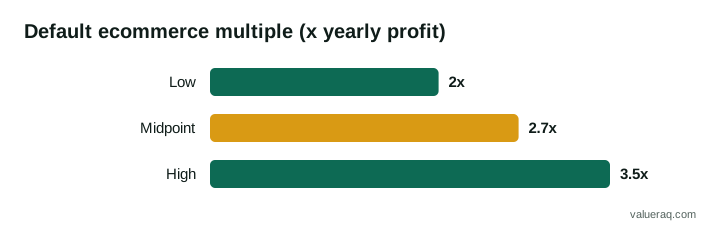
VALUERAQ's default range for an ecommerce business is 2.0 to 3.5 times yearly net profit, with 2.7 as the midpoint. It is a platform assumption, not market data, and the reasoning is in the methodology.
A worked example
A store earns $7,000 a month in profit after all costs, before the owner is paid. It holds $36,000 of stock at cost, of which $8,000 is slow-moving or damaged.
- Yearly profit: $7,000 × 12 = $84,000.
- At 2.0 times: $84,000 × 2.0 = $168,000.
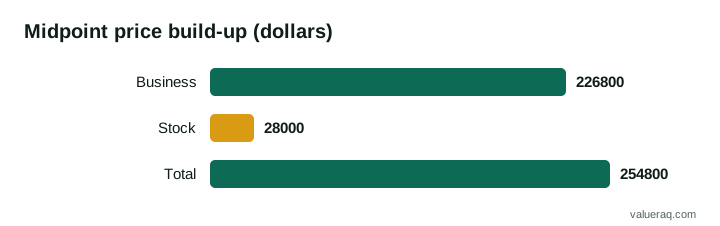
- At 2.7 times: $84,000 × 2.7 = $226,800.
- At 3.5 times: $84,000 × 3.5 = $294,000.
- Sellable stock: $36,000 − $8,000 = $28,000.
- Midpoint price with stock: $226,800 + $28,000 = $254,800.
Now suppose the offer says stock is estimated at $28,000 and is counted at closing. The joint count finds $24,500 of sellable stock. The price falls by the $3,500 difference: $254,800 − $3,500 = $251,300. The business part of the price does not move.
Where a store lands inside the range depends on how reliant it is on one channel, store age, growth and your weekly hours. The Ecommerce Valuation Tool shows each adjustment with its reason, and the ecommerce valuation guide explains them. The result is an estimate and not a promise of what a buyer will pay.
Step 6: Show how dependent you are on each channel
Buyers read channel mix as risk. The question is simple: what happens to profit if one source disappears?
| Channel pattern | What a buyer worries about | What helps |
|---|---|---|
| Most sales from one marketplace | Account suspension or rule changes | Show growth on your own store and email list |
| Most traffic from paid ads | Ad costs rising | Show repeat customer share and email revenue |
| Most traffic from one search ranking | A ranking drop | Show several ranking pages and brand searches |
| Most revenue from one supplier's product | Supplier changes terms | Show a second supplier or written terms |
You cannot fix a concentrated channel in a week, but you can present it honestly with figures. Hiding it usually comes out in due diligence and costs you more in price and trust.
Step 7: Write the listing
A good listing is factual and specific. Include yearly revenue and profit, how profit is calculated, age, channel split, stock level, what is included, what you do each week, and why you are selling. Leave out slogans. The guide to writing a business for sale listing has a template.
On VALUERAQ, listing is free, the website address stays private, and listings are reviewed against the marketplace rules before going live. You and the buyer agree the deal directly.
Step 8: Handle buyer checks and negotiate
Expect buyers to ask for the records from Step 2 and to compare them with your listing. Answer promptly and with documents rather than summaries. Use a signed confidentiality agreement before sharing supplier names or customer data. The due diligence guide shows what a careful buyer will check.
When offers arrive, compare them on what is certain:
- Cash at closing versus amounts paid later.
- Stock treatment and how the count is settled.
- Deferred payments or an earnout, which depend on the buyer running the business well after closing.
- Support period and what help you owe after the sale.
Put agreed terms in writing, and have a lawyer review the agreement. The SBA recommends that an attorney review the sales agreement.
Step 9: Close through escrow and hand over in order
Use an independent escrow service so the buyer's money is held until the assets move. The escrow guide explains the process, and escrow is defined in the glossary.
Hand over in a planned order:
- Sign the agreement and fund escrow.
- Move the domain and store platform ownership.
- Transfer marketplace accounts only where the platform's rules allow it.
- Introduce the buyer to suppliers and share price sheets.
- Ship or transfer stock and complete the joint count.
- Transfer email lists, advertising accounts and social profiles.
- Release escrow once the buyer confirms everything arrived.
- Provide the agreed support period, then step back.
Common mistakes to avoid
- Listing without records. Unverified profit is the fastest way to lose a buyer.
- Counting dead stock at cost. It invites a price cut later.
- Mixing personal and business spending and then claiming add-backs you cannot prove.
- Agreeing to hand over an account the platform does not allow to transfer.
- Skipping the support period in writing, which leads to open-ended unpaid help.
Frequently asked questions
How long does it take to sell an ecommerce business?
It varies with price, records and buyer demand. Clean records shorten the process most. The page on how long it takes to sell an online business covers typical stages.
Is stock included in the asking price?
Usually it is priced separately. The business is valued on profit, then sellable stock is added at cost. State this in the listing so buyers do not assume otherwise.
Can I sell an ecommerce business that makes no profit?
It is harder, because most buyers price on earnings. Loss-making stores are usually priced on assets, audience or brand. See selling a website with no revenue for the principles.
Do I need an accountant or a lawyer?
An accountant helps you present profit credibly and understand tax on the sale, which varies by country and situation. A lawyer should review the agreement. VALUERAQ does not give tax or legal advice.
Should I tell my suppliers and customers?
Tell suppliers once there is a signed agreement, ideally with the buyer present. For customers, follow your privacy policy on how their data is shared and announce the change after closing if the brand stays the same.
Sources
- U.S. Small Business Administration: Close or sell your business
- U.S. Small Business Administration: Buy an existing business or franchise
- BizBuySell Learning Center: Add-Backs for Seller's Discretionary Earnings
- VALUERAQ's methodology for the default multiples
Next step
Enter your profit and stock into the free Ecommerce Valuation Tool to get a range you can explain to buyers.
Written by VALUERAQ Editorial Team. The VALUERAQ editorial team writes and maintains the platform's guides, methodology and glossary. Every guide is reviewed against the published methodology before publication and when the methodology changes.