Key takeaway
Website flipping is buying a site, improving it and selling it again for more than you paid. It sounds like a way to make fast money. In practice it is closer to a small investment with a deadline, and it is decided on the day you buy, not the day you sell.
Most sites are priced as a multiple of yearly profit. A flip makes money in only two ways: profit goes up, or the multiple goes up because the site looks less risky. If you overpay at the start, no amount of work fixes it.
This guide explains how a flip works, shows one flip with the arithmetic in three outcomes, lists the risks with a way to check each, and ends with a checklist to use before you pay. All dollar figures are invented to show the method. None is market data, a prediction or a promised return.
What website flipping is
A flipper buys an existing website, usually a small content, affiliate, ad-funded or ecommerce site, spends a few months improving it, and lists it for sale. The glossary entry on website flipping gives the short definition. This page is the longer, practical version.
It differs from related ideas in one important way:
| Approach | What you do | Where the return comes from | Main risk |
|---|---|---|---|
| Flip | Buy, improve briefly, resell | Resale price minus all costs | Overpaying, or a profit fall before you sell |
| Buy and hold | Buy and keep the site | The site's profit over the years | Profit falling for good |
| Build from scratch | Create a site and grow it | Your time turns into profit later | Months of work with no income |
A flip is the shortest of the three. That is also why mistakes hurt more: there is little time for the site to recover from a bad purchase.
How a flip makes money
Both ends of a flip use the same pricing rule. Sellers and buyers usually agree a price as profit times a multiple, as covered in what multiple websites sell for and the profit multiple entry. Profit here is normally seller's discretionary earnings, or SDE, which is profit before the owner's own pay.
So there are two levers:
- Raise profit. More traffic, better conversion, lower costs, or a second income stream.
- Raise the multiple. Cleaner records, documented processes, income spread over several sources, and less dependence on one person. These make a buyer more comfortable paying more times profit. See increase website value before selling.
VALUERAQ's default profit range for a website is 2.5x to 4.0x yearly profit, with 3.2x as the midpoint. That is VALUERAQ's own assumption, explained in the methodology, not market data. Use it as a way to test a price, not as a promise of what a buyer will pay.
A worked flip, step by step
Take an invented content site. Every figure below is made up to show the arithmetic.
Buying
- Profit when you buy: $1,500 a month, which is $18,000 a year.
- Asking and agreed price at 2.5x: $18,000 × 2.5 = $45,000.
- Costs to buy and check the site (records review, transfer help, legal fees): assumed $1,500.
Improving, over six months
- Spend on fixing slow pages, adding a second income source and tidying the records: assumed $4,500.
- Profit earned while you hold it: assumed to average $1,500 a month, so 6 × $1,500 = $9,000.
Selling
- Profit when you sell, in the good case: $2,100 a month, which is $25,200 a year.
- Sale price at 3.0x: $25,200 × 3.0 = $75,600.
- Selling costs, assumed at 10% of the price: $7,560.
Total cash you put in: $45,000 + $1,500 + $4,500 = $51,000.
Net gain in the good case: $75,600 − $7,560 (selling costs) + $9,000 (profit while holding) − $51,000 = $26,040. That is $26,040 ÷ $51,000, about 51% over roughly seven months, before tax and before counting your own time.
The picture changes quickly if the plan does not work. Here are three outcomes for the same purchase:
| Good case | Flat case | Traffic-drop case | |
|---|---|---|---|
| Profit when sold, per month | $2,100 | $1,500 | $1,000 |
| Multiple when sold | 3.0x | 2.5x | 2.5x |
| Sale price | $75,600 | $45,000 | $30,000 |
| Selling costs (10%) | $7,560 | $4,500 | $3,000 |
| Profit while holding | $9,000 | $9,000 | $7,500 |
| Cash put in | $51,000 | $51,000 | $51,000 |
| Net result | +$26,040 | −$1,500 | −$16,500 |
| Return on cash put in | about +51% | about −3% | about −32% |
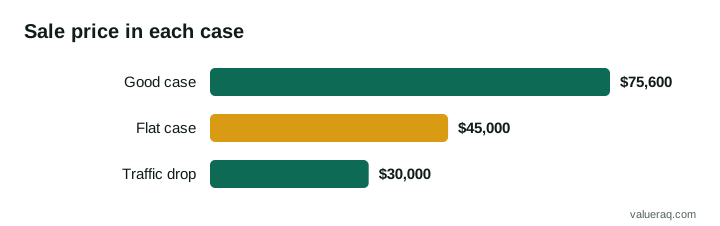
Three lessons come out of this table:
- The flat case loses money. Selling at the price you paid still loses $1,500, because buying and selling both cost money. A flip needs a real improvement, not just time.
- A drop hurts twice. Profit falls and the lower profit is multiplied. A $500 fall in monthly profit removed $15,000 from the sale price.
- The break-even price is higher than you paid. Your cash outlay after profit earned while holding is $51,000 − $9,000 = $42,000. With 10% selling costs, you need a sale price of $42,000 ÷ 0.90, about $46,667, just to break even.
What the sale price depends on
In the good case the sale price used a 3.0x multiple. Buyers may not agree. Here is the same $25,200 yearly profit at VALUERAQ's default low, midpoint and high multiples:
| Multiple | Calculation | Sale price |
|---|---|---|
| 2.5x (low) | $25,200 × 2.5 | $63,000 |
| 3.2x (midpoint) | $25,200 × 3.2 | $80,640 |
| 4.0x (high) | $25,200 × 4.0 | $100,800 |
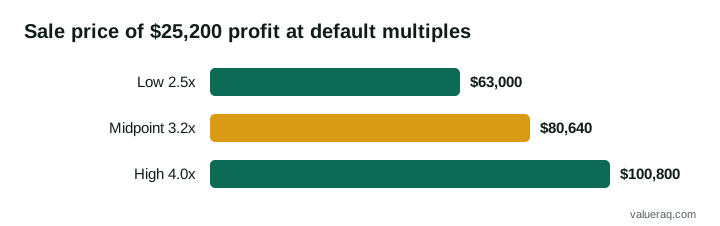
A $37,800 gap between the low and high prices is larger than the whole gain in the good case. That is why the multiple matters as much as profit. A plan that works only at the high end is a weak plan. Run your plan at the low end first.
Where flippers look for sites
Sites for sale are listed in marketplaces, with brokers, and in private deals between owners. VALUERAQ lists digital businesses on its businesses for sale page, where you can filter by price, profit and age and message sellers privately. Whichever place you use, a listing is a seller's description, not a checked fact.
Look for sites where the price looks low for a reason you can fix, and be suspicious of a price that looks low for no reason. Common fixable reasons are a seller with no time, messy records, or a single neglected income source. Reasons you cannot easily fix include a site that lost its search rankings, or income that depends on one program that can change its rules.
The risks, and how to check each
| Risk | Why it happens | How to check before buying |
|---|---|---|
| Traffic falls after you buy | A search ranking change, a lost link, or a seller who was doing hidden work | Read a full year of traffic data, and the main sources. See how to verify website traffic |
| Profit was overstated | Add-backs that will not repeat, or income that cannot be matched to bank records | Match revenue to payment records. See how to verify website revenue |
| Overpaying | A multiple that assumes growth you have not seen | Test the price at cautious and confident profit figures |
| One source supplies most income | An affiliate program, ad network or marketplace changes its terms | Note the largest source's share of income, and ask what happens if it halves |
| The improvements do not lift profit | The work was guessed, not tested | Start with cheap, reversible changes and measure |
| Selling takes longer than planned | Few buyers, or a buyer's checks find a problem | Allow time and cash to wait. See how long it takes to sell an online business |
| Assets do not transfer | Accounts, code or content tied to the seller | Get a written list of every asset. See how to transfer a website to a new owner |
BizBuySell warns that "some add-backs can unrealistically overvalue the company". For a flipper, that matters twice: you may pay for earnings that are not there, and a later buyer may remove the same add-backs from your sale figure. See add-backs.
The holding costs people forget
A flip's costs go beyond the price and the repairs. Plan for these:
- Your time. Count hours and decide what an hour is worth. A $26,040 gain over seven months at 20 hours a week is a different result from the same gain at 5 hours a week.
- Money tied up. The $51,000 cannot be used elsewhere while you hold the site.
- Fees and services. Hosting, tools, writers or developers, and the cost of a lawyer or accountant. The U.S. Small Business Administration suggests: "Consider hiring an attorney and an accountant."
- Taxes. How a gain is taxed depends on where you live and how the sale is structured. Ask an accountant before you buy, not after you sell.
- Selling costs. The example assumed 10%. Your actual costs depend on how you sell, so check them first.
Buy, build or flip: which fits you
- Flip if you have cash, can spot underpriced sites, can judge risk, and can wait for a buyer.
- Buy and hold if you want the profit more than the resale, and can accept a lower, steadier return.
- Build if you have more time than money and are comfortable with months of work before any income.
None of these is safer by default. They carry different risks.
A checklist before you pay for a site
- Value it yourself first. Use the website valuation tool with your cautious figures, and compare the result with the asking price.
- Test three outcomes. Work out the good, flat and drop cases as in the table above. Only go ahead if you could live with the drop case.
- Find the break-even sale price. Include buying, fixing and selling costs.
- Verify the numbers. Match revenue to bank records, and traffic to analytics you can see yourself. The SBA describes the buyer's job as a "thorough, objective investigation".
- Read the red flags. See red flags when buying a website.
- Work through due diligence. Use the digital business due diligence checklist.
- Use escrow. Pay through an independent service, and release funds only when the assets have transferred. See how escrow works for website sales.
- Plan the exit. Know who the likely buyers are and what records they will ask for. See how to sell a website.
Frequently asked questions
Is website flipping profitable?
It can be, but it is not guaranteed. In the example above the same purchase returned about 51%, about −3% and about −32%, depending on whether profit rose, stayed flat or fell. The result depends on the price paid, the improvement achieved and the costs of buying and selling.
How much money do you need to start flipping websites?
It depends on the sites you target, and this guide does not quote a typical amount. The worked example uses $51,000 in total, but that is an invented figure. Small sites cost less and carry the same types of risk. Start by working out your total outlay, including the price, fixes, checks and selling costs.
How long does a website flip take?
The example assumes about six months of improvement plus time to sell. Real timelines vary, and sales can take longer than planned. Allow time and cash for that.
What is the biggest risk when flipping a website?
Overpaying, followed by a fall in traffic or profit before you sell. Both can be reduced by checking records, testing the price at cautious figures and avoiding sites that depend on a single income source.
Do I need to pay tax on a flip?
Usually a gain has some tax treatment, but the rules depend on where you live. This guide does not give tax rules. Ask an accountant.
Sources
- U.S. Small Business Administration, Buy an existing business or franchise: a "thorough, objective investigation" and advice to consider an attorney and an accountant.
- BizBuySell Learning Center, Add-Backs for Seller's Discretionary Earnings: the definition of add-backs and the overvaluation warning.
- Corporate Finance Institute, Multiples analysis: what multiples do well, and where they oversimplify.
- VALUERAQ, Valuation methodology: the default multiple ranges used in the examples.
Next step
Before you pay for a site, check what it could be worth with the free website valuation tool. It takes about a minute and needs no sign-up.
Written by VALUERAQ Editorial Team. The VALUERAQ editorial team writes and maintains the platform's guides, methodology and glossary. Every guide is reviewed against the published methodology before publication and when the methodology changes.